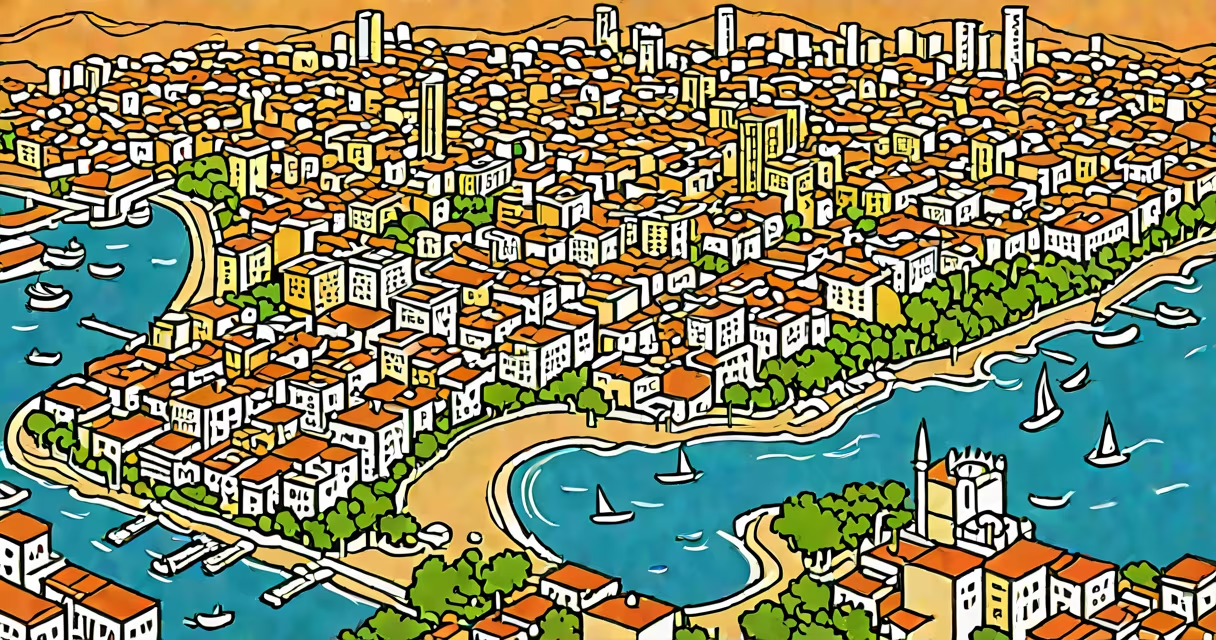
Izmir is a port city on Turkey's western coast, situated along the Aegean Sea near the mouth of the Gediz River. It lies approximately 350 kilometers (217 miles) south of Istanbul and 160 kilometers (99 miles) west of Ankara. The city serves as the capital of İzmir Province and is Turkey's third-largest urban center.
Izmir sits at the heart of the Aegean Region, bordered by the Menderes River to the east and the Dilek Peninsula to the southeast. Its location places it within a historically rich zone that has hosted civilizations since at least 3000 BCE. The city's proximity to ancient sites like Ephesus, Pergamon, and Smyrna makes it a central hub for archaeological tourism.
The city's coordinates are 38.4192° N, 27.1287° E. It lies at an elevation of about 15 meters (50 feet) above sea level and experiences a Mediterranean climate with hot, dry summers and mild, wet winters. Average summer temperatures reach 30°C (86°F), while winter highs hover around 15°C (59°F).
Izmir lies on the western edge of Anatolia, facing the Aegean Sea. It is part of the larger region known as the Aegean Coast, which includes cities such as Bodrum, Marmaris, and Fethiye. Unlike eastern coastal cities like Antalya, Izmir is less focused on beach resorts and more centered on culture, history, and commerce.
Within Turkey, Izmir ranks behind Istanbul and Ankara in population size. As of 2023, the metropolitan area had approximately 4.5 million residents. The city's urban core spans about 25 square kilometers (9.7 sq mi), with dense neighborhoods surrounding the historic Konak Square and the bustling Kemeraltı district.
Transportation access is strong. Izmir Adnan Menderes International Airport (ADB) handles over 10 million passengers annually and offers direct flights to major European hubs like Frankfurt, London, and Amsterdam. The city is also connected by rail to Istanbul via the high-speed YHT line, with a process time of about 6 hours.
Izmir was known in antiquity as Smyrna, a major Greek city-state and later a Roman colony. It played a role in early Christianity-Saint Paul preached in the city, and the Book of Revelation references the Church of Smyrna. The city was destroyed by fire in 178 CE during the reign of Emperor Marcus Aurelius, then rebuilt under Byzantine rule.
After the fall of Constantinople in 1453, Izmir became part of the Ottoman Empire. It remained largely under Ottoman control until 1919, when Greek forces landed in the city during the Greco-Turkish War. The subsequent conflict led to the 1922 fire that devastated much of the city's non-Muslim quarter. The population exchange between Greece and Turkey following the war reshaped Izmir's demographics.
Today, Izmir is home to over 20 universities and research centers, including the University of İzmir and Ege University. The city hosts the annual İzmir International Film Festival and is a cultural center for western Turkey.
Some travelers confuse Izmir with Istanbul or Antalya due to similar-sounding names or overlapping tourism routes. Izmir is not a resort destination like Antalya, nor is it a historical capital like Istanbul. It is a working city with significant economic activity, particularly in shipping, textiles, and food processing.
Another misconception is that Izmir is isolated from major transportation networks. In reality, it is well-connected. The city's metro system, launched in 2017, runs through the city center and connects to the airport. The tramway extends into the suburban districts of Buca and Bornova.
A lesser-known fact: Izmir is one of the few cities in Turkey where the majority of the population lives within walking distance of green spaces. The city maintains over 1,200 parks and gardens, including the 200-acre Karşıyaka Park and the forested slopes of Mount Çeşme. This urban planning feature contributes to a lower urban heat island effect compared to other large Turkish cities.
For instance, a traveler flying into Izmir from London will land at Adnan Menderes Airport, exit the terminal, and take a 20-minute taxi ride to Konak Square. From there, they can walk to the Kemeraltı Bazaar, visit the ancient Agora of Smyrna, or board a ferry to the nearby island of Lesbos.
Another example: A business meeting scheduled in Izmir's central business district requires a 15-minute drive from the airport. The city's modern infrastructure supports over 1,000 international companies, many of which operate from the İzmir International Trade Center in the Alsancak neighborhood.
According to the World Bank's 2022 Urban Development Report, Izmir ranked among the top 10 most efficient port cities in the Mediterranean basin. The Port of Izmir handles over 25 million tons of cargo annually, primarily agricultural exports like dried figs, olives, and cotton.
| Feature | Izmir | Comparison City |
|---|---|---|
| Population (metro) | 4.5 million | Antalya: 1.8 million |
| Annual tourist arrivals | 3.2 million | Bodrum: 4.1 million |
| Port tonnage handled | 25 million tons | İstanbul: 18 million tons |
| Summer average temperature | 30°C (86°F) | Antalya: 32°C (90°F) |
During a visit in June 2023, I walked from Konak Square to the Izmir Archaeological Museum, passing through the bustling Kemeraltı market. The scent of fresh figs and grilled lamb filled the air. I stopped at a small café run by a local family, where the owner offered me a sample of çörek, a traditional pastry. That moment confirmed what maps and statistics cannot: Izmir is both a geographic reference point and a living, breathing city.
Understanding where Izmir is helps clarify its role in Turkey's economy, history, and regional identity. Whether arriving by plane, train, or ship, the city's location on the Aegean Coast places it at the crossroads of Europe, Asia, and the Mediterranean world.