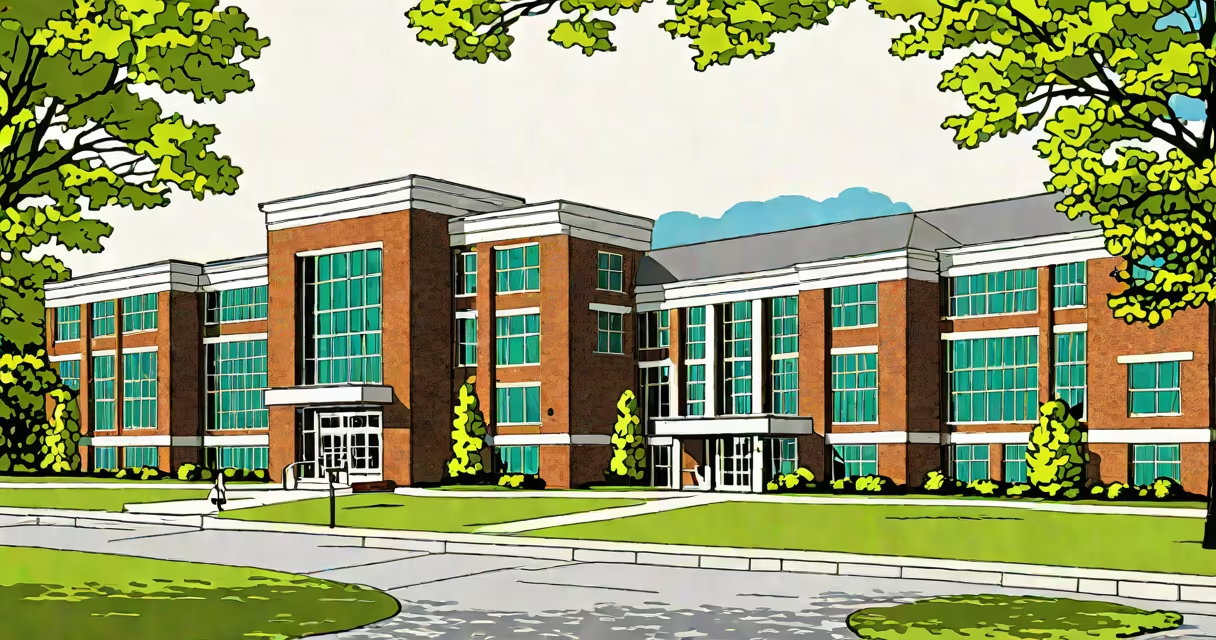
Central Carolina Community College (CCCS) is a public institution located in Sanford, North Carolina, offering associate degrees, certificate programs, and workforce training in fields such as healthcare, information technology, and skilled trades.
CCCS operates under the North Carolina Community College System, which includes 58 colleges statewide. The Sanford campus serves students from Lee County and surrounding areas, providing access to affordable higher education and career-focused curricula. The college is accredited by the Southern Association of Colleges and Schools Commission on Colleges (SACSCOC).
Students enroll in credit-bearing courses leading to an Associate in Arts (AA), Associate in Science (AS), or Associate in Applied Science (AAS) degree. Non-credit workforce development programs are also available through the Continuing Education division. Classes are offered during day, evening, and weekend hours to accommodate working adults.
CCCS follows a semester-based academic calendar with fall, spring, and summer terms. Full-time students typically take 12-15 credit hours per term. Transfer students may apply to the college's articulation agreements with four-year universities, including the University of North Carolina system.
Admission requires a high school diploma or GED. Applicants must submit official transcripts and complete placement testing in math and English unless exempt by ACT/SAT scores or prior college credit. Students who do not meet minimum proficiency levels are placed into developmental coursework.
The college uses a centralized student information system called Banner. Students register online via the myCCCS portal, access course materials through Canvas learning management software, and receive financial aid notifications through email and the student dashboard.
CCCS offers over 60 programs across six academic divisions: Business & Technology, Health Sciences, Liberal Arts, Public Service, Skilled Trades, and Workforce Development. Each program leads to a credential recognized by employers in the region.
| Academic Division | Examples of Programs | Credential Type |
|---|---|---|
| Health Sciences | Nursing (ADN), Medical Assistant, Dental Hygiene | AAS, Certificate |
| Business & Technology | Information Technology, Accounting, Web Design | AAS, Certificate |
| Liberal Arts | General Studies, Psychology, Criminal Justice | AA, AS |
| Skilled Trades | Welding, HVAC, Electrical Technology | AAS, Certificate |
For example, the Practical Nursing program takes 18 months to complete and prepares graduates to sit for the NCLEX-PN exam. Graduates often secure jobs at local hospitals and long-term care facilities. The average annual salary for licensed practical nurses in the Sanford area is $48,200, according to the U.S. Bureau of Labor Statistics (2023 data).
Non-credit workforce programs include OSHA safety certification, forklift operator training, and certified nursing assistant (CNA) preparation. These are designed for individuals seeking immediate employment and are often funded through state grants or employer partnerships.
The main campus is situated at 1000 West College Street in Sanford, NC, within the city's central business district. The facility includes classrooms, science labs, a library, computer labs, and a student center with counseling services. A satellite site exists at the Lee County Career Center for select technical programs.
Students have access to tutoring through the Learning Center, career advising via the Office of Career Services, and disability accommodations through the Accessibility Services office. The college hosts weekly workshops on time management, study skills, and financial literacy.
I visited the Sanford campus in February 2023 to observe a group of adult learners in the IT support certificate program. The class met in a room equipped with dual monitors and lab benches. Instructors used real-world scenarios-such as diagnosing network outages-to teach troubleshooting techniques. One student, a former military technician, completed the program in nine months and secured a job as a help desk analyst at a regional healthcare provider.
Some assume CCCS only offers two-year degrees. In reality, the college provides stackable credentials: students can earn a certificate in cybersecurity fundamentals, then add an associate degree, and later transfer to a university for a bachelor's in computer science.
Another misconception is that community colleges lack academic rigor. According to a 2022 report by the National Center for Education Statistics, 61% of community college students who transferred to four-year institutions completed their bachelor's degrees within six years-on par with students who began at four-year schools.
CCCS is not affiliated with private institutions like Johnson & Wales University or the University of Phoenix. It is a public institution governed by the North Carolina Community College System Board of Directors and funded through state appropriations and tuition revenue.
As of fall 2023, CCCS reported 4,218 credit students enrolled across all campuses. The average cost per credit hour is $137 for North Carolina residents, totaling approximately $2,200 per semester for a full-time schedule. Out-of-state students pay $375 per credit hour.
Eligible students may receive federal Pell Grants, state-funded scholarships, and institutional aid. The college participates in the Free Application for Federal Student Aid (FAFSA) process and offers a scholarship matching service through the North Carolina Student Financial Aid Office.
For those considering a change in academic direction, CCCS allows students to audit courses without earning credit. This option enables exploration of new fields before committing to formal enrollment.
Students interested in continuing their education beyond CCCS can explore transfer opportunities with institutions like North Carolina State University and the University of North Carolina at Chapel Hill. The college maintains articulation agreements that guarantee admission to specific majors upon completion of required coursework.