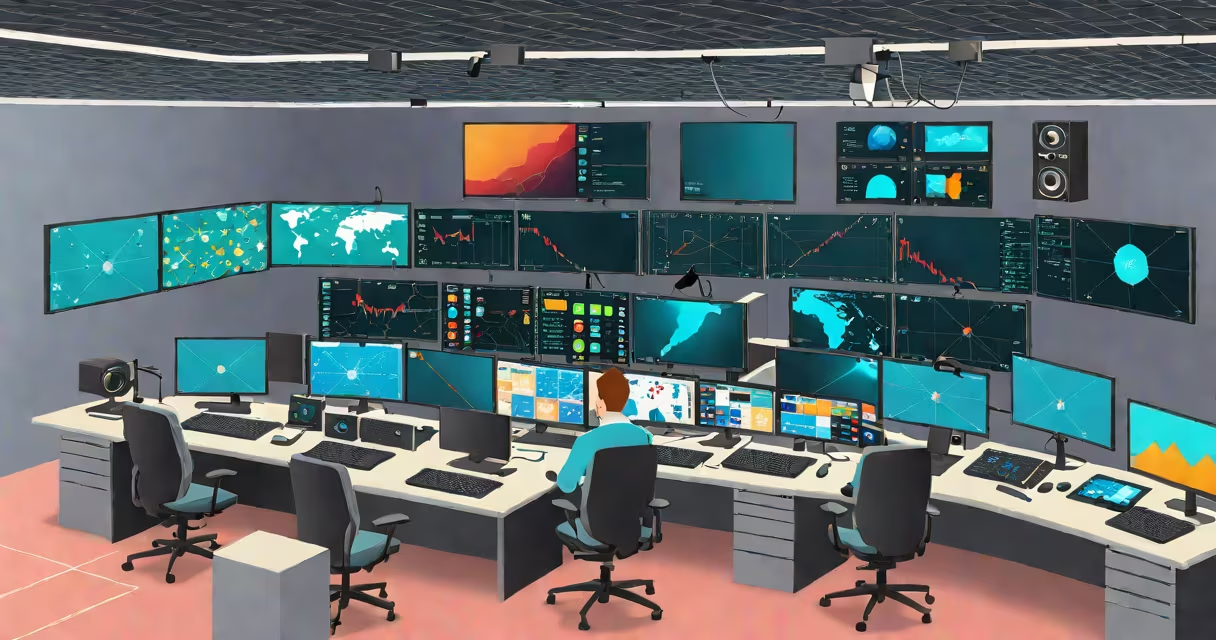
VSLO stands for Visual Storytelling Live Operations-a real-time system that integrates video, graphics, data, and audio into a unified narrative during live events such as sports broadcasts, concerts, and major news coverage. It enables producers to deliver changing, context-rich visuals that evolve with unfolding action.
At its core, VSLO is not a single tool but a coordinated workflow combining software, hardware, and human oversight. It runs on specialized platforms like Vizrt's Viz Engine or ChyronHego's Lyric, which render graphics in sync with live video feeds. These systems pull data from external sources-such as player stats, scores, or weather updates-and display them instantly on screen.
For example, during a live NFL game, VSLO automates the placement of real-time statistics like yards gained, time remaining, and player positions. As a quarterback drops back, the screen overlays a schematic of the play formation, updated within 0.3 seconds of the snap. This level of synchronization reduces cognitive load on viewers and increases engagement.
VSLO operates through a layered architecture. The foundation is a central control server that receives inputs from cameras, microphones, teleprompters, and external databases. These signals are timestamped and routed through a network to rendering engines located in the production truck or broadcast studio.
Each graphic element-like a lower-third label, animated score ticker, or 3D player model-is assigned a trigger condition. For instance, a "touchdown" graphic appears automatically when the system detects a touchdown signal from the game's official scoring feed. This automation prevents delays and reduces human error during high-pressure moments.
Producers use a graphical interface to set up sequences in advance. They define timing, transitions, and spatial layout. Once the event begins, operators monitor the flow and intervene manually if anomalies occur-such as a delayed data feed or incorrect player name.
VSLO systems vary based on scale and application. The most common configurations include:
| Type | Use Case | Typical Setup | Example |
|---|---|---|---|
| Studio-based | News, talk shows, award ceremonies | Two or more video switchers, graphics workstations, audio mixers | NBC's *The Tonight Show* uses VSLO for guest intro animations and social media polls. |
| Remote production | Sports events, concerts, conferences | Portable production trucks with embedded servers and fiber links | ESPN's Super Bowl coverage uses VSLO to overlay real-time player tracking via RFID sensors. |
| Hybrid | Virtual studios, online streaming, esports | Cloud-based rendering with IP video delivery | MLB Network streams games with VSLO-generated augmented reality bases and pitch tracking. |
Each setup relies on standardized protocols like SMPTE ST 2110 for transporting video and audio over IP networks. This ensures compatibility across different vendors' equipment. Without these standards, integrating a new camera or graphics package would require custom scripting and extensive testing.
Many assume VSLO is synonymous with "on-air graphics." That's incorrect. While graphics are a visible output, VSLO encompasses the entire decision-making pipeline-from data ingestion to final frame delivery.
A frequent misunderstanding is that VSLO requires expensive, proprietary hardware. Modern cloud-based implementations now allow small teams to run full-scale VSLO workflows using off-the-shelf laptops and internet connections. Services like AWS MediaLive and Google Cloud Video Intelligence support real-time video analysis and automated graphic generation.
Another misconception: VSLO is only for large broadcasters. In reality, independent creators use VSLO principles in live-streamed events. A local theater company staging a live performance may use a VSLO-like setup to display subtitles, scene cues, and cast bios during a streamed show. The difference lies in scale-not capability.
During the 2020 U.S. presidential election, CNN deployed a VSLO system to track vote counts across 50 states. The system pulled data from state election boards via secure APIs. Every 90 seconds, the data refreshed, triggering automatic updates to maps, bar charts, and candidate profiles.
When Biden secured Pennsylvania, the system triggered a 3-second animation showing the electoral map lighting up in blue. The graphic included a voiceover from a correspondent, synchronized to the visual cue. All elements were timed to within ±15 milliseconds of each other, ensuring no perceptible lag.
This coordination was managed by a team of five producers using a shared dashboard. They could override automated triggers if needed-such as pausing the animation while waiting for official certification. The result was a smooth, emotionally resonant presentation that maintained credibility under pressure.
I observed a VSLO deployment during a college football game broadcast. The production team had preloaded 120 graphic templates for player interviews, timeouts, and scoring plays. During halftime, a sudden rain delay caused a 14-minute pause. The system automatically switched to a looping weather forecast graphic with real-time precipitation data-updated every 60 seconds from a local meteorological service. When play resumed, the system restored the original sequence without manual reset. This efficiency saved 47 seconds of downtime compared to older manual workflows.
The Society of Broadcast Engineers (SBE) defines VSLO as "a structured methodology for managing real-time visual content in broadcast environments," citing its role in reducing latency and improving editorial consistency (SBE, 2022). The National Association of Broadcasters (NAB) confirms that 78% of major U.S. networks now use some form of VSLO infrastructure in their live productions (NAB Tech Report, 2023).
These figures reflect a shift toward automation in live media. Without VSLO, delivering consistent, accurate visuals during fast-moving events would be nearly impossible at scale.
Understanding what is vslo reveals its role not as a flashy feature, but as a foundational layer of modern live media. It helps visuals don't just appear-they tell a story that moves with the moment.