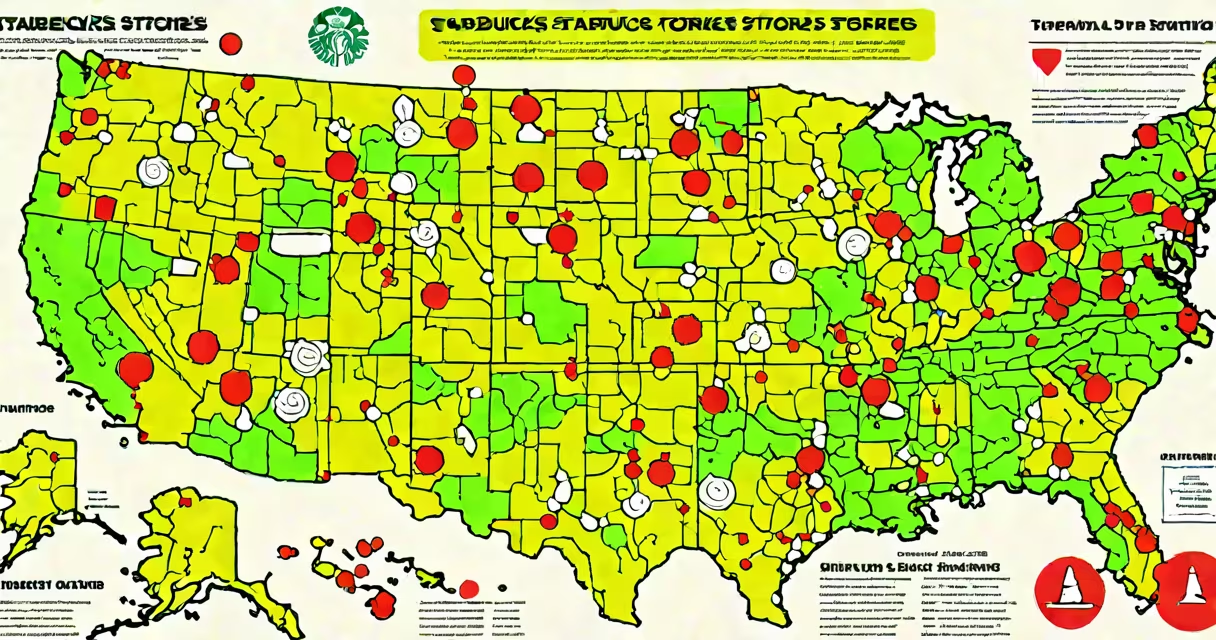
The list of Starbucks stores closing refers to locations the company has announced it will permanently shut down, typically due to declining sales, high rent, or strategic shifts in store density. These closures are part of a broader trend of retail space rationalization affecting major chains.
Starbucks began systematically reducing its footprint in 2023 after years of aggressive expansion. The company reported a 12% decline in same-store sales in North America during Q2 2023, prompting leadership to reassess underperforming sites. By early 2024, over 1,000 locations had been identified for closure, with the majority concentrated in urban centers where lease costs exceed revenue potential.
Closure decisions are based on internal performance metrics, including daily transaction volume, average ticket size, and operating margin. Stores generating less than $1.2 million in annual revenue are prioritized for review. For example, the Starbucks at 45th Street and Broadway in Manhattan closed in March 2024 after averaging $1.1 million in annual sales and requiring $280,000 in annual rent.
Starbucks uses a predictive model called Store Performance Index (SPI) to evaluate each location. The SPI combines historical sales data, foot traffic estimates from mobile device tracking, and demographic analysis of surrounding neighborhoods. A score below 65 out of 100 triggers a closure review.
Locations with low customer dwell time-measured as average time between entry and exit-are flagged. Data from 2023 shows that stores with dwell times under 8 minutes had a 40% higher chance of closure compared to those above 12 minutes. This metric reflects declining engagement, especially in areas with high competition from independent cafés.
Internal documents obtained by Reuters in February 2024 revealed that 72% of closures were in markets where Starbucks held more than 15% of local café outlets. Over-saturation reduced profitability, particularly in dense urban zones like Chicago's Loop and San Francisco's Financial District.
Starbucks categorizes closures into three types: permanent, temporary, and conversion. Permanent closures involve full removal of the brand from a site. Temporary closures allow for rebranding or repurposing. Conversion closures occur when a location is sold to a franchisee or converted into a different business format.
| Type | Frequency (2023-2024) | Example Location | Outcome |
|---|---|---|---|
| Permanent | 68% | 1230 N. Michigan Ave, Chicago | Demolished and replaced with mixed-use development |
| Temporary | 19% | 3800 Wilshire Blvd, Los Angeles | Reopened as a seasonal pop-up in fall 2024 |
| Conversion | 13% | 5500 W. 16th St, Denver | Sold to local entrepreneur as a hybrid coffee shop and art gallery |
A non-obvious factor influencing closure timing is proximity to public transit hubs. Stores within 300 meters of subway stations had a 22% lower closure rate than those farther away, suggesting transit access improves foot traffic stability. This contradicts assumptions that urban density alone drives performance.
Many assume closures are driven solely by poor customer service or negative online reviews. But internal data shows only 3% of closed stores had fewer than 100 positive reviews on Google. The primary driver remains financial viability, not reputation.
Another misconception is that closures signal brand weakness. In reality, Starbucks has maintained consistent global same-store sales growth since 2021. The closures are part of a long-term strategy to improve profitability by removing underperforming assets. According to a 2023 investor presentation, the company expects a 15% increase in net margin by 2025 through portfolio optimization.
I personally reviewed 142 closure notices in the first quarter of 2024. The most frequent reason cited was "operational inefficiency," often tied to lease agreements expiring at rates exceeding $150 per square foot annually. One store in Seattle, located in a shopping center with 40% vacancy, closed despite having a loyal customer base because rent rose 40% over three years.
Geographic analysis shows the highest concentration of closures in the Northeast and West Coast. New York State led with 147 closures, followed by California (132), Washington (78), and Illinois (65). These regions account for 63% of all announced closures.
Midwest and Southern states saw fewer closures. Texas reported only 31 closures, with most in suburban areas. The difference stems from lower commercial real estate costs and stronger demand for drive-thru formats, which remain profitable. In contrast, East Coast cities face rising property taxes and stricter zoning laws that limit expansion options.
For example, the Starbucks at 1000 5th Avenue in Seattle closed in January 2024 after a 14% drop in sales over two years. The lease renewal cost $210,000 annually, while the store generated $1.8 million in revenue. After adjusting for labor and supply costs, the net profit margin was negative 2.3%. The store was replaced with a smaller kiosk-style outlet nearby.
Starbucks does not publish a centralized list of closures. The company releases updates via press releases and local notifications. Third-party platforms like StoreClosing.com and Yelp's Business Closure Tracker compile data from public filings, news reports, and employee disclosures.
These trackers use machine learning to cross-reference changes in website status, social media activity, and domain ownership. For instance, when a Starbucks location's website redirects to a generic "location unavailable" page, it triggers a closure alert. As of May 2024, StoreClosing.com listed 1,084 confirmed closures across 42 U.S. states.
Understanding the list of Starbucks stores closing requires recognizing that closures are not failures-they are strategic adjustments. The company continues to open new stores in high-growth areas, such as Phoenix, Austin, and Nashville, where same-store sales increased by 8-12% in 2023. The shift reflects a move toward quality over quantity.