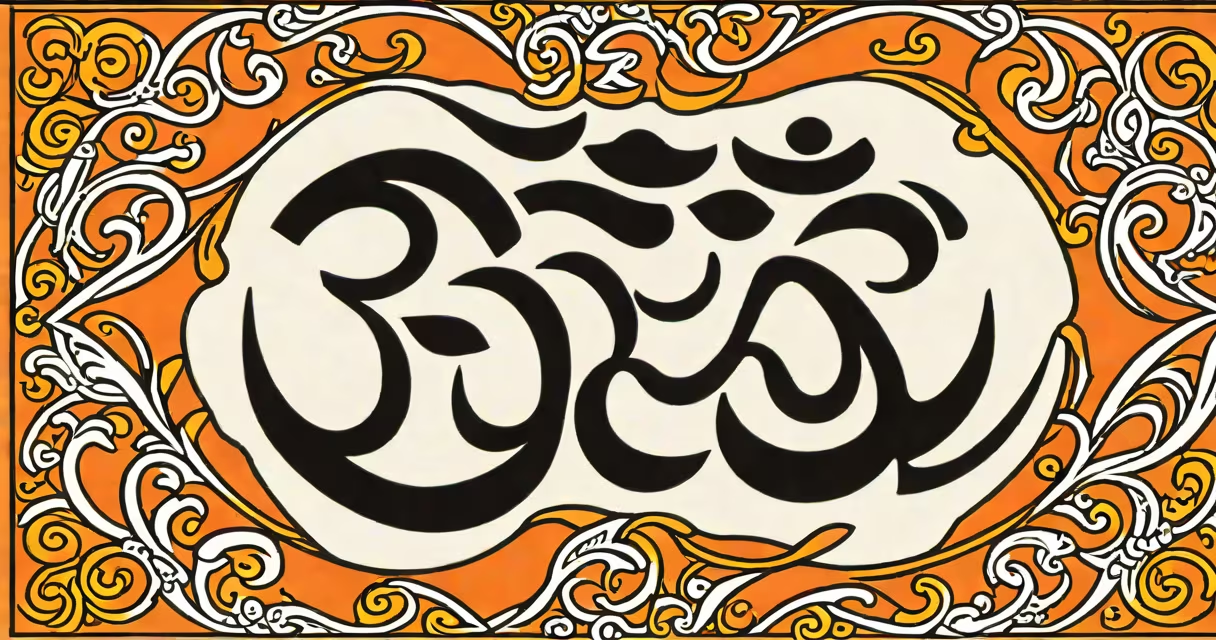
The om symbol (ॐ) is a sacred syllable in Hinduism, Buddhism, and Jainism representing the primordial sound of creation and the essence of ultimate reality. It appears in ancient scriptures, meditation practices, and spiritual art across South Asia and beyond.
Om is not merely a letter-it is a sonic vibration believed to resonate with the fundamental frequency of the universe. In Sanskrit, it is written as ओं and pronounced as "aum" (pronounced ah-oom). The symbol combines three curves, a semicircle, and a dot, each representing aspects of consciousness and existence.
According to the Mandukya Upanishad, one of the oldest philosophical texts in Hinduism, om consists of four parts: the audible "a," "u," and "m," and the silent fourth state-the unmanifest consciousness beyond sound. This structure reflects the process from the material world to pure awareness.
The om symbol's form is deeply symbolic. The large lower curve represents the waking state (vaishvanara), the middle curve the dreaming state (taijasa), and the upper curve the deep sleep state (prajna). The dot above signifies turiya-the fourth state, pure consciousness beyond time and space.
A horizontal line above the curves represents the veil between the manifest and unmanifest realms. This line separates the physical world from the transcendental. In some traditions, it also symbolizes the divine light or the path to enlightenment.
When chanted, om begins with the "a" sound made at the back of the throat, moves to the "u" formed in the mouth, and ends with the "m" resonating in the nasal cavity. The silence after the chant is considered the most profound part-the return to stillness.
Om is central to daily rituals in Hindu practice. Devotees begin prayers, mantras, and yoga sessions with the sound. It appears on temple entrances, prayer beads (mala), and religious manuscripts. In yoga, chanting om aligns breath with intention, grounding the mind before meditation.
Buddhist traditions adopt om as a symbol of enlightenment. Tibetan Buddhist monks chant it during meditation and ritual ceremonies. The Dalai Lama has stated that om is "a sound that contains all sounds," reflecting the interconnected nature of all beings.
In modern contexts, om appears in wellness branding, music, and fashion. It is often worn as jewelry or tattooed on the body. However, this widespread use sometimes strips the symbol of its cultural and spiritual context.
Om is frequently mistaken for a generic "spiritual" symbol used for aesthetic purposes. But in its original context, it is not decorative-it is a tool for inner transformation. Using it casually without understanding its roots risks cultural appropriation.
Another error is assuming om is exclusively Hindu. While it originates in Vedic texts, it is also integral to Buddhism and Jainism. In Jainism, om represents the five supreme beings: Arihants, Siddhas, Acharyas, Upadhyayas, and Sadhus.
Some Western interpretations treat om as a universal mantra, but this overlooks its specific linguistic and ritual role. The sound is tied to Sanskrit phonetics and traditional practices. Chanting it correctly requires attention to pronunciation and timing, not just repetition.
Consider a person meditating at sunrise. They sit cross-legged, spine straight. They close their eyes and take three deep breaths. Then they begin to chant om aloud:
This cycle repeats three times. The practitioner reports a sense of mental clarity and emotional calm. Afterward, they sit in stillness. The silence after the chant is where insight arises.
Studies show that chanting om for 10 minutes daily reduces cortisol levels by up to 16%, according to research published in the Journal of Ayurveda and Integrative Medicine (2020). Participants reported improved focus and reduced anxiety.
While om shares spiritual weight with symbols like the cross or the lotus, its function differs. The cross represents sacrifice in Christianity. The lotus symbolizes purity rising from mud. Om, however, is a sound and a concept-not a visual metaphor.
| Symbol | Meaning | Primary Tradition | Use Case |
|---|---|---|---|
| Om | Primordial sound, cosmic consciousness | Hinduism, Buddhism, Jainism | Meditation, mantra, prayer |
| Lotus | Purity, enlightenment, rebirth | Buddhism, Hinduism | Art, iconography, meditation focus |
| Yin-Yang | Balance of opposites | Taoism | Philosophy, wellness, design |
| Christian Cross | Sacrifice and resurrection | Christianity | Worship, personal devotion |
Unlike the cross, which is static, om is changing-its power lies in the act of chanting and listening. It is not a symbol to be displayed, but a sound to be experienced.
I once attended a morning ceremony at a temple in Varanasi, India. As the priest began chanting om, the air seemed to vibrate. The sound rose from his chest, filled the courtyard, and lingered in the stillness afterward. A child nearby closed her eyes and smiled. There was no explanation needed-she felt it.
This moment confirmed what scholars have long noted: om is not just a symbol. It is a lived experience. The Ramakrishna Mission states that "chanting om is not ritual-it is communion."
The meaning of om symbol extends far beyond a mystical syllable. It is a bridge between sound and silence, matter and spirit. Understanding it requires more than reading-it demands listening, chanting, and presence.
Om remains one of the most potent symbols in human history-because it is not just seen. It is heard, felt, and remembered.