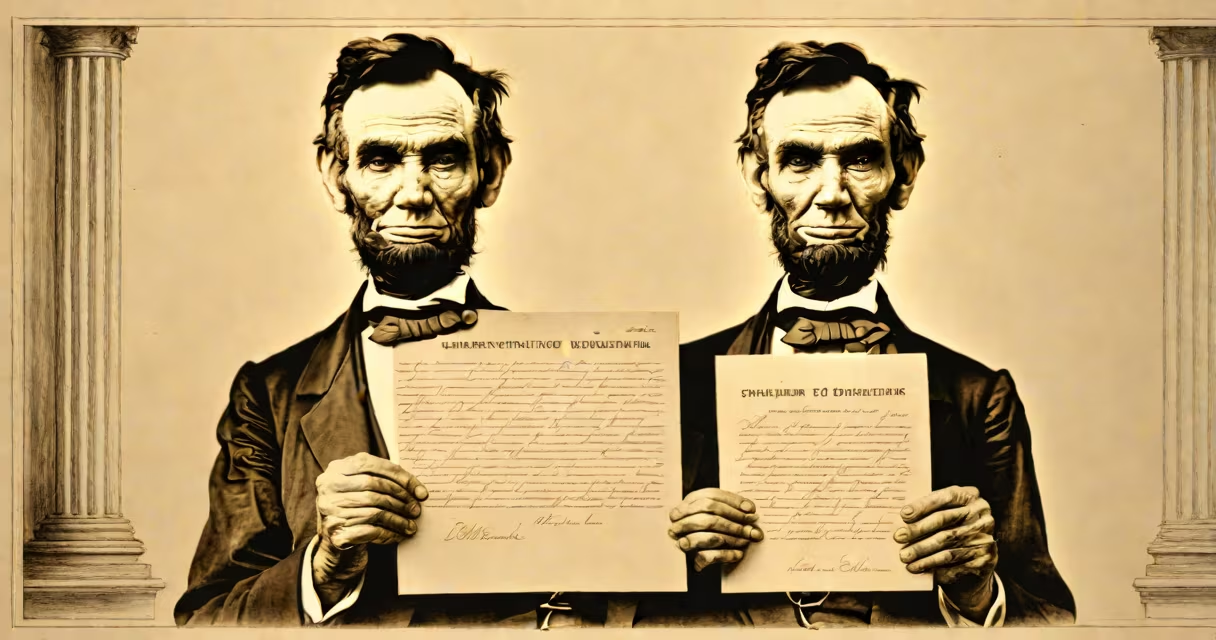
The Emancipation Proclamation, issued by President Abraham Lincoln on January 1, 1863, declared that all enslaved people in Confederate states then in rebellion against the Union were to be freed. It did not apply to border states loyal to the Union or areas already under Union control. The proclamation transformed the Civil War into a moral crusade against slavery.
Lincoln framed the proclamation as a military necessity. He cited his authority as commander-in-chief during wartime to issue orders that weakened the Confederacy. By freeing enslaved people in rebel territories, the Union disrupted Southern labor systems and encouraged thousands to flee to Union lines. These individuals became "contraband of war," later recruited into the Union Army.
Though limited in immediate geographic reach, the proclamation reshaped national policy. It shifted the war's stated goal from preserving the Union to ending slavery. This change influenced foreign governments; Britain and France, which had abolished slavery decades earlier, chose not to intervene on behalf of the Confederacy.
The Emancipation Proclamation was a presidential executive order, not a law passed by Congress. It applied only to states that had seceded and were not under federal control. That meant it had no legal effect in states like Maryland, Delaware, Kentucky, and Missouri-slaveholding states that remained in the Union.
Enforcement relied on Union military advance. As Union troops moved into Confederate territory, they began liberating enslaved people. By 1865, over 200,000 Black men served in the U.S. Army and Navy-many of them former slaves who joined after the proclamation. Their service helped secure Union victories and demonstrated the strategic value of emancipation.
A common misunderstanding is that the proclamation freed all enslaved people in the United States. It did not. Slavery continued in the border states until the 13th Amendment was ratified in December 1865. The proclamation was a wartime measure, not a permanent end to slavery.
There were two versions of the Emancipation Proclamation:
Lincoln delayed issuing the final version until after the Union victory at the Battle of Antietam in September 1862. A military win gave him the political and moral use needed to act. Without that victory, the proclamation might have been seen as desperate or weak.
| Proclamation Type | Date Issued | Scope | Legal Authority |
|---|---|---|---|
| First Proclamation | September 22, 1862 | Warning to Confederate states | Executive power as commander-in-chief |
| Final Proclamation | January 1, 1863 | Freeing slaves in 10 Confederate states | War powers under Article II of the Constitution |
The Emancipation Proclamation did not end slavery overnight. It did not free enslaved people in areas still under Confederate control until Union forces arrived. In some places, such as Texas, news of emancipation took months to reach communities. June 19, 1865-known as Juneteenth-marks the day Union General Gordon Granger arrived in Galveston and announced freedom for all enslaved people in Texas.
Despite its limitations, the proclamation was a turning point. It allowed African Americans to join the Union military, which contributed to the Union's eventual victory. It also paved the way for the 13th Amendment, which formally abolished slavery throughout the United States in 1865.
A lesser-known fact: Lincoln initially drafted the proclamation to focus on freeing enslaved people in the border states. He abandoned that idea due to political pressure. Many Union leaders feared alienating slaveholders in states like Maryland and Kentucky. Lincoln restricted the proclamation to Confederate states to preserve unity within the Union.
Many assume the Emancipation Proclamation was a law passed by Congress. It was not. It was an executive order based on military authority. Because it wasn't a constitutional amendment, it could not bind states that were not in rebellion.
Another misconception is that the proclamation freed everyone instantly. In reality, enforcement depended on Union military occupation. In parts of Louisiana and Virginia, enslaved people gained freedom only after Union troops entered their counties. Some planters attempted to hide or move enslaved people to avoid liberation.
Historian Eric Foner, author of The Fiery Trial: Abraham Lincoln and American Slavery, notes that Lincoln viewed the proclamation as both a moral and strategic decision. "He believed that freeing the enslaved would weaken the South's economy and war effort while strengthening the Union's cause," Foner writes. "It was not merely symbolic-it was a weapon."
When I visited the National Museum of African American History and Culture in Washington, D.C., I saw the original draft of the Emancipation Proclamation. The handwritten edits show Lincoln adjusting phrasing to balance moral urgency with political caution. One marginal note reads: "Better to say 'shall be free' than 'are free.'" The change preserved legal precision.
The Emancipation Proclamation remains a foundational document in American civil rights history. It redefined freedom as a national ideal tied to citizenship and human dignity. Its legacy lives on in movements for racial justice and in debates over executive power.
Today, the proclamation is studied not just for its historical impact but for how it illustrates the limits of executive action. It shows that a president can issue bold declarations-but lasting change requires legislation, enforcement, and public support.
Understanding what the Emancipation Proclamation means includes recognizing its boundaries. It was not a universal emancipation. It was a wartime strategy with lasting consequences. The document's enduring power lies in its role as a bridge between the nation's founding ideals and the long struggle for equality.