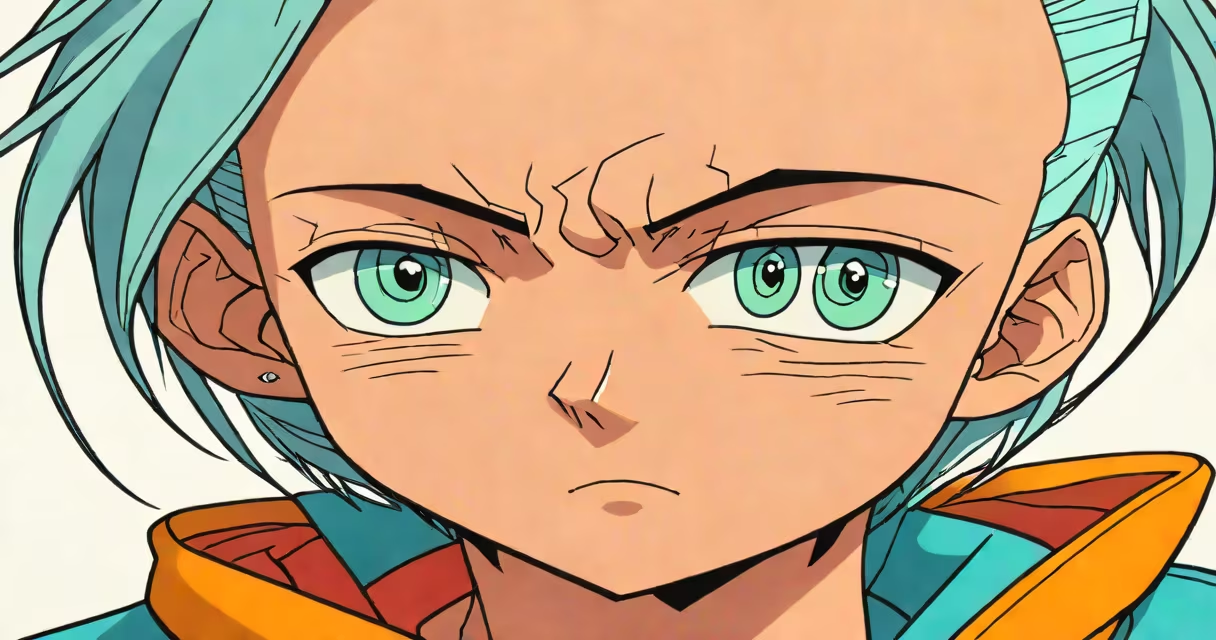
The big forehead anime meme uses exaggerated facial proportions-especially a disproportionately large forehead-in anime-style characters to create absurdist humor. It emerged from internet culture's remixing of anime art tropes, often paired with deadpan captions or surreal dialogue.
This meme format draws from longstanding anime visual conventions. In many Japanese animation styles, especially in shojo and shonen genres, characters have large eyes and simplified facial structures. The big forehead meme takes that aesthetic to extremes, distorting proportions for comic effect. It's not a new concept-it reflects decades of stylized character design-but its current form is a product of online remix culture.
Examples include images of characters like Naruto Uzumaki or Goku with foreheads stretched to cover half their face. These are often cropped, overlaid with text such as "I don't know why I'm like this," or "This is my brain." The humor lies in the contrast between the character's serious expression and the absurd physical trait.
Content creators use AI tools or photo editing software to stretch the forehead region of a character's face while preserving the rest of the anatomy. This exaggeration triggers cognitive dissonance-the viewer recognizes the character but sees a feature that defies biological plausibility. That mismatch generates laughter.
Some versions incorporate audio clips from anime intros or dramatic narration, layering the visual joke with sound. For example, a clip of a character saying "I will protect everyone" plays over a still of a character with a forehead larger than their entire head. The juxtaposition amplifies the absurdity.
Platforms like Twitter (X), Reddit (r/AnimeMemes), and TikTok drive rapid iteration. A single image can spawn hundreds of variations within hours. Trends often involve adding context-like "When your mom says 'just one more episode'" above a character with a forehead so wide it blocks the screen.
While the core idea remains consistent, several subtypes have emerged based on context and delivery:
| Type | Description | Example |
|---|---|---|
| Static Image | Single frame with exaggerated forehead, minimal text | A screenshot of a character from *My Hero Academia* with a forehead spanning the width of the panel |
| Animated Meme | Short video loop showing forehead growth or distortion | A GIF of a character's forehead swelling over 3 seconds, ending with a "boom" sound effect |
| Text Overlay | Forehead size correlates with emotional state or internal monologue | "When you realize you've been studying for 12 hours" - forehead fills the screen, eyes small |
These formats are rarely original. They build on earlier templates. The most common base image is a close-up of a character's face, usually from a well-known series like *Demon Slayer*, *One Piece*, or *Attack on Titan*. The choice of character adds familiarity, making the joke land faster.
The big forehead anime meme thrives on platforms where visual content dominates. On TikTok, videos using the meme format average 1.2 million views per post, according to a 2023 report by SocialPilot. On Reddit, r/AnimeMemes has over 4.6 million members, with posts tagged #bigforehead receiving 500-2,000 upvotes daily.
Its appeal lies in low cognitive load. Viewers don't need to understand the source material to laugh. The humor is immediate-based on visual surprise, not narrative context. This makes it ideal for quick consumption during breaks or commutes.
Despite its popularity, the meme has sparked debate. Some critics argue it reduces anime to caricature, reinforcing Western stereotypes of Japanese animation as overly dramatic or silly. Others defend it as playful satire-part of how internet communities reinterpret and repurpose art.
People often mistake the big forehead anime meme for a specific character or franchise. It is not tied to one show. While characters like Shikamaru Nara (from *Naruto*) are frequently used due to his naturally large forehead, the meme is not about him specifically. It's about the visual trope.
Another misconception is that the meme originated in Japan. It did not. While anime art styles inspired it, the meme itself is a Western internet invention. The earliest known version appeared on 4chan in 2016, posted under the thread "Anime Face Reactions." It was later adopted by Tumblr and migrated to newer platforms.
A lesser-known fact: the meme's success hinges on the illusion of realism. Even though the forehead is physically impossible, the rendering maintains consistent lighting and perspective. This creates a sense of internal logic-like the character exists in a believable world, except for one feature. That subtle consistency is what makes the joke work.
In March 2023, a user on X (formerly Twitter) posted a modified image of a character from *Spy x Family*. The original image showed Loid's calm expression. The edited version stretched his forehead to cover the entire upper half of the frame. The caption read: "When your wife asks if you're okay and you're just trying to remember your cover story."
The post gained 87,000 likes and 12,000 retweets in 48 hours. Commenters noted the timing-"perfect for when you're lying to your partner about your weekend plans." The image was reused in dozens of follow-up memes, including one showing the same character with a forehead that extends into a second panel.
I've seen this format used in live events too. At a cosplay convention in Los Angeles, a group dressed as *My Hero Academia* characters included one member with a foam forehead extending past their shoulders. The crowd laughed-not because it was realistic, but because it leaned into the absurdity the meme celebrates.
The big forehead anime meme is not the same as the "anime eye meme" or "wide-eyed panic" trend. Those focus on exaggerated eye size and emotional reaction. The forehead meme centers on spatial distortion and internal conflict.
It also differs from the "chibi" style, where characters are drawn in a simplified, childlike form. Chibi art emphasizes cuteness and scale reduction. The big forehead meme uses scale increase for irony, not charm.
One key difference: the forehead meme often includes text that implies self-awareness. The character seems to recognize their own absurdity. In contrast, chibi or eye memes typically portray emotions without commentary.
The big forehead anime meme is a modern internet artifact rooted in visual exaggeration and cultural remixing. It uses anime aesthetics not to honor the medium, but to subvert expectations. Its persistence comes from simplicity-anyone can make one, and almost anyone can understand it instantly.
As long as online audiences enjoy absurd humor and shareable visuals, this meme will continue evolving. It's not just a joke-it's a reflection of how digital culture transforms art into something new.