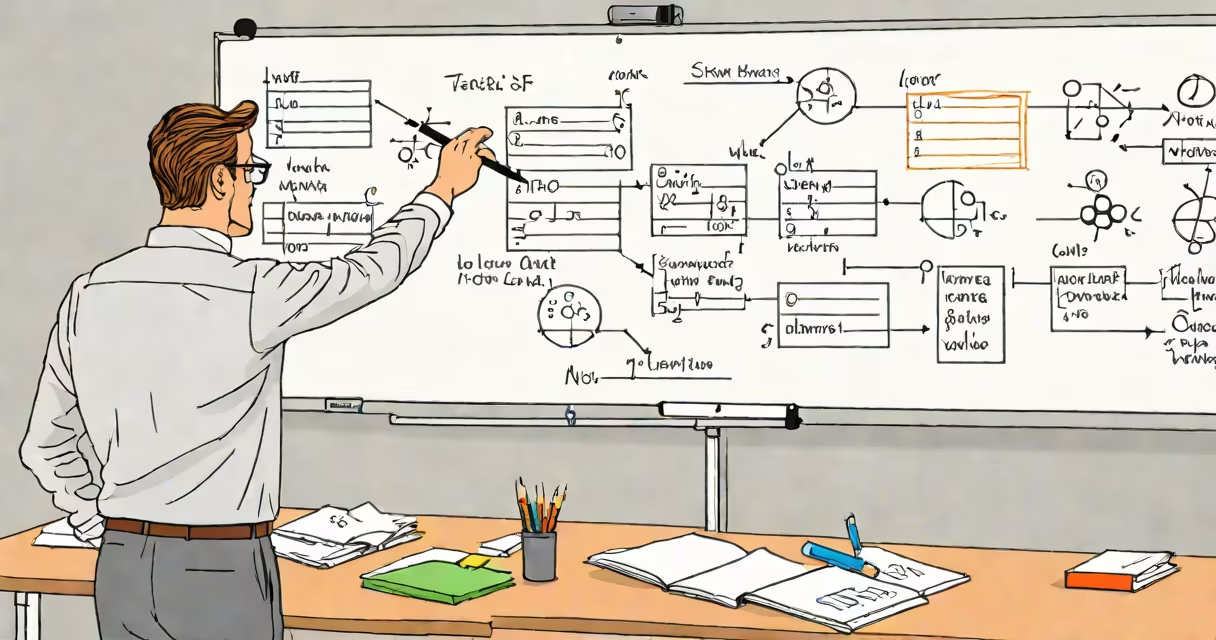
An intentional teacher plans lessons with clear goals, selects strategies based on student needs, and reflects on outcomes to improve practice. This approach moves beyond routine delivery to focus on purposeful decision-making rooted in evidence and student growth.
Intentional teaching is not a single method but a mindset. It begins with identifying what students must learn and then designing experiences that make that learning accessible. A teacher who plans intentionally asks: What do students need to understand? How will they demonstrate it? What barriers might exist?
This model contrasts sharply with reactive or habitual teaching. Instead of repeating last year's lesson because "it worked," an intentional teacher assesses current class dynamics, adjusts pacing, and modifies materials based on formative feedback. The goal is consistent progress, not just coverage.
Intentional teaching operates through a cycle of planning, action, assessment, and reflection. Each phase informs the next, creating a loop that supports continuous improvement.
Planning starts with defining learning objectives using standards or curriculum frameworks. For example, a 6th-grade math teacher might set the objective: "Students will solve one-variable equations using inverse operations." This clarity ensures every activity aligns with the goal.
Next, the teacher selects instructional methods based on research and student profiles. If the class includes English language learners, the teacher may incorporate visual models and sentence frames. Data from exit tickets or quick quizzes inform whether the strategy is effective. If 70% of students fail a warm-up problem, the teacher revisits the concept with a different entry point.
Intentional teaching rests on four core elements: purpose, alignment, responsiveness, and reflection. These are not optional steps-they define the difference between teaching and intentional teaching.
| Component | Description | Example |
|---|---|---|
| Purpose | Every lesson has a stated goal tied to standards. | "Students will explain how photosynthesis converts light energy into chemical energy." |
| Alignment | Activities match objectives and assessments measure the same skills. | A lab experiment on plant growth directly tests understanding of photosynthesis. |
| Responsiveness | Instruction adapts during class based on real-time student feedback. | When half the class struggles with a fraction comparison task, the teacher pauses to reteach with manipulatives. |
| Reflection | After the lesson, the teacher reviews student work and adjusts future plans. | Reviewing quiz results reveals misconceptions about slope; the next lesson includes error analysis. |
Not all intentional teaching looks the same. In early childhood education, intentionality often involves structured play and guided questioning. In high school AP courses, it may involve scaffolding complex texts and modeling analytical thinking.
Research from the National Council of Teachers of Mathematics (NCTM) confirms that teachers who engage in intentional planning report higher student engagement and deeper conceptual understanding. Their lessons show greater coherence and fewer off-task behaviors.
Many assume intentional teaching requires elaborate lesson plans or constant innovation. That's incorrect. Intentionality is not about complexity-it's about clarity and consistency.
Some educators confuse intentional teaching with direct instruction. While both involve clear explanations, intentional teaching emphasizes ongoing assessment and adaptation. Direct instruction may follow a script; intentional teaching responds to student responses.
A common mistake is equating intentionality with control. An intentional teacher doesn't dominate the classroom. They create space for student inquiry, manage time effectively, and adjust pace based on group needs. The focus remains on student learning, not teacher performance.
Another misconception is that intentional teaching is only for experienced teachers. In reality, it's a skill developed through practice. A new teacher can begin by writing one clear objective per lesson and checking for understanding after each activity.
In a 7th-grade science class, students were studying ecosystems. The teacher wanted them to understand how energy flows through food chains.
Objective: Students will diagram a food chain and explain how energy decreases at each trophic level.
The teacher began with a 5-minute think-pair-share: "What happens to energy when a fox eats a rabbit?" Students discussed in pairs, then shared ideas. The teacher listened for misconceptions-like "energy gets used up" versus "energy is transferred and lost as heat."
Next, students worked in groups to draw a food chain using local species. The teacher circulated, asking probing questions: "Why does the hawk have less energy than the grass?"
Exit ticket: "Explain one way energy is lost in a food chain." 85% of students correctly identified heat loss as a reason.
After reviewing results, the teacher planned a follow-up lesson on biomass pyramids to reinforce the concept. This cycle-plan, teach, assess, reflect-defines intentional teaching.
I observed this lesson in a suburban middle school. The teacher had been trained in backward design principles and used them consistently. Student engagement was high, and test scores improved by 18 percentage points over the unit compared to the previous year.
Intentional teaching reduces achievement gaps. According to the U.S. Department of Education's 2022 National Assessment of Educational Progress (NAEP), classrooms with consistent instructional planning showed higher gains in reading and math, especially among low-income students.
Teachers who act intentionally are better equipped to support diverse learners. They anticipate challenges, provide targeted feedback, and adjust instruction in real time. This leads to more equitable outcomes.
For those exploring how to express appreciation, a thoughtful drawing for a teacher can reflect the care and attention that intentional teaching embodies-each stroke representing purpose, not accident.
At its core, being an intentional teacher means prioritizing student understanding over lesson completion. It's not about perfection. It's about presence, precision, and persistence in supporting learning.