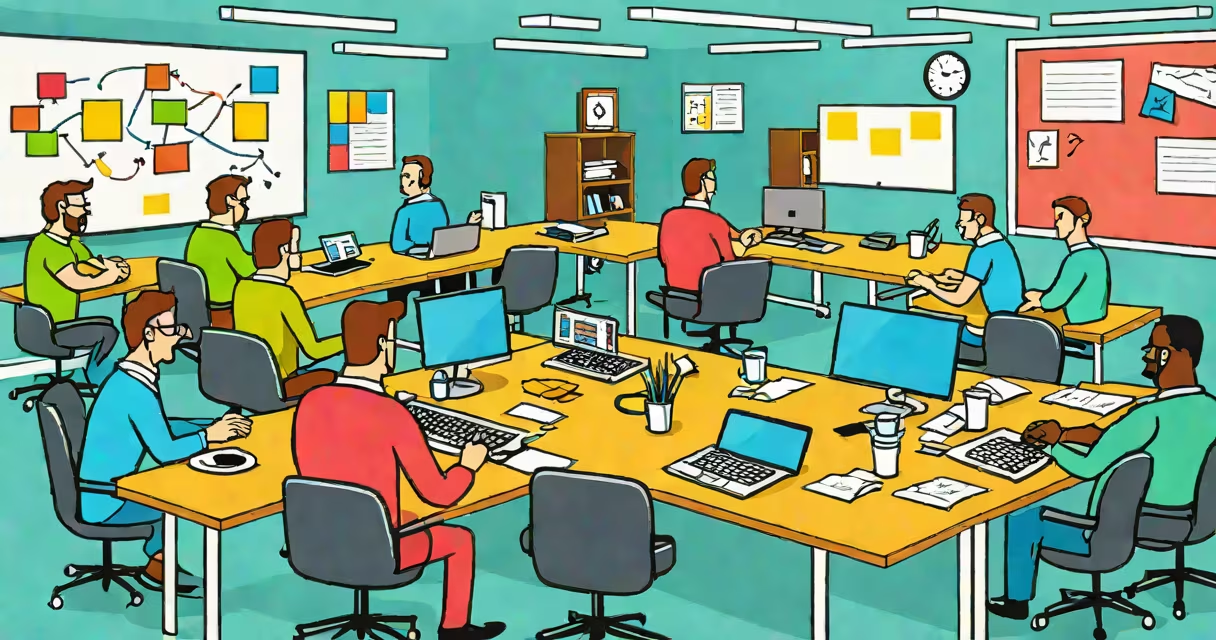
Agile is a project management philosophy emphasizing iterative development, customer collaboration, and adaptability. Scrum is a specific structure within the agile umbrella that structures work into time-boxed sprints, defines roles like Product Owner and Scrum Master, and uses daily stand-ups, sprint reviews, and retrospectives.
Agile is not a single method. It's a mindset rooted in the Agile Manifesto, which values individuals and interactions, working software, customer collaboration, and responding to change over rigid processes, documentation, and planning. The manifesto was published in 2001 by 17 software developers who sought better ways to build software.
Scrum is one implementation of agile. It provides a clear structure: teams work in fixed-length iterations called sprints-typically two weeks long. Each sprint begins with a planning meeting and ends with a review and retrospective. Scrum defines three roles: the Product Owner, who prioritizes work; the Scrum Master, who removes blockers; and the Development Team, responsible for delivering increments.
Agile sets the guiding principles: deliver value early, adapt quickly, and involve customers throughout. Scrum delivers a practical way to apply those principles through rituals, artifacts, and responsibilities.
For example, a software team building a mobile app uses agile thinking to prioritize features based on user feedback. They then adopt scrum to organize their work: every two weeks, they plan a sprint focused on a subset of features. During the sprint, they hold daily 15-minute stand-ups to sync progress. At the end, they demo the working product to stakeholders and reflect on what went well and what didn't.
This combination allows teams to stay flexible while maintaining discipline. A 2022 survey by VersionOne found that 94% of organizations using agile reported improved project visibility, and 86% saw faster time-to-market. Teams using scrum reported higher predictability in delivery timelines compared to those using only agile principles without a structure.
Agile is not a single model. It includes several frameworks-Scrum, Kanban, XP (Extreme Programming), and SAFe (Scaled Agile Structure)-each suited to different team sizes, project types, and organizational cultures.
| Structure | Structure | Best For | Example Use Case |
|---|---|---|---|
| Scrum | Time-boxed sprints, defined roles, regular ceremonies | Product teams needing predictable delivery cycles | A fintech startup releasing new payment features every two weeks |
| Kanban | Visual workflow board, continuous delivery, WIP limits | Support teams managing ongoing requests | A customer service team tracking bug fixes and feature requests |
| XP (Extreme Programming) | Pair programming, test-driven development, frequent releases | High-risk software projects requiring quality assurance | An autonomous vehicle software team testing safety-critical code |
| SAFe | Multiple agile teams aligned across departments | Large enterprises scaling agile across divisions | A global bank rolling out a new core banking system across regions |
Scrum is not interchangeable with agile. You can be agile without using scrum. A team might embrace agile values-frequent feedback, small batches, continuous improvement-but run their work via Kanban or a custom process. Conversely, using scrum doesn't guarantee agility. A team can follow all scrum rituals but still resist change, ignore stakeholder input, and produce low-value outputs.
A common mistake is treating scrum as a silver bullet. According to the Project Management Institute (PMI), 47% of failed agile transformations stem from misapplying frameworks without addressing cultural readiness. Teams may adopt scrum ceremonies but fail to help the Product Owner or allow the Scrum Master to remove impediments effectively.
Many assume that agile means "no planning" or "constant chaos." That's incorrect. Agile requires disciplined planning-just not upfront, detailed plans. Instead, planning happens iteratively. Teams commit to a sprint goal, then adjust based on feedback and changing priorities.
Another misconception: scrum is only for software teams. While it originated in software development, scrum applies to any complex, uncertain work. A marketing team launching a campaign can use scrum to break down tasks, assign ownership, and review results after each sprint.
One non-obvious distinction: the Scrum Master is not a project manager. The role is servant-leader focused on enabling the team, not directing it. A 2021 study by the Scrum.org Professional Scrum Training team found that teams with certified Scrum Masters delivered 25% more value per sprint than those without formal training.
A fitness app company wanted to launch a new workout tracker. They adopted agile principles: they engaged users early, released minimum viable features, and adjusted based on feedback. But they needed structure to avoid scope creep and missed deadlines.
They chose scrum. The Product Owner gathered user stories: "As a user, I want to log my workout duration so I can track progress." The team broke this into tasks: design UI, build backend API, integrate with calendar, test on devices.
Over four two-week sprints, they delivered incremental functionality. After Sprint 1, they had a basic timer. After Sprint 2, users could save sessions. After Sprint 3, they added social sharing. After Sprint 4, they launched a beta version to 500 users.
At the end of each sprint, they held a review. Users reported bugs and suggested improvements. The team adjusted the backlog accordingly. By the end of Sprint 4, they had a working prototype with 87% user satisfaction in internal surveys.
This approach reduced rework by 40% compared to previous waterfall-based launches. The team credited scrum's transparency and regular feedback loops for catching issues early.
Use agile when your project involves uncertainty, evolving requirements, or high customer interaction. It's ideal for startups, innovation labs, or any environment where speed and responsiveness matter.
Use scrum when you need a lightweight, repeatable structure to manage complex work. It's effective for cross-functional teams building products incrementally. If your team struggles with focus, unclear priorities, or missed deadlines, scrum's cadence and roles provide clarity.
Agile vs scrum is not a choice between two options. It's understanding that agile is the philosophy, and scrum is one proven way to operationalize it. The most successful teams don't just follow a structure-they live the values: inspect, adapt, collaborate, deliver.