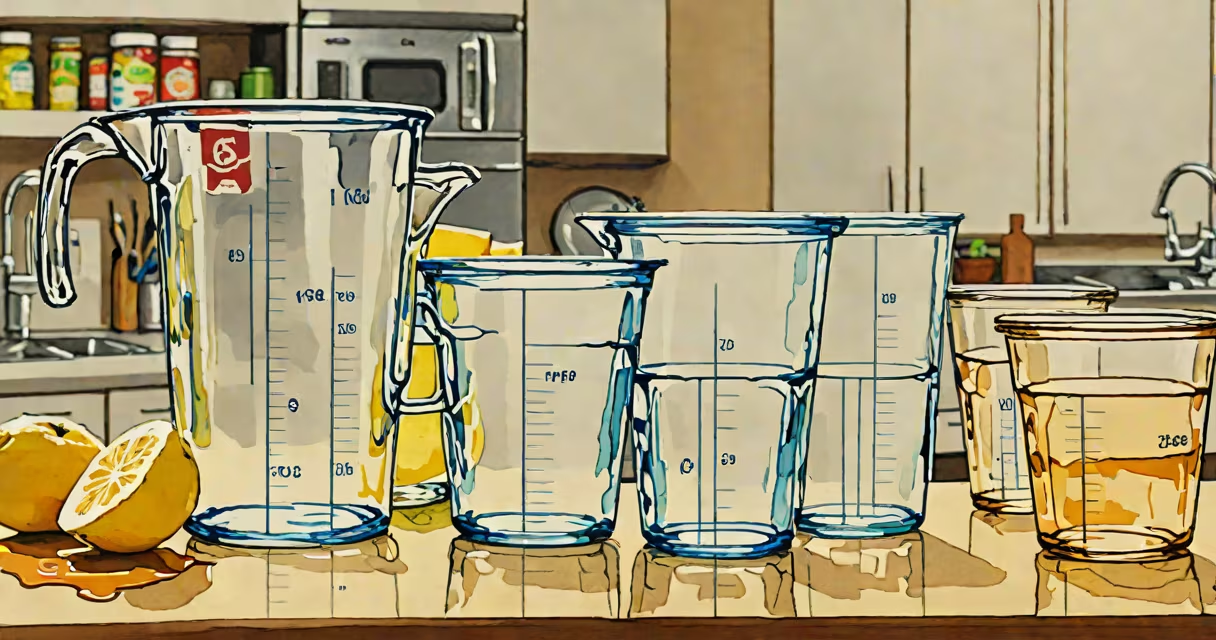
Water cups to oz refers to converting fluid volume from U.S. customary cups to fluid ounces, where 1 cup equals exactly 8 fluid ounces. This conversion applies directly to liquids like water, and is standardized across cooking, nutrition, and hydration tracking.
The U.S. customary system defines a cup as 8 fluid ounces. This is distinct from the imperial system used in the UK, where a cup is 10 imperial fluid ounces. Using the correct system prevents errors in recipes, medication dosing, and daily water intake tracking.
For example, 2 cups of water equal 16 fluid ounces. This standard is consistent across food labels, nutrition facts panels, and kitchen measuring tools. The U.S. Food and Drug Administration (FDA) mandates this conversion in dietary guidelines, ensuring clarity in consumer information.
Each U.S. cup holds exactly 8 fluid ounces. This relationship is fixed and does not change based on the substance being measured. Water, milk, juice, or oil all follow the same rule: 1 cup = 8 fl oz.
Converting from cups to fluid ounces requires multiplying the number of cups by 8. For instance, 3 cups × 8 = 24 fluid ounces. To reverse the process, divide fluid ounces by 8 to get cups. A 16-oz bottle of water contains exactly 2 cups.
This system simplifies tracking daily fluid intake. Health organizations recommend drinking 8 cups of water per day, which equals 64 fluid ounces. This aligns with common hydration goals and is widely cited in public health materials.
There are two primary systems for measuring volume: U.S. customary and metric. The U.S. system uses cups and fluid ounces. The metric system uses milliliters and liters. Conversions between these systems are necessary for international recipes or scientific contexts.
Common conversion values:
| Cups | Fluid Ounces | Milliliters |
|---|---|---|
| 1 | 8 | 237 |
| 2 | 16 | 473 |
| 4 | 32 | 946 |
| 8 | 64 | 1,892 |
Some people confuse U.S. cups with metric cups. A metric cup is 250 milliliters, slightly larger than a U.S. cup. Using a metric cup in a recipe designed for U.S. cups can result in too much liquid, altering texture and outcome.
A frequent mistake is assuming that 1 cup of water weighs 8 ounces. While 8 fluid ounces of water measures 8 ounces in volume, it weighs approximately 8.34 avoirdupois ounces due to density. This difference matters in precise applications like pharmaceuticals or lab work.
Another error occurs when scaling recipes. Doubling a recipe that calls for 1.5 cups of water results in 3 cups, or 24 fluid ounces. Some users mistakenly multiply by 16 instead of 8, leading to overly diluted mixtures.
Using a dry measuring cup for liquids introduces inaccuracies. Dry cups are designed for solids and often have a flat edge, while liquid measuring cups have spouts and markings visible from eye level. This leads to over-pouring or under-pouring.
Consider a recipe requiring 2.5 cups of water. Multiply 2.5 × 8 = 20 fluid ounces. This is equivalent to 614 milliliters. If you only have a measuring jug marked in milliliters, fill it to 614 mL.
When tracking daily water intake, someone aiming for 64 fluid ounces (8 cups) may use a reusable bottle labeled in both units. A 32-oz bottle fills halfway to meet half the daily goal. This visual cue supports consistency and reduces cognitive load.
I once used a kitchen scale to verify water volume during a hydration study. I filled a 1-cup glass with water and placed it on a digital scale. The reading was 8.34 ounces, confirming that volume and weight differ slightly for water. This helped me correct a participant's misunderstanding about fluid intake.
Online calculators and mobile apps simplify conversions. However, relying solely on automated tools risks misinput. Always double-check the unit type-fluid ounces versus dry ounces-and ensure the tool uses U.S. customary measurements unless otherwise specified.
For reference, a standard 8-ounce water bottle is roughly 1 cup. A 16-ounce bottle is 2 cups. A 32-ounce container holds 4 cups. These benchmarks help estimate volume without tools.
Inconsistent measurements affect outcomes. Baking relies on precise ratios. Too much water in bread dough leads to dense loaves. Too little causes crumbly textures. Nutrition labels depend on accurate volume reporting to reflect serving sizes correctly.
Health professionals use fluid ounce equivalents to assess hydration status. A patient consuming less than 64 oz of water daily may be flagged for dehydration risk. Accurate tracking ensures proper clinical decisions.
Understanding water cups to oz is essential for home cooks, fitness enthusiasts, and medical staff. It enables consistent results across kitchens, labs, and clinics.
Knowing that 1 cup equals 8 fluid ounces provides a foundation for accurate measurement. Whether following a recipe, tracking hydration, or preparing a science experiment, this conversion remains constant and reliable.