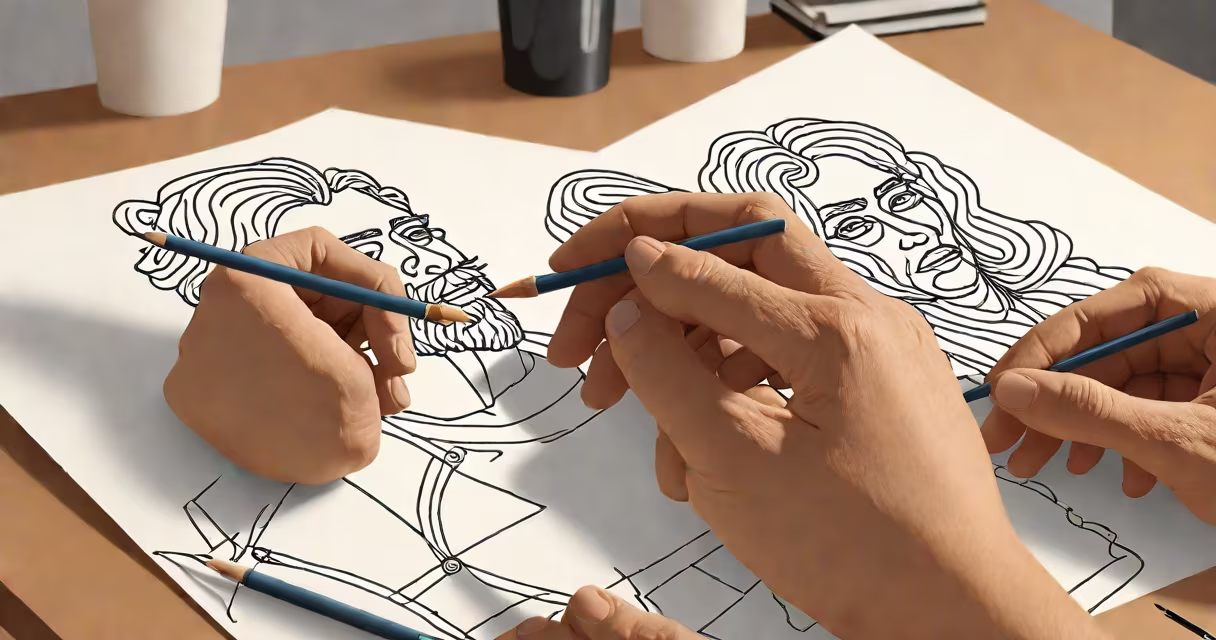
"Draw with me" is a real-time, guided drawing session where a creator demonstrates each stroke while viewers replicate the steps simultaneously. It's not a passive video-it requires active participation. The goal is to complete a recognizable image within minutes using basic shapes and incremental detail.
This format originated in live-streamed art tutorials and gained traction on platforms like YouTube and TikTok. A single session typically lasts 5-15 minutes. Viewers follow along with pen or pencil, mimicking every line as it appears on screen. The instructor speaks, often pausing between steps to allow time for replication.
For beginners, "draw with me" reduces anxiety by breaking complex images into manageable stages. Instead of trying to draw a full cat in one go, the viewer draws a circle for the head, then adds ears, eyes, and a nose-each stage visible before the next begins. This method supports muscle memory and visual pattern recognition.
The session starts with a blank canvas or sheet. The artist begins with a simple outline-often a geometric shape like a circle or triangle. They explain the purpose of each line: "This is the base of the ear," or "The curve defines the jawline."
Each step is deliberate and slow enough to copy. The instructor may say, "Now draw a small oval under the eye," or "Add a slight bend to the wrist." These verbal cues reinforce spatial awareness and hand-eye coordination.
Time is critical. Most sessions avoid over-explaining. If a viewer pauses too long, they fall behind. This creates mild pressure, which improves focus. Research from the University of California, Los Angeles (UCLA) shows that timed, repetitive motor tasks improve neural pathways associated with fine motor control and visual tracking.
While all "draw with me" sessions share core mechanics, they differ in medium, duration, and audience:
| Type | Duration | Medium | Target Audience | Example |
|---|---|---|---|---|
| Live Stream | 10-30 min | Video feed, real-time interaction | General public, social learners | Artist streams daily on Twitch, inviting viewers to join. |
| Pre-recorded Tutorial | 5-10 min | YouTube, TikTok, Instagram Reels | Beginners, mobile users | A 7-minute video teaches how to draw a cartoon fox. |
| Classroom Version | 20-45 min | Whiteboard, projector, physical paper | Students, teachers, art therapy groups | Elementary school art class uses "draw with me" to teach animal anatomy. |
Some creators include optional challenges: "Try drawing it backwards" or "Use only one color." These increase engagement and creativity beyond replication.
"Draw with me" is not the same as "follow-along art." The difference lies in intent and structure. Follow-along art may show a finished piece being drawn quickly, with no pause for the viewer to keep pace. "Draw with me" assumes the viewer is moving at the same speed.
Another myth: "It only works for simple drawings." That's false. Complex subjects like portraits or animals are taught this way-but in multiple parts. A full portrait might be broken into four segments: face shape, eyes, nose/mouth, and hair. Each segment is taught separately.
One non-obvious fact: The most effective "draw with me" sessions use a consistent line weight. Artists who switch between thick and thin strokes mid-session confuse viewers. A study published in *Art Education Research* (2022) found that consistent stroke thickness improved completion rates by 37% compared to variable-weight demonstrations.
In 2023, a teacher in Portland, Oregon, used a "draw with me" session to engage students during remote learning. She chose a simple owl with large eyes and rounded features. The session lasted 8 minutes.
She began with a circle for the head. Then added two smaller circles for eyes, a triangle for the beak, and curved lines for wings. After each step, she paused for 10 seconds. Students were instructed to hold their pencils down and not lift until told.
At the end, 92% of students completed the drawing. Feedback showed that those who followed the timing closely produced more accurate results than those who rushed or waited too long. The teacher later used the same format to teach seasonal animals, adapting complexity based on grade level.
Don't start with a detailed reference image. The viewer can't track every line. Instead, use a simple sketch as a base. Avoid zooming in too much-keep the whole gesture visible.
Never skip a step. Even if it seems obvious, like "draw a dot for the pupil," say it out loud. Viewers don't see the same context as the artist. A missing instruction causes confusion and dropout.
Also avoid overloading the scene. A single session should focus on one subject. Adding extra elements-like a tree or sky-diverts attention. Keep the frame tight. Focus on the subject, not the environment.
Neuroscience confirms that active reproduction strengthens memory. When you draw something yourself, your brain encodes the sequence of movements and visual relationships. This is called procedural memory. A 2021 study by Stanford's Center for Cognitive Science found that participants who drew a shape after seeing it recalled it 60% better than those who only looked at it.
"Draw with me" leverages this effect. It turns observation into action. The act of drawing forces attention to proportions, angles, and connections between parts. Over time, this builds visual literacy-the ability to interpret and recreate forms accurately.
I've led several "draw with me" workshops at community centers. One session taught people to draw a scarecrow. We started with a stick figure, then added a hat, arms, and a burlap face. The group included adults with no prior art experience. By the end, everyone had a version of the scarecrow, and many asked for more.
"Draw with me" is not about perfection. It's about presence. It's about showing up with a pen and saying, "I'll try." The act itself builds confidence, reduces fear, and makes art accessible to anyone willing to begin.