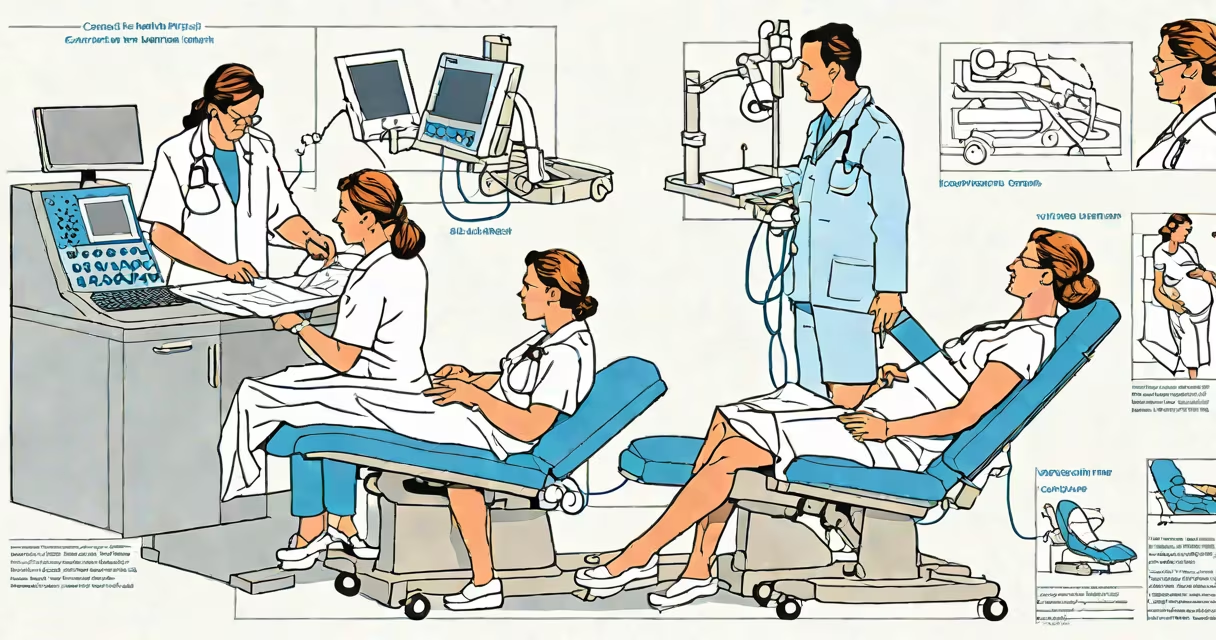
A cervical check is a physical examination where a healthcare provider assesses the cervix's position, dilation, and effacement to evaluate progress toward labor. It's typically performed during the third trimester or when labor is suspected. The procedure involves inserting gloved fingers into the vagina to feel the cervix's texture, firmness, and openness.
Cervical checks are part of routine prenatal care near term. They help determine if the body is preparing for childbirth. Providers use them to track changes in the cervix, such as softening (ripening), thinning (effacement), and opening (dilation). These signs indicate whether labor may begin soon. The American College of Obstetricians and Gynecologists (ACOG) states that cervical checks are most useful in late pregnancy, especially around 36 weeks and beyond.
During the exam, the provider checks for three key factors: dilation (measured in centimeters from 0 to 10), effacement (percentage of thinning from 0% to 100%), and station (how far the baby's head has descended into the pelvis). A full dilation of 10 cm signals the start of the pushing phase. Effacement reaches 100% when the cervix is paper-thin. Station ranges from -5 (high in the pelvis) to +5 (below the pelvic brim).
The patient lies on an exam table with feet in stirrups. The provider wears gloves and uses a lubricated finger to gently insert into the vagina. They then press against the cervix to assess its firmness, position, and openness. The process takes less than a minute and may cause mild pressure or discomfort, but not pain.
Providers often perform cervical checks during routine visits near term. They may also do one if contractions begin, water breaks, or labor seems imminent. The exam is not done routinely before 36 weeks unless medically indicated. Overuse can increase infection risk, so ACOG recommends limiting checks to when clinically necessary.
One common misconception is that cervical checks predict labor timing precisely. In reality, they offer only a snapshot. A cervix that's 2 cm dilated at 38 weeks may remain unchanged for days. Some women show no change until labor begins. The consistency of findings varies widely between individuals.
Dilation measures how open the cervix is. At 0 cm, it's closed. At 10 cm, it's fully open. Effacement tracks thinning. At 0%, the cervix is thick; at 100%, it's nearly paper-thin. Station shows fetal descent. A station of -1 means the baby's head is above the pelvic inlet. A station of +2 means it's below the pelvic outlet.
| Measurement | Normal Range | Meaning |
|---|---|---|
| Dilation | 0-10 cm | Openness of cervical canal |
| Effacement | 0%-100% | Thinning of cervical tissue |
| Station | -5 to +5 | Fetal head position relative to pelvis |
For example, a woman at 39 weeks with 4 cm dilation, 70% effacement, and station +1 is considered "early labor." Her cervix is softening and opening, and the baby is descending. This combination suggests labor may progress within hours or days. However, no single measurement guarantees delivery timing.
Some patients report feeling anxious about cervical checks. The exam can trigger fear of premature labor or false alarms. But research shows that frequent checks don't improve outcomes. A 2021 Cochrane review found no benefit in reducing cesarean rates or improving neonatal health through routine cervical exams before labor.
One widespread error is equating cervical dilation with labor onset. Dilation can occur gradually over days. A woman may be 3 cm dilated at 38 weeks and remain stable for several days. Conversely, some women enter active labor with minimal dilation. The cervix doesn't always open early.
Another myth is that cervical checks cause preterm birth. There's no evidence supporting this. The procedure is safe when performed correctly. However, providers avoid checking if membranes are ruptured or if there's vaginal bleeding, due to infection risk.
Patients sometimes confuse cervical checks with internal ultrasounds. While both involve vaginal access, internal scans use a probe to visualize the fetus and placenta. Cervical checks rely on touch, not imaging. Internal ultrasounds are used for anatomy scans or monitoring fetal growth, not labor readiness.
I once observed a cervical check during a hospital rotation. A woman at 37 weeks reported irregular contractions. The provider found 1 cm dilation and 20% effacement. The patient was reassured that this wasn't early labor. She returned at 40 weeks, when the cervix had progressed to 5 cm dilation and 80% effacement. That shift confirmed she was approaching active labor.
Cervical checks are most useful in late pregnancy. They help confirm readiness for induction or assess labor progression. They're also used during labor to monitor dilation and station. In some cases, providers perform them to decide whether to proceed with a vaginal birth after cesarean (VBAC).
They're not recommended before 36 weeks unless complications arise. Early checks increase the risk of ascending infection. ACOG advises against routine assessments before 36 weeks unless there's clinical concern.
If you're pregnant and scheduled for a cervical check, ask your provider about the reason. Knowing whether it's for monitoring, labor evaluation, or induction planning helps reduce anxiety. You can also request a partner or support person to be present during the exam.