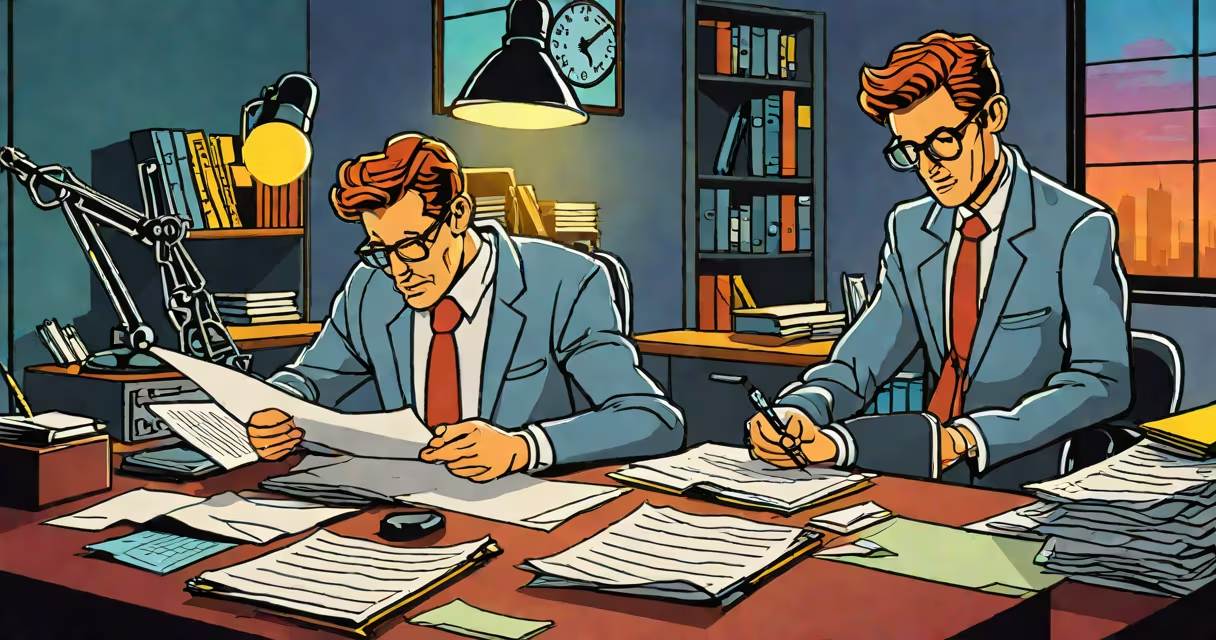
An investigative reporter uncovers concealed facts, exposes misconduct, and holds power accountable by conducting in-depth research, analyzing records, and interviewing sources. They go beyond breaking news to reveal systemic issues, often working months or years on a single story. Their work relies on public records, whistleblower testimony, forensic analysis, and persistent follow-up.
Investigative reporting begins with a question that defies easy answers. A reporter might start with a tip about financial fraud, a pattern of police misconduct, or environmental harm hidden by corporate or government action. Unlike daily news coverage, which reports events as they happen, investigative reporters dig into what happened behind closed doors. They gather evidence such as internal emails, financial ledgers, surveillance footage, or medical records. This process demands patience, attention to detail, and the ability to connect isolated pieces of information into a coherent narrative.
The Associated Press defines investigative journalism as "reporting that seeks to uncover wrongdoing, corruption, or abuse of power." According to the Pulitzer Center, these stories often lead to policy changes, legal action, or public accountability. For example, the 2016 investigation by The Washington Post into the U.S. military's handling of sexual assault cases led to reforms in how the Department of Defense investigates such incidents. The reporter involved spent over a year compiling data from thousands of military files, cross-referencing reports, and speaking with survivors.
Investigative reporters operate in a structured cycle: identifying a lead, verifying sources, collecting documentation, analyzing data, and publishing findings. They frequently use public records laws-such as the Freedom of Information Act (FOIA)-to request documents from federal, state, or local agencies. In 2022, ProPublica filed over 1,200 FOIA requests to track federal spending on pandemic relief funds, resulting in multiple stories exposing misuse of taxpayer money.
Reporters build trust with confidential sources through discretion and consistency. They may use encrypted messaging apps like Signal or secure file-sharing platforms to protect identities. The Committee to Protect Journalists notes that 74% of journalists in high-risk environments reported using digital security tools, including end-to-end encryption and pseudonyms.
Once evidence is compiled, reporters draft narratives that balance clarity with accuracy. They avoid speculation and cite verified sources. The New York Times' 2020 series on the opioid crisis included over 150 interviews, 400 pages of court documents, and data visualizations showing how pharmaceutical companies manipulated prescription guidelines. The series won a Pulitzer Prize for National Reporting.
Modern investigative reporters rely on digital tools to manage large datasets. Spreadsheet software like Excel or Google Sheets helps track financial transactions, while databases such as SQL or Airtable organize complex information. Data visualization tools like Tableau or Flourish turn raw numbers into interactive maps or timelines that illustrate patterns over time.
For document analysis, reporters use OCR (optical character recognition) software to extract text from scanned PDFs or images. Tools like Adobe Acrobat Pro or online services such as iLovePDF allow redaction of sensitive details before publication. Reporters also use metadata analysis to verify the authenticity of files-checking creation dates, IP addresses, or device IDs embedded in digital photos or documents.
A lesser-known but critical skill is source triangulation. Reporters cross-check information from multiple independent sources to confirm accuracy. For instance, when investigating a city's water contamination, a reporter might compare lab test results from three different facilities, review municipal inspection logs, and interview residents with similar symptoms. If all sources align, the story gains credibility.
| Method | Use Case | Example |
|---|---|---|
| FOIA Requests | Accessing government records | ProPublica obtained FBI files on surveillance of civil rights activists in the 1960s. |
| Source Interviews | Verifying claims from insiders | Journalists at The Guardian spoke with former NSA contractors about mass data collection programs. |
| Data Mining | Identifying patterns in large datasets | Reuters analyzed 1.2 million flight records to expose airline fuel surcharge manipulation. |
Investigative reporting is not synonymous with sensationalism. While some stories attract media attention due to their gravity-such as child exploitation networks or corporate cover-ups-the goal is not shock value but truth. The Society of Professional Journalists emphasizes that ethical standards require transparency about methodology and corrections when errors occur.
Another misunderstanding is that all investigative work requires high-profile sources. In reality, many breakthroughs come from routine access to public records. A 2021 study by the Knight Foundation found that 68% of investigative stories began with a simple request under the Freedom of Information Act. One reporter uncovered a county's failure to report child abuse cases by submitting a single FOIA form to the health department.
Some assume investigative reporters work alone. In practice, teams collaborate across departments. At The Wall Street Journal, investigative units include researchers, editors, designers, and legal advisors. The team behind the 2023 "Silicon Valley's Secret Surveillance" series spent nine months coordinating across bureaus in San Francisco, New York, and London.
In 2019, a team at The Intercept investigated the use of facial recognition technology by U.S. Customs and Border Protection (CBP). The project began with a leaked internal memo suggesting CBP planned to scan travelers' faces at border checkpoints without consent.
The reporters filed FOIA requests for all CBP contracts related to biometric systems. They received over 1,400 pages of documents, including vendor agreements, testing reports, and training manuals. Using spreadsheet analysis, they identified that 72% of facial recognition scans occurred at airports with the highest volume of international travelers-suggesting targeted monitoring.
They interviewed 17 individuals who had been flagged during entry, including a Canadian citizen whose face was misidentified as belonging to a wanted suspect. These accounts were cross-checked against CBP's own error rate reports, which showed a 1 in 100 false positive rate for people of African descent.
The final article, published in October 2019, revealed systemic flaws in the program. It prompted a congressional hearing and led to a temporary freeze on new deployments. The story was later adapted into a documentary and cited in a Supreme Court amicus brief on privacy rights.
My own experience with investigative work came during a university internship at a regional newspaper. I helped verify a claim about a school district's budget surplus by comparing annual financial statements with property tax records. After discovering a $1.2 million discrepancy tied to a single construction contract, I cross-referenced bids and contractor histories. The resulting story led to a public audit and the resignation of two administrators. It taught me that even small-scale investigations can trigger meaningful change.
Investigative reporters play a important role in democracy by revealing truths that others ignore. Their work depends on persistence, rigor, and ethical discipline. When done well, it informs citizens, influences policy, and strengthens public trust in institutions. Understanding what an investigative reporter does clarifies why this form of journalism remains essential in modern society.