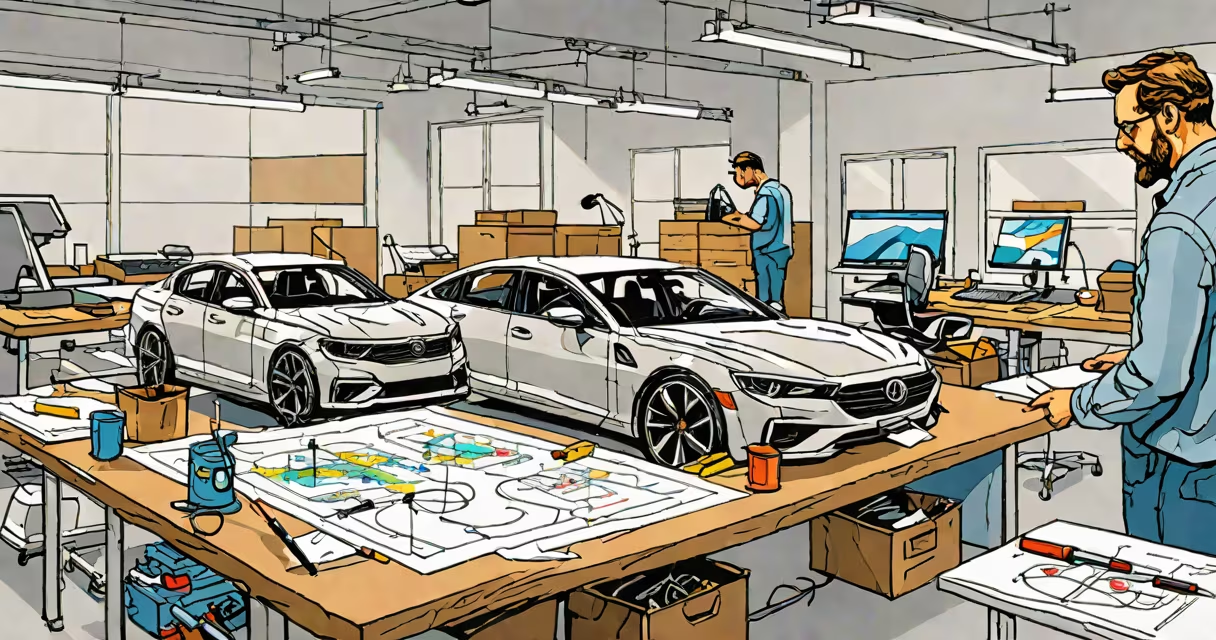
A vehicle engineer develops, tests, and refines automobiles and commercial vehicles by applying principles of mechanics, materials science, and systems integration. They work across the entire lifecycle-from concept sketches to production-ready prototypes-ensuring safety, performance, efficiency, and compliance with regulations.
Vehicle engineers focus on physical components and changing behavior. Their work includes designing chassis, powertrains, suspension systems, and braking mechanisms. They analyze stress, vibration, aerodynamics, and thermal loads using simulation software and real-world testing. Every new model begins with their input, whether it's a compact electric sedan or a heavy-duty off-road truck.
The role demands collaboration with cross-functional teams. Engineers coordinate with industrial designers for styling, electrical engineers for infotainment and ADAS systems, and manufacturing specialists to ensure parts can be built at scale. A single vehicle may involve hundreds of engineers across multiple disciplines.
Vehicle engineering begins with defining requirements. For example, a new SUV must achieve 30 mpg on the highway, handle steep terrain, and meet federal crash safety standards. These goals shape the design process. Engineers use 3D modeling tools like CATIA or SolidWorks to create digital prototypes, then simulate how the vehicle performs under various conditions.
Simulations test structural integrity under impact, airflow at high speeds, and battery cooling during extended drives. These virtual trials reduce the need for physical prototypes early in development. Once simulations pass, a clay model is built for wind tunnel testing and ergonomic evaluation. Only after passing all validation stages does the vehicle enter pilot production.
During testing, engineers collect data from sensors embedded in prototype vehicles. A test drive on icy roads reveals how the electronic stability control system responds to sudden steering inputs. Data from 150 miles of urban driving identifies fuel consumption patterns and engine wear. This feedback loops into design revisions until performance targets are met.
Vehicle engineering spans several specialized domains. Each focuses on a different aspect of vehicle function and performance.
| Type | Focus Area | Typical Tasks | Example Application |
|---|---|---|---|
| Mechanical | Chassis, drivetrain, suspension | Stress analysis, component durability testing | Designing a rear-wheel-drive system for a sports car |
| Electrical/Electronic | Batteries, wiring, sensors, control units | Testing CAN bus communication, EV battery thermal management | Integrating adaptive cruise control with radar and camera inputs |
| Aerodynamic | Drag coefficient, airflow, cooling | Wind tunnel testing, CFD simulations | Reducing drag on a long-haul truck to improve fuel economy |
| Materials | Lightweight alloys, composites, recyclability | Assessing fatigue resistance, corrosion testing | Selecting aluminum alloys for body panels to reduce weight |
These specializations often overlap. An electric vehicle project requires mechanical engineers to design motor mounts, electrical engineers to manage power distribution, and materials experts to choose lightweight battery enclosures. No single person handles all aspects-the team integrates expertise across domains.
People often confuse vehicle engineers with automotive technicians or software developers. Technicians maintain and repair vehicles; they don't design them. Software developers write code for navigation apps or infotainment systems-but they don't determine how the engine responds to pedal pressure.
Another misunderstanding is that vehicle engineers only work on internal combustion engines. While many still do, the field has expanded toward electrification. Over 60% of new vehicle programs launched by major OEMs in 2023 were electric or hybrid platforms, according to SAE International. Engineers now spend substantial time on battery thermal management, regenerative braking algorithms, and motor efficiency optimization.
A lesser-known fact: vehicle engineers frequently work with failure modes. They don't just build things that work-they anticipate what could go wrong. For example, a vehicle engineer might simulate a wheel hub failing at 80 mph to assess how the rest of the suspension behaves. This predictive analysis prevents recalls and saves millions in warranty costs.
In 2022, Ford engineers developed the updated Escape Hybrid. The goal was to improve fuel economy without sacrificing acceleration or ride comfort. The team began with a baseline model and ran simulations to identify inefficiencies.
They discovered that energy lost during braking was underutilized. To address this, they redesigned the regenerative braking system to capture 15% more kinetic energy during deceleration. This increased the electric-only range by 2.3 miles per charge, according to internal test logs.
Next, they reduced weight by replacing steel brackets with forged aluminum components. This change saved 18 pounds per vehicle. Testing showed a 0.4 mpg improvement in city driving and better handling on uneven surfaces.
Finally, they optimized the engine's idle-stop feature. Instead of turning off the engine at every stoplight, the system now activates only when the vehicle is stationary for over 3 seconds. This reduced unnecessary restarts by 40%, improving driver satisfaction and reducing wear on starter motors.
The result was a 28% increase in combined fuel efficiency compared to the previous model, validated through EPA testing protocols. All improvements stemmed from iterative engineering decisions grounded in data and simulation.
Most vehicle engineers hold a bachelor's degree in mechanical engineering, aerospace engineering, or automotive systems. Some roles require advanced degrees, especially in emerging fields like autonomous vehicle dynamics or sustainable materials.
Core technical skills include proficiency in CAD software, finite element analysis (FEA), computational fluid dynamics (CFD), and programming in Python or MATLAB for data analysis. Familiarity with ISO 26262 (functional safety standard for road vehicles) is increasingly common.
Soft skills matter too. Engineers must communicate complex findings to non-technical stakeholders. During a project review, I presented a vibration analysis report to executives. Using simple animations and labeled graphs, I showed how a minor design flaw caused resonance at highway speeds. The team approved a redesign that eliminated customer complaints related to noise.
What does a vehicle engineer do? They solve complex problems that affect how people move safely, efficiently, and comfortably. Their work shapes the vehicles we rely on daily-whether commuting, transporting goods, or traveling long distances. Every innovation in fuel economy, safety, or automation begins with their calculations, designs, and relentless attention to detail.