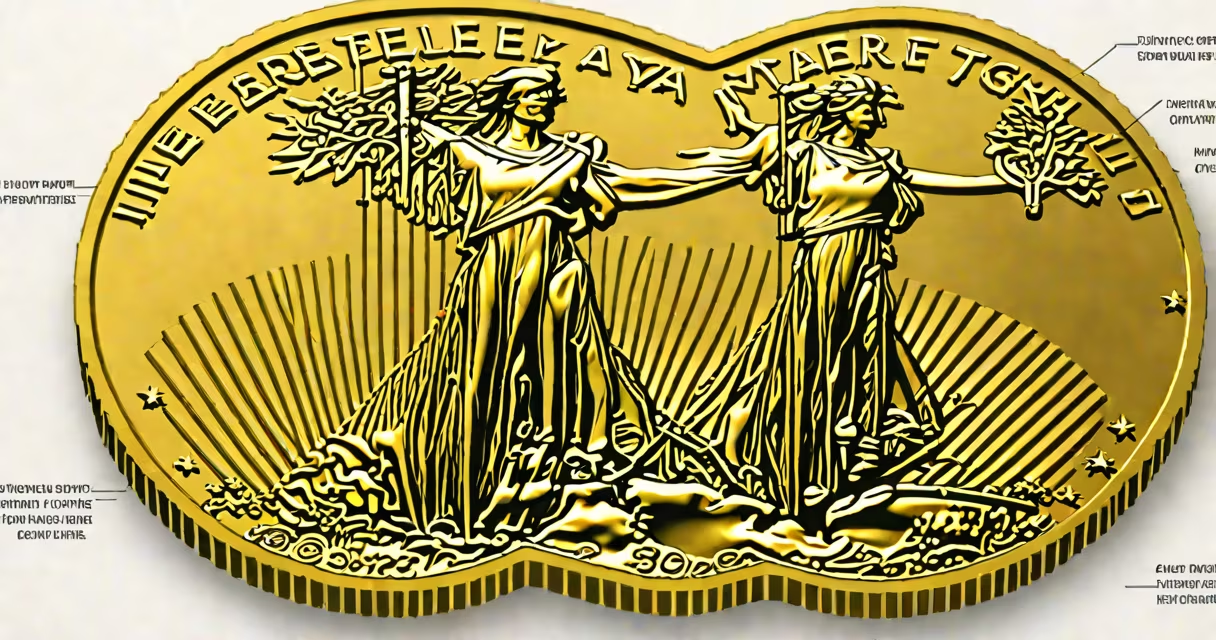
American gold bullion consists of gold products produced by the United States Mint, including 1-ounce American Eagle gold coins and gold bars. These items are officially recognized as legal tender and carry a guaranteed purity of .9999 fine gold. They are among the most trusted physical gold assets worldwide.
The term "bullion" refers to gold in bulk form, typically measured in troy ounces, that meets specific standards for weight, fineness, and authenticity. American gold bullion is distinct because it is issued under U.S. federal authority, backed by the full faith and credit of the United States. This distinguishes it from privately minted gold products or foreign bullion such as Canadian Maple Leafs or South African Krugerrands.
Each American Eagle gold coin bears the official U.S. Mint mark, a unique serial number, and a design featuring Liberty on the obverse and a bald eagle on the reverse. The U.S. government guarantees both the weight and purity of each coin. For example, a 1-ounce American Eagle contains exactly 1 troy ounce of .9999 pure gold and has a face value of $50, though its market value exceeds this by several hundred dollars due to gold's spot price.
When you purchase American gold bullion, you're acquiring a standardized asset with verified weight and purity. The U.S. Mint produces these items through a controlled process involving refining, casting, and minting. Each coin undergoes quality control checks before being released into circulation or sold through authorized dealers.
These products are traded on global markets and are accepted by major financial institutions, central banks, and private investors. Their liquidity stems from consistent specifications and widespread recognition. A 1-ounce American Eagle can be sold in over 100 countries, often at a premium above the daily gold spot price based on supply and demand.
For example, on April 5, 2024, the spot price of gold was $2,310 per troy ounce. An American Eagle coin sold for $2,375, reflecting a $65 premium. This premium covers production costs, dealer markup, and market demand. Over time, premiums fluctuate-sometimes dropping below $10 during high-volume trading periods.
There are two primary forms of American gold bullion: coins and bars. Coins are issued in denominations of 1/10, 1/4, 1/2, and 1 ounce. Bars are available in 1-ounce, 10-ounce, and 1-kilo sizes. All bear the U.S. Mint's sign and a certificate of authenticity.
| Type | Weight | Purity | Face Value | Common Premium (2024) |
|---|---|---|---|---|
| 1 oz American Eagle Coin | 1 troy ounce | 99.99% | $50 | $60-$75 |
| 1 oz Gold Bar (U.S. Mint) | 1 troy ounce | 99.99% | N/A | $55-$70 |
| 10 oz Gold Bar | 10 troy ounces | 99.99% | N/A | $500-$600 |
Bars are often preferred by institutional buyers due to lower per-ounce premiums and higher weight efficiency. Coins remain popular among retail investors for their portability, collectibility, and ease of resale. The U.S. Mint also issues limited-edition proof versions with enhanced finishes, which command higher premiums due to scarcity and craftsmanship.
Investors use American gold bullion as a hedge against inflation, currency devaluation, and geopolitical instability. During periods of economic uncertainty-such as the 2008 financial crisis or the 2020 pandemic-gold prices surged. In 2020, gold rose 25% year-over-year, outperforming stocks and bonds.
Central banks hold American gold bullion as part of their reserves. The Federal Reserve does not publicly disclose holdings of American Eagles, but the U.S. Treasury reports that it maintains gold reserves valued at over $100 billion. These reserves include both domestic and foreign gold assets, with American Eagles forming a portion of the U.S. government's strategic gold inventory.
Individuals buy American gold bullion for portfolio diversification. According to the World Gold Council, gold accounts for 10-15% of average investor portfolios in stable economies. In emerging markets, this share can exceed 20%. The U.S. Mint's gold products are particularly favored in the U.S. and Canada due to trust in U.S. government backing.
Many confuse American gold bullion with generic "gold bullion." Not all gold bullion is American. Private mints produce bullion in various weights and purities, but only U.S.-issued products qualify as American gold bullion. The term specifically denotes U.S. government authorization.
Another misconception is that American gold bullion is purely a collectible. While some coins have numismatic value-especially older or rare editions-the core function of American gold bullion is as a store of value. A 2023 study by the University of Pennsylvania's Wharton School found that 87% of American Eagle holders intended to use the gold as long-term savings, not for resale or display.
It is also incorrect to assume that all U.S. gold coins are bullion. The American Eagle series is bullion-grade, but the U.S. Mint also produces commemorative coins like the Presidential dollar series, which are not intended for investment and lack guaranteed gold content.
On a personal note, I once attended a private auction in New York where a 1986 American Eagle coin sold for $3,200-over $800 above the spot price. The buyer cited the coin's historical significance and low mintage. However, the majority of transactions involve standard-issue coins priced close to the spot rate plus a modest premium.