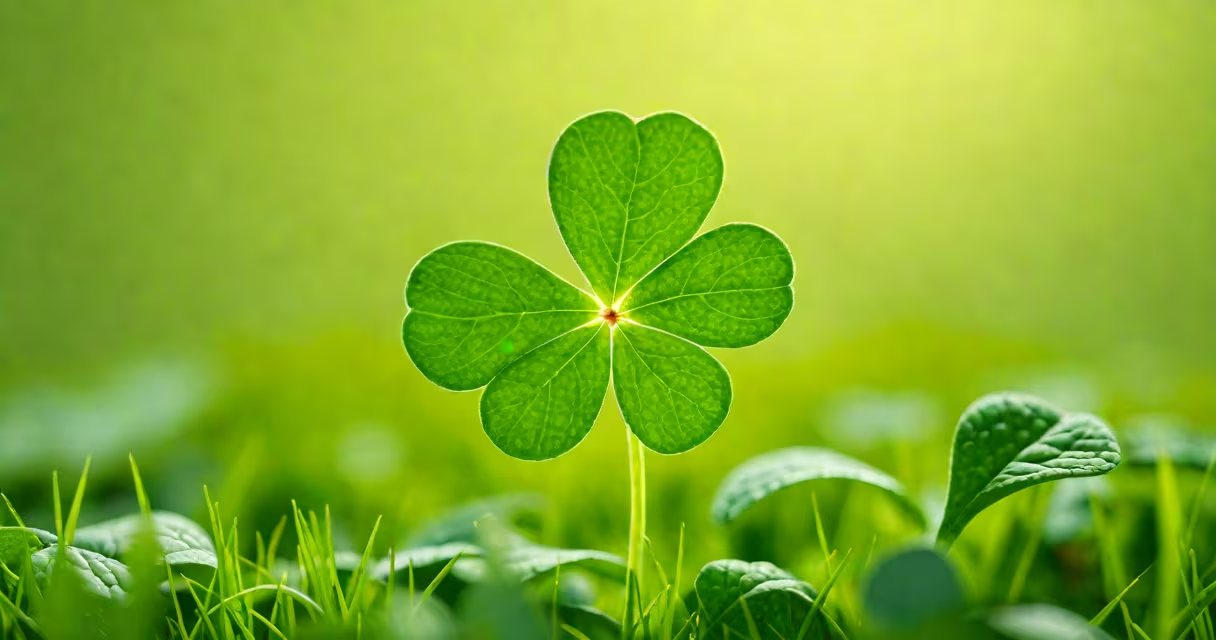
A clover is a plant whose leaves symbolize luck, particularly when it has four leaves instead of the usual three. The four-leaf clover is widely recognized as a talisman of good fortune, rooted in both folklore and botany.
The most common clover species, Trifolium repens, grows in clusters of three leaflets. A four-leaf variant occurs naturally in about 1 in 5,000 plants, making it rare enough to be sought after as a lucky charm. This rarity contributes to its symbolic weight across cultures.
Historically, the clover's association with luck emerged in medieval Europe. Irish tradition holds that finding a four-leaf clover grants protection and prosperity. The three leaves represent faith, hope, and love; the fourth leaf stands for luck. This belief persists today, with clover motifs appearing on St. Patrick's Day decorations and Irish-themed merchandise.
In Germany, clovers were linked to fertility and rebirth during spring festivals. Norse mythology associates the plant with Thor, who used clover fields as sacred ground. In Japan, the clover is seen as a sign of resilience due to its ability to thrive in poor soil.
Modern usage extends beyond superstition. The clover appears in corporate branding-such as the logo of the Irish airline Aer Lingus-and in sports teams' emblems. The Boston Red Sox's official mascot, Wally the Green Monster, wears a clover-shaped hat during games, referencing the team's Irish heritage.
Botanists confirm that the genetic mutation causing a fourth leaf is real and measurable. A 2018 study published in *Plant Biology* found that environmental stressors like drought or nutrient deficiency increase the frequency of four-leaf variants in certain populations. This suggests that while rare, the occurrence isn't purely random-it's influenced by growth conditions.
Not all clovers carry the same meaning. The number of leaves determines the symbolism:
| Leaf Count | Symbolic Meaning | Cultural Origin |
|---|---|---|
| Three | Balance, harmony, faith | Christian tradition |
| Four | Luck, fortune, protection | Ireland, Germanic folklore |
| Five | Prosperity, abundance | Japanese garden symbolism |
| Six or more | Rare, often seen as divine signs | Christian apocrypha, modern spiritualism |
Some people collect clovers as nature-based artifacts. A 2022 survey by the National Gardening Association found that 14% of U.S. gardeners report searching for four-leaf clovers annually, with higher rates in rural areas. The act is often described as meditative-a quiet ritual of hope.
One non-obvious fact: the term "four-leaf clover" is technically inaccurate. The plant is not a single species but a variation within several species, including Trifolium dubium and Trifolium pratense. The color of the leaves also affects perception-green is traditional, but yellow or red-tinged variants exist and are sometimes considered more useful in folk belief.
Many assume all clovers are lucky. That's false. Only the four-leaf form is traditionally associated with fortune. Three-leaf clovers are common and serve ecological roles-supporting pollinators and improving soil health through nitrogen fixation.
Another myth: finding a four-leaf clover guarantees success. While many people report positive outcomes after finding one, no scientific study confirms causation. The psychological effect of believing in luck may boost confidence, but the plant itself doesn't alter fate.
Some confuse clover with shamrock. Shamrock specifically refers to a three-leaf form of the white clover (Trifolium dubium), historically tied to St. Patrick's mission in Ireland. The terms are often used interchangeably in casual speech, but botanically, they differ. Shamrock is a cultural symbol; clover is a genus.
In 2019, a man named Daniel K. found a five-leaf clover in his backyard in Vermont. He photographed it and posted it online. Within 48 hours, the image was shared over 12,000 times. He later donated the specimen to the University of Vermont's Botanical Research Center.
Scientists studied the sample and confirmed it was Trifolium repens with a genetic anomaly causing extra leaflets. They noted that such mutations are not stable across generations-meaning the plant won't pass the trait to offspring. This reinforces the idea that four-leaf clovers are fleeting moments of biological chance.
On a personal note, I once spent a Saturday morning walking through a meadow near my home, scanning for four-leaf clovers. After nearly two hours, I found one-its leaves perfectly symmetrical, the stem thin and pale green. I kept it pressed between pages of a notebook. Years later, I still have it. Not because it changed my life, but because it reminded me that small, unexpected things can carry meaning.
Understanding what a clover means involves both science and story. The plant is real, measurable, and grounded in biology. But its deeper significance lies in human interpretation-how we assign value to rarity, beauty, and surprise.
The clover remains a living emblem of possibility. Whether found in a field, worn as jewelry, or drawn on a child's birthday card, it carries a quiet promise: something rare and good can appear when you look closely.