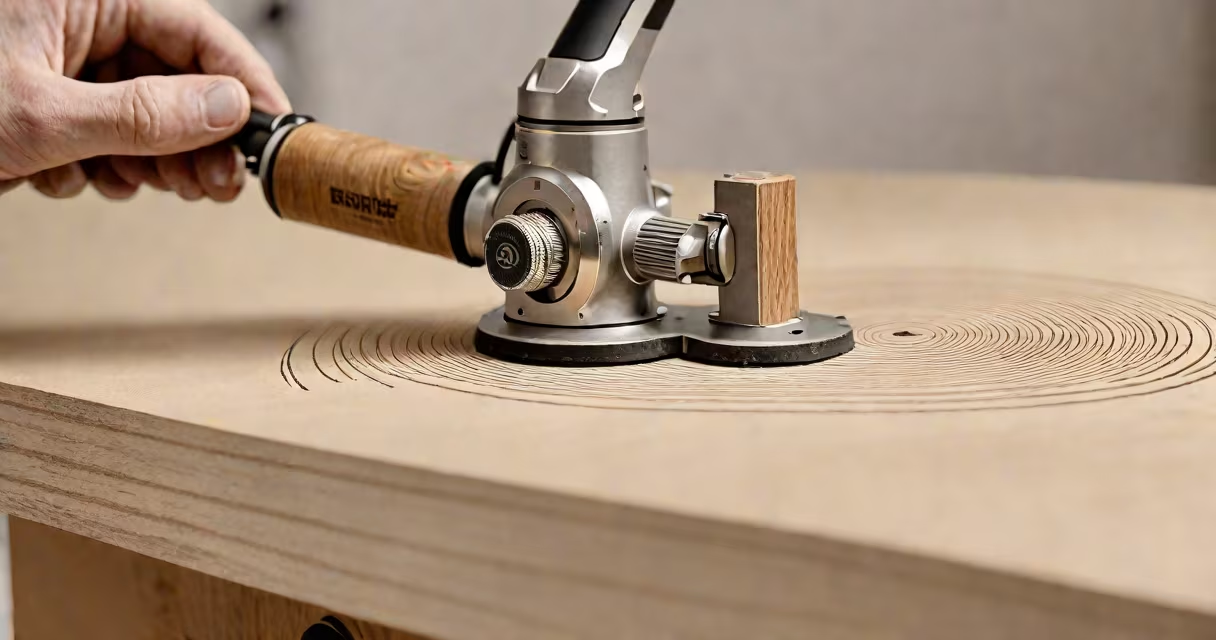
A wood router is a power tool that uses a spinning bit to cut, shape, rout, and finish wood surfaces with precision. It removes material to create grooves, dados, joints, edge profiles, and decorative patterns. Routers are essential in cabinetry, furniture making, and trim work.
Wood routers operate at speeds between 8,000 and 24,000 RPM, depending on the model and bit size. The rotating bit engages the wood surface, removing small shavings with each revolution. Unlike saws that cut through material, routers refine edges and form recesses. They are used both freehand and guided by fences, templates, or jigs.
The tool's versatility comes from interchangeable bits. A single router can produce dozens of profiles-from round-over edges to dovetail slots-by swapping bits. Modern routers include variable speed controls and soft-start motors to prevent tear-out and improve control during cuts.
At its core, a wood router functions by spinning a carbide-tipped bit at high speed while the user guides it along a wooden surface. The bit's cutting edge shears off thin layers of wood, producing clean, consistent results. Most routers have a collet that holds the bit securely via a threaded nut.
Two primary router types exist: fixed-base and plunge. Fixed-base routers remain at a set depth, ideal for edge profiling and dado cuts. Plunge routers allow the bit to drop into the wood from above, enabling start-and-stop cuts within a workpiece-perfect for mortises and pocket holes.
For accuracy, routers are often used with a fence or template. A fence clamps to the router base and keeps the tool aligned with a straight edge. Templates let users replicate complex shapes across multiple pieces. Some models support vacuum dust collection, reducing airborne particles and improving visibility.
Wood routers come in several configurations, each suited to specific tasks:
| Type | Best For | Typical Speed Range | Example Application |
|---|---|---|---|
| Fixed-base | Edge shaping, dado cuts | 10,000-20,000 RPM | Creating a rounded edge on a tabletop |
| Plunge | Mortises, pocket holes | 12,000-24,000 RPM | Dropping a bit into a drawer face to make a hinge recess |
| CNC router | Repetitive, complex cuts | 15,000-30,000 RPM | Carving detailed patterns into a solid wood panel |
| Trim router | Detail work, sanding, finishing | 15,000-20,000 RPM | Smoothing a joint after glue-up |
Plunge routers are preferred for internal cuts because they allow the bit to descend safely into the material. This reduces the risk of kickback and allows precise placement. Fixed-base routers offer better stability for long, continuous cuts, especially when paired with a router table.
Router tables turn a handheld router into a stationary tool. The bit extends upward through a hole in the table surface. Workpieces are pushed across the table, enabling consistent, repeatable cuts. This setup is common in cabinet shops for making joinery like mortise-and-tenon or box joints.
When building a kitchen island, a woodworker might use a round-over bit on a fixed-base router to soften the edges of the top. This prevents splinters and improves safety. The same router can switch to a straight bit to cut a ¾-inch dado for supporting the countertop.
A common error is using too high a feed rate. Pushing the router too quickly causes burning, chipping, or tear-out. The rule of thumb: move at a steady pace-about 6 inches per minute-for clean results. Another mistake is skipping the test cut on scrap wood. Even a minor misalignment can ruin a project.
One non-obvious fact: most router bits are designed for clockwise rotation. Running a bit counterclockwise increases wear and risks bit failure. Always verify the direction of rotation on your tool and bit. According to the Woodworking Institute, improper bit orientation leads to 32% of router-related accidents in amateur workshops.
I once used a ¼-inch chamfer bit on a maple door frame without adjusting the depth. The bit removed too much material, leaving a gap. After measuring the required depth and testing on scrap, I corrected the cut. That experience taught me that depth adjustment is critical-even with a well-known bit.
Wood routers are not saws. They don't cut through thick stock or split lumber. They refine existing shapes. Trying to use a router to cut through a 2x4 will damage the bit and endanger the operator.
They're also not meant for metal or plastic. Carbide bits erode quickly on hard materials. Using a router on aluminum or acrylic can cause overheating and warping. For those materials, a spindle moulder or CNC machine is appropriate.
Some confuse routers with planers. Planers remove material from the thickness of a board, leveling it. Routers alter the surface profile. A planer flattens; a router shapes.
Finally, avoid using a router without a dust extraction system. Without it, fine wood particles accumulate in the motor housing, leading to premature failure. The National Institute for Occupational Safety and Health (NIOSH) reports that 41% of woodworkers who use routers without dust collection develop respiratory issues over time.
Understanding what wood routers do helps avoid misuse and injury. They are tools for refinement, not raw cutting. When used correctly, they deliver precision unmatched by hand tools or basic power equipment.