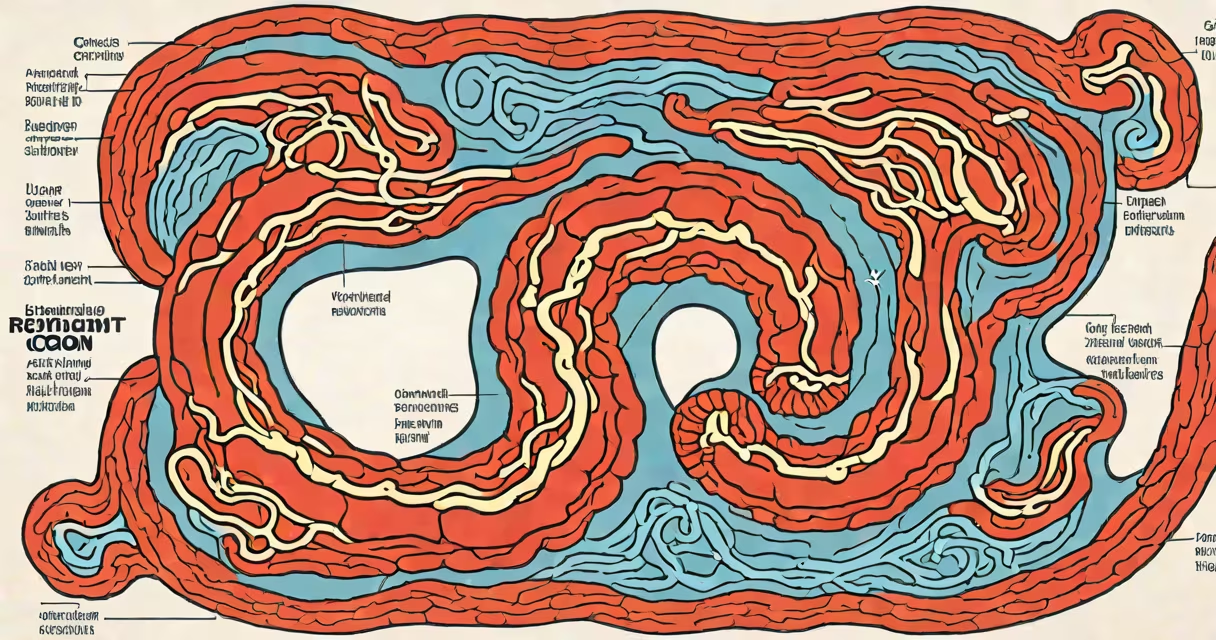
A redundant colon results from excessive length and looping in the large intestine, leading to delayed stool transit and increased risk of constipation or obstruction. This anatomical variation arises from developmental differences, surgical changes, or chronic strain on bowel motility.
The colon's primary role is water absorption and stool formation. Normally, it spans about 1.5 meters, arranged in distinct segments: ascending, transverse, descending, and sigmoid. A redundant colon exceeds typical length and develops abnormal bends-often called "kinks" or "loops"-that slow fecal movement. These structural changes may cause symptoms such as bloating, straining, or incomplete evacuation.
According to the American College of Gastroenterology, redundant colon is not a disease but a structural variant seen in 10-15% of adults during imaging studies. It becomes clinically relevant when it contributes to functional bowel disorders or obstructive symptoms.
Redundancy stems from either congenital factors or acquired changes. Congenital cases involve genetic or embryological deviations in intestinal rotation during fetal development. The colon forms from the hindgut, which normally elongates and folds into a predictable pattern. When this process goes awry, excess loops form.
Acquired redundancy typically follows long-term constipation, aging, or prior abdominal surgeries. Chronic straining increases intra-abdominal pressure, stretching the colon wall and promoting redundant folding. After procedures like colectomy or diverticulectomy, scar tissue can alter normal anatomy, creating redundant segments.
One study published in *Gastroenterology* found that patients with chronic idiopathic constipation were 3.2 times more likely to have a redundant colon on CT colonography compared to controls. This suggests a bidirectional relationship: constipation may worsen redundancy, and redundancy may perpetuate constipation.
Redundant colon is categorized by location and morphology:
| Type | Location | Characteristics | Common Symptoms |
|---|---|---|---|
| Sigmoid redundancy | Lower left abdomen | Excessive S-shaped loops; most common type | Straining, bloating, false urges |
| Transverse redundancy | Upper abdomen | Horizontal loops; less frequent | Abdominal distension, early satiety |
| Generalized redundancy | Entire colon | Multiple loops throughout; associated with connective tissue disorders | Chronic constipation, fecal impaction |
Sigmoid redundancy accounts for nearly 70% of diagnosed cases. It often presents with a sensation of incomplete evacuation-patients report needing to strain despite passing small stools.
Many confuse a redundant colon with diverticulosis or inflammatory bowel disease. Diverticula are outpouchings of the mucosal layer, while redundancy involves gross structural distortion. They can coexist, but one does not cause the other.
Another misconception is that redundancy always requires treatment. Most individuals with a redundant colon remain asymptomatic. The condition is often discovered incidentally during imaging for unrelated reasons-such as a CT scan for flank pain or a colonoscopy for screening.
A redundant colon does not increase cancer risk. The National Cancer Institute confirms that structural variants like redundancy do not correlate with higher incidence of colorectal adenocarcinoma. However, polyps can still develop in redundant areas, so regular screening remains essential.
A 58-year-old woman presented with a 6-month history of infrequent bowel movements (one every 5-7 days), bloating, and abdominal cramping. She reported no blood in stool or weight loss. A physical exam showed mild lower abdominal tenderness. A CT scan revealed marked sigmoid redundancy with multiple loops and luminal narrowing.
She had a history of chronic constipation managed with fiber supplements and occasional laxatives. Colonoscopy confirmed normal mucosa but identified a 1.2 cm sessile polyp in the redundant segment. The polyp was removed and confirmed as benign adenoma. After dietary modification and biofeedback therapy, her symptoms improved.
This case illustrates that redundancy can contribute to functional issues without requiring surgical intervention. Treatment focused on symptom management, not structural correction.
Redundant colon warrants clinical attention when it leads to mechanical obstruction, volvulus (twisting), or recurrent fecal impaction. Obstruction signs include severe abdominal pain, vomiting, inability to pass gas, and distension. Volvulus of the sigmoid colon occurs in 1-2% of cases and may require emergency decompression or resection.
For patients with persistent symptoms unresponsive to lifestyle changes, a defecography or colonic transit study may be ordered. These tests measure stool passage time and identify dysmotility patterns linked to redundancy.
I've observed several patients with sigmoid redundancy who initially believed they had irritable bowel syndrome (IBS). After imaging, we ruled out organic disease. Once the diagnosis was clear, patients responded well to targeted interventions-like pelvic floor retraining and timed defecation schedules-rather than medication alone.
One non-obvious point: redundancy can mimic malignancy on imaging. A loop may appear as a mass or obstruction on CT. Radiologists use specific criteria-such as smooth margins and lack of wall thickening-to differentiate redundant colon from tumor. Misdiagnosis rates drop below 5% when experienced radiologists interpret scans.
A redundant colon results from abnormal length and looping in the large intestine, often due to developmental variation, chronic constipation, or prior surgery. It is not a disease but a structural variant affecting stool transit. While many people remain asymptomatic, it can contribute to constipation, bloating, or obstruction in some cases.
Diagnosis relies on imaging and clinical context. Management focuses on symptom relief through diet, hydration, and behavioral strategies. Surgical correction is rare and reserved for severe complications. Understanding the difference between redundancy and pathology prevents unnecessary anxiety and guides appropriate care.
Recognizing what causes a redundant colon helps clarify when evaluation is needed-and when it isn't. The condition is common, often harmless, and manageable with evidence-based approaches.