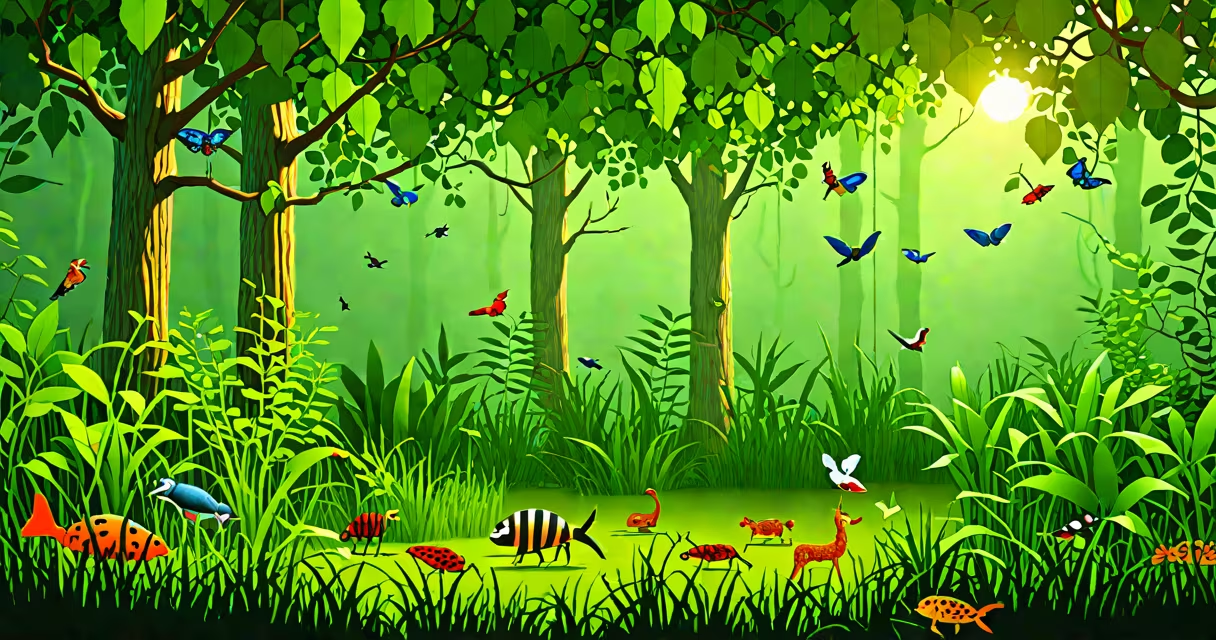
A food chain is a single, linear path of energy transfer from producers to top predators through successive feeding levels. A food web is a network of interconnected food chains that reflects the actual complexity of feeding relationships in an system.
Food chains start with autotrophs-organisms like plants and algae-that produce their own food using sunlight. These form the base of the system. Primary consumers, such as herbivores, eat the producers. Secondary consumers, like insectivorous birds, consume the herbivores. Top predators, such as foxes or eagles, occupy the highest level. Decomposers return nutrients to the soil, completing the cycle.
Food webs go beyond this simplicity. Instead of one path, they show multiple connections. A single organism may feed on several others and be eaten by multiple predators. This interdependence stabilizes ecosystems by distributing energy and reducing the risk of collapse if one species declines.
Energy flows through ecosystems in one direction-from the sun to producers, then through consumers. At each step, about 90% of energy is lost as heat, leaving only 10% available for the next level. This is known as the 10% rule in ecology.
For example, in a grassland system, grass converts solar energy into chemical energy via photosynthesis. Grasshoppers eat the grass. Frogs eat the grasshoppers. Snakes eat the frogs. Hawks eat the snakes. This sequence forms a food chain: grass → grasshopper → frog → snake → hawk.
But in reality, frogs don't eat only grasshoppers. They also consume beetles, worms, and spiders. Snakes may eat frogs, lizards, and small birds. Hawks prey on snakes, rabbits, and birds. These overlapping diets create a food web. Removing one species-say, frogs-disrupts multiple pathways, affecting both predators and prey.
Food chains are typically divided into four to five trophic levels:
| Trophic Level | Example Organism | Role |
|---|---|---|
| Primary Producers | Grass, phytoplankton | Make food from sunlight |
| Primary Consumers | Deer, zooplankton | Eat producers |
| Secondary Consumers | Frogs, small fish | Eat primary consumers |
| Tertiary Consumers | Snakes, large fish | Eat secondary consumers |
| Top Predators | Hawks, sharks | Consume other carnivores |
Food webs are not structured in clean lines. They include omnivores-animals that eat both plants and animals-and scavengers that feed on dead organisms. These roles blur boundaries between levels and increase resilience.
One non-obvious fact: decomposers like fungi and bacteria are often left out of basic food chains but are essential in food webs. They recycle nutrients, making them available again to producers. Without them, ecosystems would run out of usable elements like nitrogen and phosphorus.
Ecologists use food chains and webs to model energy flow, predict population changes, and assess system health. They help identify keystone species-those whose removal causes widespread disruption.
In conservation, understanding these systems prevents unintended consequences. For example, introducing a predator to control pests can backfire if the predator also eats native species. The 19th-century introduction of the cane toad to Australia to control beetles led to the decline of native predators that ate the toxic toads.
Food webs also inform sustainable agriculture. Rotating crops and maintaining biodiversity reduce pest outbreaks by supporting natural enemies. A study in the journal *Nature* found that farms with diverse plant and insect communities had 20% fewer pest infestations than monocultures.
Many assume food chains are accurate representations of nature. But real ecosystems are too complex for a single path. A food chain simplifies reality for teaching purposes. A food web provides a more realistic picture.
Another misconception: energy is recycled. Energy is not recycled-it flows through the system and exits as heat. Nutrients, however, are recycled. This distinction is critical. Carbon, nitrogen, and phosphorus move through biogeochemical cycles, while energy moves unidirectionally.
I once observed this during a field trip to a temperate forest. We mapped feeding interactions among oak trees, caterpillars, robins, and owls. The food chain seemed straightforward: oak leaves → caterpillars → robins → owls. But when we traced the data, we found that robins also ate ants and earthworms, and owls consumed mice and shrews. The web revealed that removing caterpillars wouldn't collapse the system-other food sources existed.
Use food chains to teach basic ecological principles. Use food webs to analyze real-world ecosystems, manage habitats, or evaluate environmental policies.
Consider a freshwater lake. A food chain might be: algae → zooplankton → minnows → bass → herons. But a food web includes: ducks eating zooplankton and seeds, bass eating crayfish and frogs, herons eating bass and turtles. The web shows that a drop in algae affects multiple species, not just one chain.
When studying system dynamics, food webs reveal redundancy and stability. A 2016 study in *Science* analyzed 140 food webs and found that those with higher connectivity were less likely to collapse under stress. This supports the idea that complexity enhances resilience.
Understanding both food chains and food webs helps explain how ecosystems respond to change. Climate shifts, pollution, and habitat loss disrupt feeding patterns. Knowing which species are central to the web allows targeted conservation efforts.