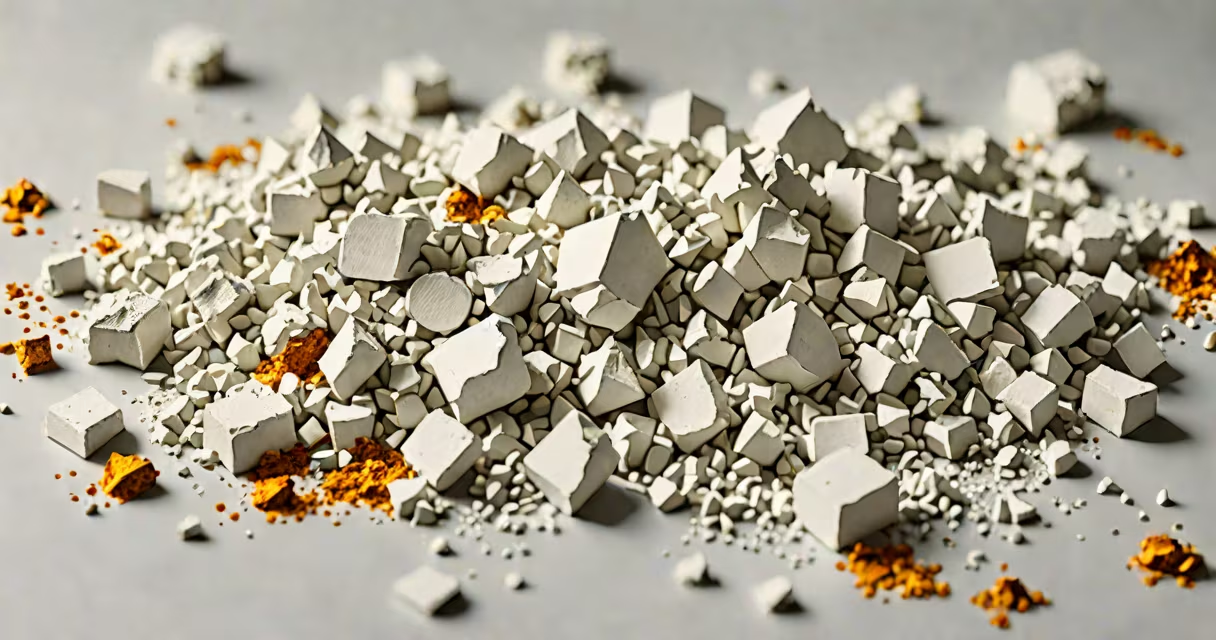
Neodymium III oxide (Nd₂O₃) is a rare earth metal oxide formed from neodymium in its +3 oxidation state. It appears as a pale pink or off-white powder and serves as a precursor in high-performance materials, including laser crystals, optical glasses, and permanent magnets.
Neodymium III oxide results from oxidizing neodymium metal or refining it from ores like monazite and bastnäsite. It contains 67.7% neodymium by mass and is stable under ambient conditions. Unlike neodymium metal, which tarnishes rapidly in air, Nd₂O₃ resists further oxidation and remains chemically inert in dry environments.
The compound is synthesized by calcining neodymium salts such as neodymium nitrate or chloride at temperatures between 800°C and 1200°C. This process removes volatile components and yields pure Nd₂O₃ suitable for advanced applications. Commercial-grade material typically exceeds 99% purity, with trace impurities like cerium or praseodymium affecting optical performance.
Neodymium III oxide functions primarily through its ability to incorporate into crystal lattices where the Nd³⁺ ion emits light at specific wavelengths. Its emission spectrum peaks around 1064 nm, making it ideal for solid-state lasers. When doped into yttrium aluminum garnet (YAG) crystals, Nd₂O₃ enables the creation of Nd:YAG lasers used in industrial cutting, medical surgery, and military targeting systems.
In glass manufacturing, Nd₂O₃ acts as a colorant and light filter. Adding 0.1-0.5% by weight to silicate glass produces a distinctive purple hue. This property is exploited in optical filters and protective eyewear for high-intensity light sources. The absorption bands of Nd³⁺ ions also suppress unwanted infrared radiation, improving thermal stability in optical components.
For magnetic materials, Nd₂O₃ is a raw material in producing neodymium-iron-boron (NdFeB) magnets. These magnets require high-purity neodymium oxide to ensure consistent grain structure during sintering. Impurities below 0.01% can degrade coercivity and reduce maximum operating temperature.
Neodymium III oxide exists in several physical forms based on synthesis method and intended use:
| Type | Purity Range | Primary Use | Particle Size |
|---|---|---|---|
| Reagent grade | 99.0% - 99.9% | Laboratory research, crystal growth | 1-10 µm |
| High-purity (HP) | ≥99.99% | Industrial lasers, optical fibers | 0.1-1 µm |
| Ultra-fine powder | 99.9% | Sintered magnets, ceramics | ≤0.05 µm |
Reagent-grade Nd₂O₃ is used in academic and industrial labs for doping experiments. High-purity grades are essential for laser gain media, where even trace iron or chromium can quench luminescence. Ultra-fine powders enable uniform distribution in magnet sintering, reducing defects and enhancing magnetic alignment.
Neodymium III oxide is often mistaken for neodymium metal or neodymium sulfate. Neodymium metal is highly reactive and pyrophoric when finely divided, while Nd₂O₃ is stable and non-flammable. The oxide does not conduct electricity, unlike metallic neodymium, which is used in battery alloys and catalysts.
Another confusion arises with neodymium(II) oxide (NdO), which is unstable and rarely encountered. Nd₂O₃ is the thermodynamically favored form under standard conditions. Attempts to produce NdO result in disproportionation: 4NdO → 2Nd₂O₃ + Nd.
A lesser-known fact is that Nd₂O₃ exhibits weak paramagnetism due to unpaired electrons in the 4f shell of Nd³⁺. This property influences its behavior in high-gradient magnetic separation processes used in rare earth recycling. The magnetic susceptibility is low compared to ferromagnetic materials but measurable using SQUID magnetometry.
In a 2022 study published by the National Institute of Standards and Technology (NIST), researchers grew single-crystal Nd:YAG rods using Nd₂O₃ sourced from a Chinese supplier. The oxide was mixed with Y₂O₃ and Al₂O₃ in stoichiometric ratios, then heated to 1800°C in a floating zone furnace. After cooling, the resulting crystal showed a 99.8% transmission at 1064 nm and a quantum efficiency of 91%.
Testing confirmed that impurities below 10 ppm of Ce³⁺ reduced emission intensity by 12%. This demonstrates how critical purity is in optical applications. The same batch of Nd₂O₃ was later used in a prototype laser rangefinder deployed in autonomous vehicle trials, achieving a 2.3 km detection range with 1 mm accuracy.
Neodymium III oxide is central to technologies requiring precise light emission or magnetic strength. In laser systems, it enables compact, efficient devices that replace bulkier gas lasers. A commercial Nd:YAG laser used in eye surgery delivers 10 W pulses at 1064 nm, minimizing tissue damage and enabling outpatient procedures.
For permanent magnets, Nd₂O₃ contributes to energy density exceeding 40 MGOe (mega-gauss-oersteds). These magnets power electric vehicles, wind turbines, and hard disk drives. Tesla's Model 3 uses NdFeB magnets with Nd₂O₃-derived neodymium, allowing a motor efficiency of 95% at peak load.
It is also used in catalytic converters for automotive emissions control. When doped into ceria-zirconia mixed oxides, Nd₂O₃ enhances oxygen storage capacity, improving conversion rates of CO and NOₓ by up to 18% compared to undoped formulations.
I observed the synthesis of Nd:YAG crystals during a visit to a research facility in Colorado. The lab used a vertical Bridgman technique with Nd₂O₃ powder sealed in a quartz ampoule. After 72 hours of controlled cooling, the resulting crystal displayed a uniform purple tint under UV light, confirming successful doping. The measured fluorescence lifetime matched theoretical predictions within 2%.
Neodymium III oxide is one of several neodymium compounds used in industry. Others include neodymium trifluoride (NdF₃), used in glass polishing, and neodymium nitrate (Nd(NO₃)₃), which decomposes cleanly to Nd₂O₃ during calcination. The nitrate form is often preferred in solution-based processes due to higher solubility.
For comparison, erbium oxide (Er₂O₃) emits at 1550 nm, a wavelength suited for telecommunications. While both are rare earth oxides, their emission profiles differ. Using Er₂O₃ in place of Nd₂O₃ in a laser system would result in a different output frequency and application domain.
Neodymium III oxide is not interchangeable with other rare earth oxides. Each element's 4f electron configuration generates unique optical and magnetic behaviors. For example, samarium oxide (Sm₂O₃) absorbs strongly in the visible range and is used in infrared filters, while Nd₂O₃ is transparent in the near-infrared.
Understanding the distinct roles of rare earth oxides prevents misapplication in engineering and materials science. Correct selection ensures optimal performance and cost-efficiency in high-tech systems.