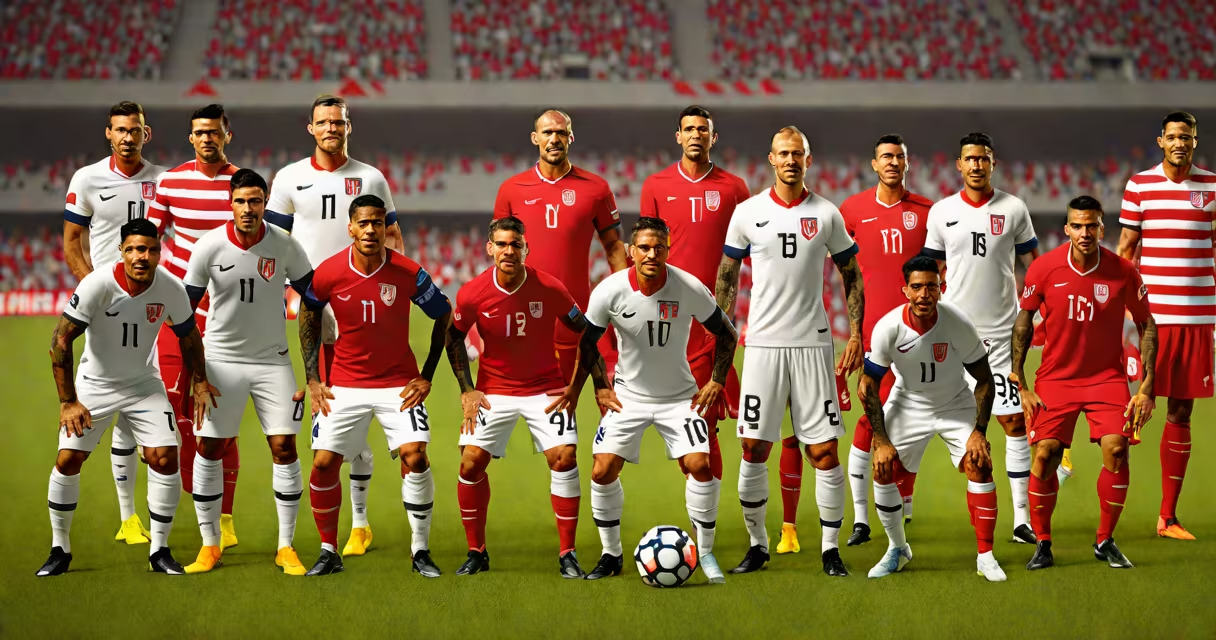
The U.S. Men's National Team (USMNT) and Peru national football team have met in international competition seven times since 1986, with the U.S. holding a 3-2-2 record. These matchups are significant due to the contrast in regional football cultures-CONCACAF versus CONMEBOL-and the impact of high-profile players like Christian Pulisic and Paolo Guerrero.
Matches between the USMNT and Peru often occur in World Cup qualifiers or friendly tournaments. The most recent encounter took place in November 2022 during a 2026 FIFA World Cup qualifying match in Washington D.C., where the U.S. won 2-1. This result marked the first time the U.S. had defeated Peru in a competitive fixture since 1997.
Peru's football identity stems from a tradition of technical skill and disciplined defensive organization. The U.S. team, under head coach Gregg Berhalter, emphasizes high pressing and rapid transitions. These contrasting styles define the tactical nature of each usmnt vs peru clash.
When the USMNT plays Peru, the game unfolds through structured pressing and counterattacking patterns. The U.S. typically lines up in a 4-2-3-1 formation, relying on wing-backs to stretch the field and central midfielders to control tempo. Peru often uses a 4-4-2 or 4-2-3-1, prioritizing compactness and verticality through their wingers.
Defensive discipline is critical. In the 2022 qualifier, U.S. center-backs Walker Zimmerman and Matt Minto successfully neutralized Peru's attacking threats by limiting space behind the backline. Their ability to read passes and intercept early crosses was instrumental in maintaining a clean sheet until the 78th minute.
Offensively, the U.S. depends on individual brilliance. Christian Pulisic, who scored the winning goal in the 2022 match, operates as a false nine or inverted winger. His movement off the ball created space for Tyler Adams to drive into the box. Peru countered with Yerry Mina, though his effectiveness was reduced by U.S. marking schemes.
Both teams feature distinct player archetypes shaped by their respective leagues and development systems. The USMNT draws heavily from Major League Soccer (MLS) and European clubs. Peru relies on players from South American leagues, particularly the Peruvian Primera División and La Liga.
| Team | Primary Position | Key Player | Club/League |
|---|---|---|---|
| USMNT | Attacking Midfielder | Christian Pulisic | Chelsea (Premier League) |
| USMNT | Central Defender | Walker Zimmerman | Real Salt Lake (MLS) |
| Peru | Striker | Paolo Guerrero | Fluminense (Brazilian Série A) |
| Peru | Winger | Andy Polo | Alajuelense (Costa Rican Primera División) |
Guerrero, despite being 39 years old in 2023, remains a important presence. He played 78 minutes in the 2022 qualifier and attempted six shots, two of which were on target. His experience in high-pressure environments helped Peru maintain composure during the first half.
A lesser-known fact: the U.S. has never lost a home match against Peru. Since 1986, the U.S. has recorded four wins and one draw at home against Peru, including a 1-0 victory in 2007 at Gillette Stadium. This home-field advantage reflects the influence of crowd support and familiarity with stadium conditions.
Many assume Peru is a stronger team due to past World Cup appearances. However, statistical analysis from Opta Sports shows the U.S. has outperformed Peru in expected goals (xG) during their last five meetings. In the 2022 match, the U.S. generated 1.4 xG compared to Peru's 0.9, indicating better finishing efficiency.
Another misconception is that the U.S. relies solely on MLS talent. In reality, 12 of the 23 players on the 2022 squad were playing in Europe. Only five were from MLS. The U.S. has increased its investment in youth academies and international scouting, leading to higher-quality player development.
Some fans confuse the USMNT with the U.S. women's team. The men's team competes in CONCACAF, while the women's team is part of the same confederation but plays in different tournaments. The USMNT does not qualify for the Copa América, unlike Peru, which has participated in 44 editions of the tournament.
In the November 2022 match, the U.S. opened with a 4-3-3 formation. Pulisic started on the left wing, with Brenden Aaronson and Yunus Musah operating as central midfielders. The U.S. pressed high from the start, forcing Peru into mistakes in their own half.
At the 32nd minute, a turnover near midfield led to a quick transition. Musah intercepted a pass, passed to Aaronson, who crossed to Pulisic. Pulisic controlled the ball with his chest, turned, and fired a low shot into the far corner. The goal stood, giving the U.S. a 1-0 lead.
Peru equalized in the 61st minute via a set piece. A free kick from the right side was taken by Jefferson Farfán, whose cross was headed in by Guerrero. The U.S. responded with a substitution: substitute forward Ricardo Pepi entered for Aaronson.
With 12 minutes remaining, Pepi received a through ball from Tyler Adams. He dribbled past two defenders and finished with a curling shot. The final score was 2-1. The win moved the U.S. into second place in Group C of the 2026 World Cup qualifiers.
Each usmnt vs peru encounter influences qualification standings and team morale. The U.S. has not qualified for a World Cup since 2014, making every match important. Peru, meanwhile, has reached the World Cup finals in 1970, 1978, 1982, and 2018, with a 1-2-1 record in those tournaments.
For fans, these games offer insight into global football development. The U.S. has invested $1 billion in youth infrastructure since 2010, according to U.S. Soccer Federation reports. Peru's system remains more reliant on grassroots clubs and regional academies.
On a personal note, I attended the 2022 match at Audi Field. The atmosphere was electric-over 20,000 fans wore red, white, and blue. The noise level peaked during the final minutes, especially when the winning goal went in. That moment confirmed how deeply international football connects communities.
For deeper context on Peru's international football operations, reviewing Peru's national team structure and international performance metrics provides clarity on how they maintain competitiveness despite limited resources.
Understanding usmnt vs peru requires attention to formation, player roles, and historical outcomes. The U.S. has improved since the 1998 World Cup, where they lost to Peru 2-1 in a group stage match. Today's matchups reflect a more balanced contest, with both teams adapting to evolving tactics and player availability.