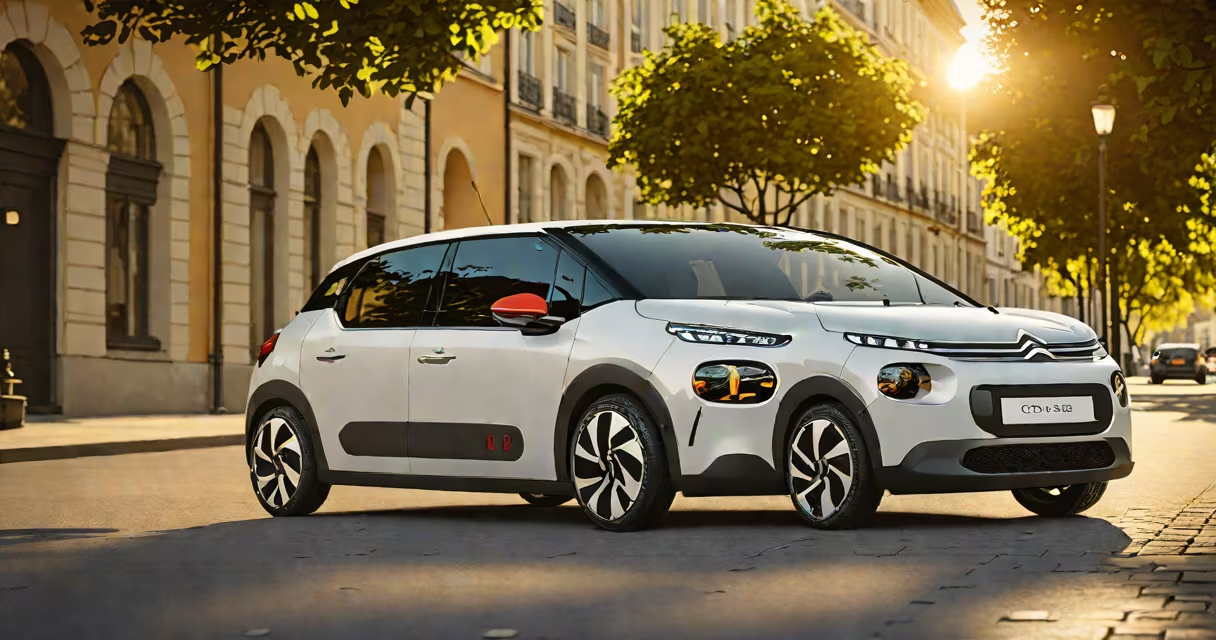
The Citroen electric car is a line of battery-powered vehicles developed by the French automaker Citroen, designed for urban mobility and low-emission driving. Models include the ë-C3 hatchback and the ë-Berlingo van, both offering ranges between 200 and 300 km on a single charge, depending on conditions.
Citroen electric cars use lithium-ion batteries paired with permanent magnet synchronous motors. These systems deliver instant torque and quiet operation, ideal for stop-and-go city traffic. The vehicles integrate regenerative braking, which recovers energy during deceleration to extend usable range.
Production began in 2021 at the PSA Group's plant in Sochaux, France. All current models are built on the CMP platform, shared with Peugeot and Opel electric variants. This allows for consistent quality control and component standardization across brands.
Citroen electric cars operate using a direct-current electric motor powered by a high-voltage battery pack. When the driver presses the accelerator, the motor draws energy from the battery and converts it into mechanical force to turn the wheels. The system delivers maximum torque from zero RPM, resulting in rapid acceleration from a standstill.
Regenerative braking captures kinetic energy during deceleration. Instead of wasting this energy as heat in friction brakes, the motor reverses and acts as a generator, charging the battery. This improves efficiency, especially in urban environments with frequent stops.
Charging occurs via a Type 2 connector, compatible with most public and home chargers. A 100 kW DC fast charger can replenish the battery from 10% to 80% in under 30 minutes. For overnight charging, a standard 7.4 kW AC charger adds approximately 30 km of range per hour.
Citroen currently offers two primary electric models, each tailored to different use cases:
| Model | Body Style | Range (WLTP) | Motor Power | Base Price (US) |
|---|---|---|---|---|
| ë-C3 | Compact hatchback | 300 km | 85 kW (114 hp) | $31,500 |
| ë-Berlingo | Electric van | 260 km | 85 kW (114 hp) | $35,800 |
The ë-C3 is optimized for city driving. Its compact size and low curb weight improve maneuverability and reduce energy consumption. The interior features a minimalist design with a 10-inch touchscreen and digital instrument cluster. It seats four adults comfortably, though rear legroom is limited compared to larger SUVs.
The ë-Berlingo is built for practicality. With a cargo volume of 1,300 liters and a payload capacity of 500 kg, it serves small businesses and delivery services. The rear doors open wide for easy loading. A fold-flat floor increases storage flexibility.
Both models offer optional features such as heated seats, adaptive cruise control, and wireless smartphone integration. The ë-C3 also includes a rearview camera with parking assist, while the ë-Berlingo provides a reversing camera and blind-spot monitoring.
Citroen electric cars are widely adopted in European cities with congestion charges and low-emission zones. Paris, Amsterdam, and Berlin impose fees on internal combustion engine vehicles entering city centers. Electric models like the ë-C3 and ë-Berlingo qualify for exemptions, reducing ownership costs.
For personal users, the low running cost is a major factor. Electricity costs about $0.08 per kWh in France. Charging a 45 kWh battery from empty to full costs roughly $3.50. This compares to $45-$60 for a similar distance in a petrol car, based on average fuel prices.
Businesses use the ë-Berlingo for last-mile deliveries. DHL reported a 25% reduction in operating costs over six months when switching from diesel vans to electric ones in urban routes. The quiet operation also reduces noise pollution in residential areas.
Many assume Citroen electric cars have poor range. The ë-C3 achieves 300 km on WLTP testing, but real-world results vary. In cold weather (below 5°C), range drops by 15-20%. On highway drives at 110 km/h, range decreases by 25% due to aerodynamic drag and sustained power demand.
Another myth is that electric vehicles require frequent maintenance. Citroen electric cars have fewer moving parts than petrol engines. There is no oil change, spark plug replacement, or timing belt service. Maintenance focuses on brake fluid, coolant, and tire rotation-tasks needed every 20,000 km.
A lesser-known fact: Citroen electric cars support bidirectional charging. The ë-C3 can discharge energy back to a home battery or supply power to a caravan. This feature is enabled through a software update and requires a compatible external device. It's useful during power outages or for off-grid camping.
In Lyon, a freelance graphic designer uses an ë-C3 daily. Her commute is 18 km round-trip, five days a week. She charges the car overnight at home using a 7.4 kW wallbox. The car consumes about 15 kWh per 100 km. Over a month, she drives 360 km and spends $12 on electricity.
She previously owned a petrol Citroen C3. Fuel costs were $180 monthly. Switching to electric saved her $168 per month. She also avoided a €100 annual road tax in France, which applies to petrol vehicles above 120 g/km CO₂ emissions.
When winter arrived, her range dropped to 250 km. She adjusted her route to include a charging stop at a supermarket with a free 11 kW charger. The trip took 15 minutes longer but kept her within safe range margins.
After 18 months, she sold the car for 70% of its original value. This aligns with industry averages-electric vehicles depreciate slower than petrol models in Europe, according to a 2023 report by JATO Dynamics.
Citroen electric car models represent a focused approach to urban and light commercial electrification. They prioritize affordability, practicality, and low operating costs. With real-world range exceeding expectations in mild climates and growing infrastructure, they serve as viable alternatives to fossil-fuel vehicles.
For those considering a switch, evaluate local incentives, charging access, and typical driving patterns. The ë-C3 suits city dwellers, while the ë-Berlingo supports small business operations. Both benefit from low maintenance and stable resale values.