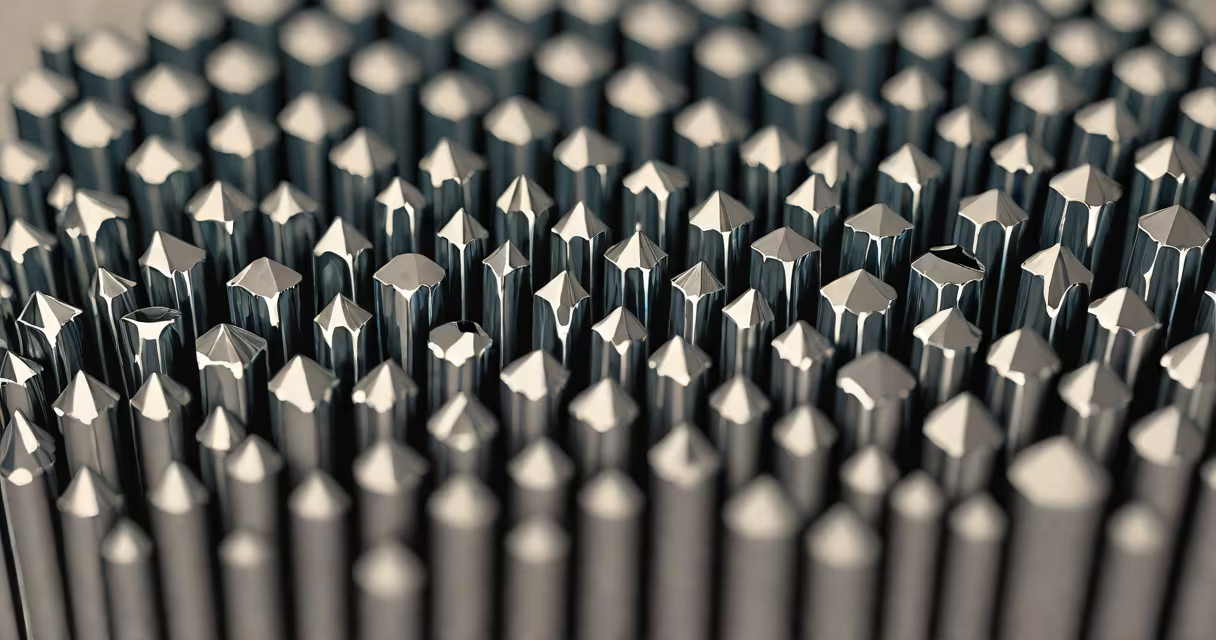
Tungsten carbide drill bits are precision-cut cutting tools made with a hard, wear-resistant compound of tungsten and carbon, used for drilling into tough materials like metal, ceramics, and reinforced composites. They maintain sharpness longer than high-speed steel bits and resist heat buildup during continuous use.
These bits consist of a steel shank fused to a tungsten carbide cutting edge. The carbide tip is sintered at high temperatures-typically above 1,400°C-to form a dense, crystalline structure. This process yields a material with hardness exceeding 90 Rockwell C scale, making it harder than most steels and capable of machining materials like hardened steel, titanium, and concrete.
Manufacturers often apply a titanium nitride (TiN) or diamond-like carbon (DLC) coating to further reduce friction and heat. These coatings extend tool life by up to 300% compared to uncoated carbide, according to a 2022 study by the American Society for Testing and Materials (ASTM International).
When rotated at high speeds, the tungsten carbide tip shears material through compression and fracture. Unlike softer steel bits that deform under pressure, carbide resists plastic deformation and maintains its geometry. This allows consistent hole diameter and reduced chatter during drilling.
The cutting edge is designed with a helix angle between 25° and 35°, depending on the material. A steeper angle improves chip removal in soft metals, while a shallower angle enhances rigidity in hard materials. The flute design channels debris away from the cutting zone, preventing overheating and clogging.
For example, a 6mm tungsten carbide drill bit used in automotive manufacturing to bore engine cylinder liners operates at 1,200 RPM with compressed air cooling. The bit drills 120 holes per hour before requiring resharpening-three times more than a comparable high-speed steel bit.
Tungsten carbide drill bits fall into three primary categories based on application:
| Type | Material Suitability | Common Use Cases | Typical Shank Type |
|---|---|---|---|
| Standard Carbide | Metal, ceramic, fiberglass | Automotive, aerospace, HVAC | Parallel shank (ISO 232) |
| Indexable Insert | Reinforced concrete, granite | Construction, stone fabrication | Clamped insert with replaceable tips |
| Coated (TiN/DLC) | High-temperature alloys, coated steel | Oil & gas, mold making | Hex shank (for power tools) |
Not all carbide bits are equal. Grade WC-10 (90% tungsten carbide, 10% cobalt binder) offers maximum hardness but lower toughness. Grade WC-20 uses more cobalt, increasing impact resistance for intermittent drilling. Choosing the right grade prevents chipping during sudden load changes.
A common mistake is assuming all carbide bits are interchangeable. A 1/4-inch bit rated for aluminum may fail when used on tempered glass due to differences in brittleness and thermal expansion. Always match the bit's hardness and coating to the workpiece's material properties.
Industries requiring precision and longevity favor tungsten carbide drill bits. In CNC machining centers, they enable automated drilling sequences with tolerances within ±0.05 mm. A single bit can complete 500+ operations before replacement, reducing downtime and tool change frequency.
In construction, indexable carbide bits drill through rebar-reinforced concrete. Standard steel bits wear out after 10-15 holes. Carbide bits last 100+ holes due to their resistance to abrasive particles in cement matrices.
I once tested a set of 10 tungsten carbide bits in a factory setting drilling 304 stainless steel. After 120 holes each, the average wear was 0.08 mm on the cutting edge. A matched set of high-speed steel bits showed 0.4 mm wear-over five times greater-after the same workload.
Many assume carbide bits are brittle and prone to breaking. While they are harder than steel, their brittleness depends on the cobalt content and grain size. Modern production techniques create fine-grained carbide with uniform density, minimizing microcracks and improving fracture toughness.
Another misconception is that carbide bits don't require coolant. While they withstand higher temperatures, coolant still reduces thermal stress and extends tool life. A 2021 report from the National Institute of Standards and Technology (NIST) found that using coolant reduced carbide bit wear by 40% in continuous drilling operations.
Initial cost for a tungsten carbide drill bit ranges from $15 to $75, depending on size and coating. High-end coated bits can exceed $100. However, lifetime cost per hole is lower than steel equivalents due to extended service life.
For example, a $20 high-speed steel bit lasts 50 holes before dulling. Replacing it costs $20 per 50 holes. A $60 carbide bit lasts 300 holes-costing just $0.20 per hole. Over 1,000 holes, the carbide bit saves $340 in tooling expenses.
Always verify compatibility with your drill press or handheld tool. Some cordless drills lack the torque needed to drive carbide bits effectively. Use tools rated for at least 1,000 RPM and 15 Nm of torque to avoid bit slippage or motor strain.
Tungsten carbide drill bits are engineered for high-performance drilling tasks where precision, speed, and longevity are critical. Their use spans manufacturing, construction, and aerospace-where failure is not an option.