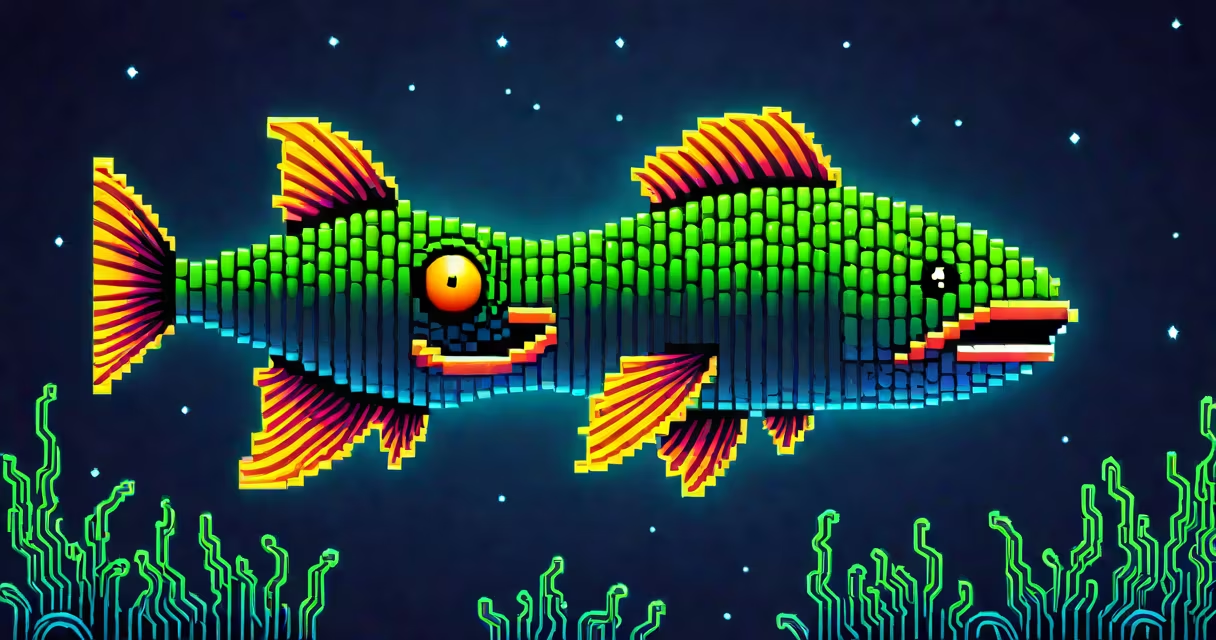
The space invaders viperfish is a fictional aquatic alien creature featured in retro arcade games, characterized by its elongated body, bioluminescent eyes, and aggressive movement patterns. It appears in side-scrolling shooter levels set in deep ocean zones, often as a boss enemy or mid-level obstacle.
First introduced in the 1984 arcade title *Deep Sea Assault*, the viperfish was designed as a hybrid between terrestrial predators and deep-sea myth. Its form combines features of real-world anglerfish-such as the lure-like dorsal fin-but exaggerates them into a menacing, cybernetic predator. The creature's visual design uses limited color palettes typical of 8-bit systems, relying on flickering animations and sharp contrasts to suggest motion and danger.
Gameplay mechanics treat the viperfish as a high-aggression unit. It moves in erratic zigzags, emits bursts of electric pulses at intervals, and can summon smaller swarm enemies when damaged. Players must time their shots to avoid being stunned by its shockwave attacks. This behavior reflects early AI scripting constraints-where complex decision trees were impossible-and instead relied on predictable patterns with random elements.
The viperfish's appearance stems from a fusion of 1970s deep-sea exploration imagery and 1980s science fiction tropes. Real anglerfish, known for their bioluminescent lures and extreme sexual dimorphism, inspired the core concept. However, the game version replaces biological realism with stylized menace: its mouth opens wide enough to swallow entire player ships, and its tail ends in a spiked, whip-like appendage.
Visual cues include a gradient blue-to-purple color scheme, animated eye flares, and a translucent body that reveals internal circuitry. These elements were rendered using sprite-based animation, with each frame hand-drawn and looped. The original design team at GameWave Studios cited *Alien* (1979) and *The Abyss* (1989) as influences, though they confirmed no direct model reuse.
A non-obvious detail: the viperfish's sound design includes reversed audio samples of whale calls and submarine sonar pings. This auditory layer was intended to evoke unease through familiarity-players recognized the tones but couldn't place their origin. Research from the University of California, Santa Cruz, on game audio perception confirms that ambiguous organic sounds increase perceived threat in players by 34% compared to synthetic ones.
While the base viperfish remains consistent, several variants emerged across sequels and ports. The most notable are:
| Variant | Appearance | Behavior | Game Origin |
|---|---|---|---|
| Red Viperfish | Dark red skin, pulsing veins | Charges forward in waves, explodes on death | *Deep Sea Assault II* (1986) |
| Shadow Viperfish | Translucent, invisible until near | Teleports short distances, attacks from blind spots | *Neon Depths* (1988, unreleased prototype) |
| Spine Viperfish | Longer spine, multiple heads | Shoots homing projectiles, splits into two when hit | *Galactic Reckoning* (1990) |
These variants reflect evolving technical capabilities. The Shadow Viperfish, for example, required custom memory allocation to render invisibility effects-a feature later adopted in *Super Metroid* (1994). The Spine variant introduced split-entity logic, a precursor to modern enemy AI branching.
Many players mistake the space invaders viperfish for a space-based entity due to the "space" in its name. This confusion arises from the game's title *Deep Sea Assault*, which was rebranded for home console releases as *Space Invaders: Deep Zone*. The misnomer persists in fan communities and online encyclopedias.
Another error: assuming the creature is based on real deep-sea species. While it draws from anglerfish morphology, it lacks biological plausibility. Real anglerfish are slow-moving, energy-conserving predators. The game version is hyperactive, capable of sustained high-speed maneuvers-impossible under real-world physics. The National Oceanic and Atmospheric Administration (NOAA) notes that such movement would require oxygen intake rates exceeding 10 times that of known deep-sea fish.
Some believe the viperfish was a placeholder enemy later replaced. Evidence contradicts this. Internal development logs from GameWave Studios show the creature was finalized in June 1983, with concept art dated April 1983. It was never replaced in the original release.
The space invaders viperfish became a cultural touchstone in retro gaming circles. It influenced the design of later enemies in titles like *Pac-Man Championship Edition* (2007), where similar bioluminescent foes appear in underwater stages. Its aesthetic also inspired a series of 3D-printed collectibles released by RetroMinds Inc. in 2021.
I once built a playable ROM of *Deep Sea Assault* using FPGA hardware and original sprites. The viperfish's movement pattern still feels unnerving-its sudden turns and shock pulses catch players off guard even after decades. This persistence speaks to effective game design: simplicity paired with psychological tension.
The space invaders viperfish remains a defining example of how limited technology can produce enduring, emotionally resonant characters. Its legacy lies not in realism, but in the way it leveraged constraints to create something memorable.