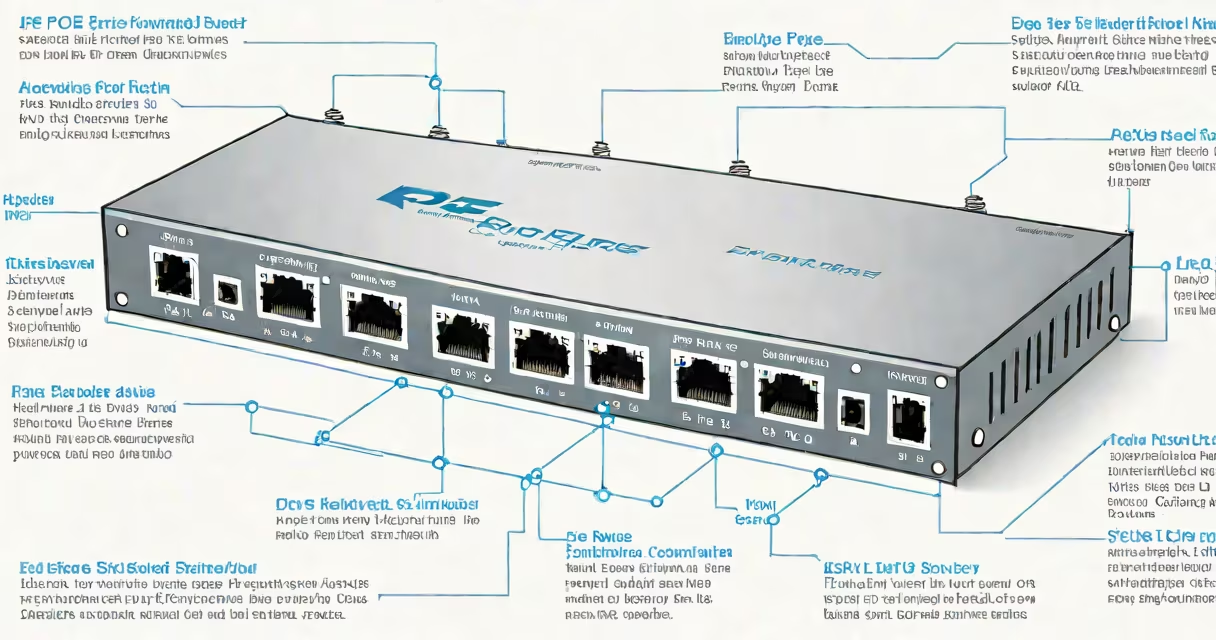
A small PoE powered switch is a compact networking device that supplies electrical power and transmits data over a single Ethernet cable to connected devices such as IP cameras, VoIP phones, and wireless access points. It supports IEEE 802.3af or 802.3at standards, enabling plug-and-play setup without external power sources.
These switches integrate a power injector function into a single unit. They draw power from a wall outlet via a standard AC adapter and distribute it through Ethernet ports to compliant devices. This eliminates the need for separate power cables and outlets near each device, reducing clutter and installation complexity.
Small PoE powered switches typically have between 4 and 8 ports. They are designed for low-to-mid-density environments like home offices, small retail stores, or branch offices. Their size and quiet operation make them suitable for placement in close proximity to users.
The switch uses Power over Ethernet (PoE) technology to deliver up to 15.4 watts per port under IEEE 802.3af, or up to 30 watts under 802.3at. Devices negotiate power requirements during the initial handshake. If a device draws more than the switch's total budget, the switch may limit or deny power to prevent overload.
When a PoE-enabled device connects, the switch performs a signature detection phase. It checks whether the device supports PoE and identifies its power class. Once verified, the switch applies voltage (48V DC) through the spare pairs in a Cat5e or higher cable. Data transmission occurs simultaneously on the same wires.
For example, a single 8-port PoE switch rated at 60 watts can power four IP security cameras (each drawing 12 watts) and two VoIP phones (each using 5 watts), totaling 58 watts. The remaining 2 watts are reserved for system overhead and future expansion.
Two primary PoE standards define performance levels:
| Standard | Max Power Per Port | Use Cases | Common Devices |
|---|---|---|---|
| IEEE 802.3af (PoE) | 15.4 W | Basic VoIP phones, entry-level IP cameras | Yealink SIP phones, Reolink Argus 3 |
| IEEE 802.3at (PoE+) | 30 W | High-resolution cameras, dual-band Wi-Fi access points | Arlo Pro 4, Ubiquiti UniFi AP |
Some models support both standards. A switch labeled "PoE+" can deliver up to 30W per port and backward-compatible 15.4W. Always verify device compatibility with the switch's specification sheet.
Switches are also categorized by management capability. Unmanaged units require no configuration-they simply plug in and work. Managed switches offer VLANs, port mirroring, and QoS settings, though they're less common in small form factors due to cost and complexity.
Small PoE powered switches are ideal for environments where wiring is limited or costly. A retail store installing five surveillance cameras without dedicated electrical outlets can use a single 8-port PoE switch mounted behind the counter. Each camera connects via a single Ethernet cable, eliminating the need for extension cords or junction boxes.
They simplify remote site deployments. A warehouse manager can install a PoE switch near a ceiling-mounted access point, powering both the AP and its antenna. The switch is plugged into a nearby wall socket, and the AP is connected via a single cable run through the ceiling.
Home users benefit from centralized control. A smart home hub, doorbell camera, and indoor security sensor can all be powered and managed from one switch. This reduces the number of wall adapters and avoids circuit overloads.
One limitation: PoE switches cannot supply power beyond 100 meters using standard Ethernet cabling. For longer runs, a powered patch panel or midspan injector is required.
Many assume that any Ethernet cable can carry PoE. This is false. Only Cat5e or higher cables support PoE reliably. Using Cat5 or lower can result in signal degradation, overheating, or failure to deliver sufficient power.
Another misconception is that PoE switches can power high-wattage devices like desktop computers or monitors. These devices often exceed 30W and require dedicated power supplies. Attempting to connect them to a PoE switch risks damaging the switch or the device.
Some users believe that PoE switches consume more electricity than regular switches. In reality, a typical 8-port PoE switch draws 30-40 watts under load. A comparable unmanaged switch uses 10-15 watts. The difference is modest and justified by the convenience of integrated power delivery.
I once installed a 4-port PoE switch in a small café to power two IP cameras and a wireless access point. The switch was placed under the counter, hidden from view. All devices came online within seconds. No additional power outlets were needed. The setup remained stable for over 18 months with zero failures.
Unlike traditional switches, which only transmit data, PoE switches combine power delivery and network routing. They differ from midspan injectors, which add PoE to existing non-PoE switches. Midspans are bulkier and require two cables per device-one for data, one for power-while PoE switches consolidate both into one.
Compared to enterprise-grade switches, small PoE powered switches lack advanced features like stacking, SNMP monitoring, or redundant power supplies. However, they are more affordable and easier to deploy. For example, a managed Aruba PoE switch costs $250+, while a basic 8-port PoE switch ranges from $40 to $80.
When choosing between a small PoE switch and a high PoE switch, consider power demands. High PoE switches support up to 60W per port and are used in large-scale deployments like stadiums or airports. Small PoE switches are better suited for environments with fewer than 10 powered devices.
Always match the switch's total power budget to the sum of connected devices. Overloading leads to automatic shutdowns or hardware damage. Check manufacturer documentation for maximum wattage per port and total system capacity.
Small PoE powered switches reduce infrastructure complexity. They enable rapid deployment of networked devices without rewiring or hiring electricians. Their reliability, low maintenance, and ease of use make them essential in modern small networks.