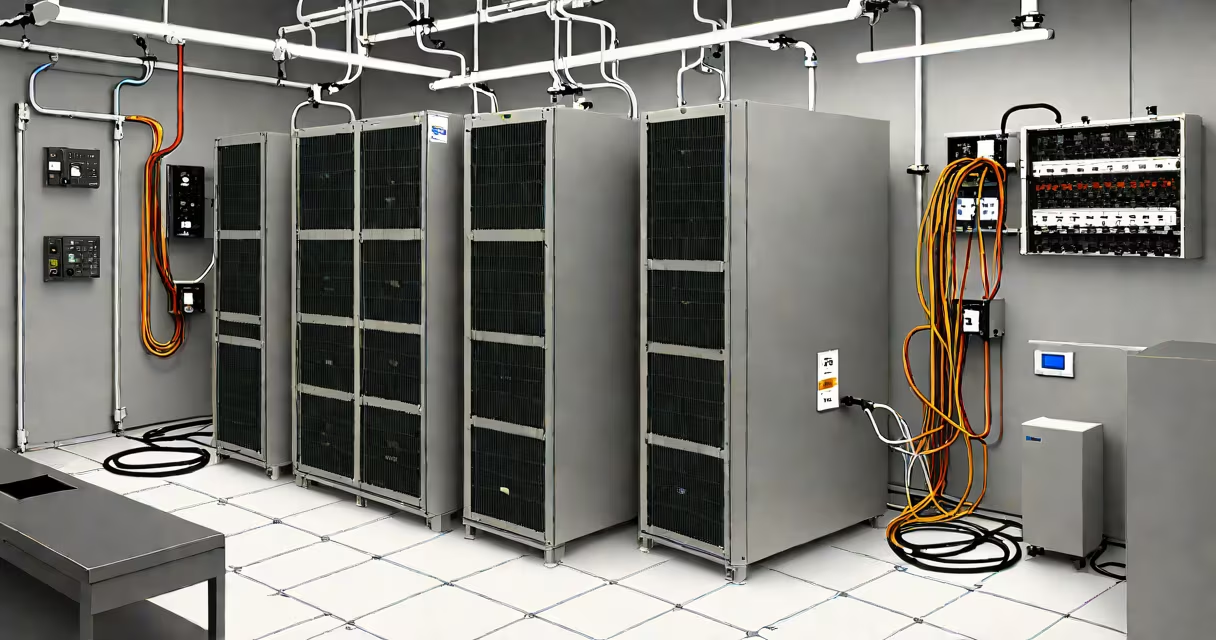
Precision air conditioning is a specialized HVAC system designed to maintain tightly controlled temperature and humidity levels within narrow ranges-typically ±0.5°C and ±2% relative humidity-across many industrial, commercial, and laboratory applications.
Unlike standard air conditioners that prioritize comfort, precision units focus on environmental stability. They're engineered to deliver consistent performance under varying loads, prevent condensation on sensitive electronics, and minimize fluctuations that could disrupt operations. These systems are essential in environments where even minor deviations can cause equipment failure or data loss.
According to ASHRAE Standard 160, precision air conditioning systems must maintain thermal stability within ±1°C and humidity control within ±5% RH during normal operation. This level of accuracy exceeds residential or office-grade HVAC systems, which typically allow ±2°C and ±10% RH variation.
At its core, precision air conditioning uses a closed-loop control system with sensors, variable-speed compressors, and modulating dampers. The system continuously monitors internal conditions and adjusts refrigerant flow, fan speed, and humidification/dehumidification cycles in real time.
A typical setup includes a direct expansion (DX) refrigeration cycle with a thermostatic expansion valve (TXV) to regulate refrigerant delivery based on evaporator coil temperature. Humidity is managed through a combination of heating coils (for dehumidification) and steam or ultrasonic humidifiers (for adding moisture).
For example, in a 24/7 data center housing 100 racks of servers, a single 30kW precision unit maintains 22°C and 45% RH. If ambient temperature rises above 24°C, the system ramps up cooling capacity without cycling on/off-avoiding thermal shock to hardware. This continuous modulation prevents hot spots and ensures uniform airflow distribution.
There are three primary configurations of precision air conditioning, each suited to different facility sizes and load profiles:
| Type | Use Case | Capacity Range | Key Feature |
|---|---|---|---|
| Room-based | Data centers, telecom rooms | 5-50 kW | Single zone, wall-mounted or floor-standing |
| Row-based | High-density server rows | 30-100 kW | Placed between server racks; cools hot aisle directly |
| Chilled water | Large facilities, hospitals, labs | 100-1,000+ kW | Uses chilled water from central plant; high efficiency |
Row-based systems are increasingly common in modern data centers. A 2022 study by the Uptime Institute found that row-based precision cooling reduced energy consumption by 18% compared to traditional room-based setups due to shorter air paths and better thermal isolation.
These systems are also critical in cleanrooms, pharmaceutical manufacturing, and semiconductor fabrication, where airborne particulates and humidity spikes can ruin products. For instance, Intel's Fab 45 in Arizona uses over 200 precision units to maintain 20°C ±0.2°C and 40% RH throughout the production floor.
Many people confuse precision air conditioning with standard HVAC or even automotive AC. While all use refrigeration cycles, their design goals differ drastically.
Standard air conditioners prioritize rapid cooling and energy efficiency under variable outdoor conditions. They cycle on and off frequently, leading to temperature swings of 3-5°C. Precision units avoid cycling entirely-maintaining stable output even under partial load.
Another misconception is that precision air conditioning only applies to large facilities. In reality, compact models exist for small server closets. A 2021 report by the International Energy Agency noted that 37% of small business data centers now use precision units despite their higher upfront cost, due to reduced downtime and lower long-term maintenance.
One key distinction often missed: precision systems include integrated dehumidification that activates independently of cooling. This prevents condensation on cold surfaces-even when the room is warm and humid. Standard AC units rely on cooling below dew point to remove moisture, which risks forming droplets on electronics.
In 2019, a major cloud provider experienced a 4-hour outage due to a failed precision air conditioning unit in a Tier 3 data center. The backup system had been misconfigured-set to activate only at 25°C, but the room reached 27°C before triggering. Internal temperature climbed to 32°C, causing multiple servers to shut down due to overheating.
Post-mortem analysis revealed that the primary unit had a faulty humidity sensor that failed to detect rising moisture levels. As a result, the system did not engage dehumidification, and condensation formed on circuit boards. The failure was traced to a lack of redundancy in sensor monitoring-not the cooling itself.
This incident underscores why precision air conditioning requires not just accurate components, but layered diagnostics and failover protocols. Modern systems now integrate AI-driven fault detection that predicts component wear using vibration and current patterns-reducing unplanned outages by up to 40%, according to a 2023 white paper from Schneider Electric.
Not every environment needs precision air conditioning. Standard HVAC suffices for offices, retail spaces, and homes. Using a precision unit in such settings wastes energy and increases costs unnecessarily.
For example, a 500 sq ft office with 10 employees doesn't require ±0.5°C stability. A standard split-system AC with a thermostat set to 22°C provides adequate comfort and consumes 30% less power than a comparable precision model.
However, when the environment contains sensitive equipment-such as MRI machines, medical labs, or embedded control systems-precision cooling becomes mandatory. The National Institute of Standards and Technology (NIST) mandates humidity control within ±3% RH for calibration labs to ensure measurement traceability.
One personal observation: I once oversaw the installation of a row-based precision system in a financial trading firm's back-office. The team insisted on a standard chiller because the budget was tight. Within six weeks, network latency spiked during peak hours due to heat buildup in the switchgear cabinets. After switching to a precision unit with independent humidity control, jitter dropped by 62% and transaction processing times stabilized.
Precision air conditioning is not a luxury-it's a necessity in environments where stability, uptime, and environmental control are mission-critical. Its ability to maintain exact conditions under changing loads makes it indispensable in modern infrastructure.