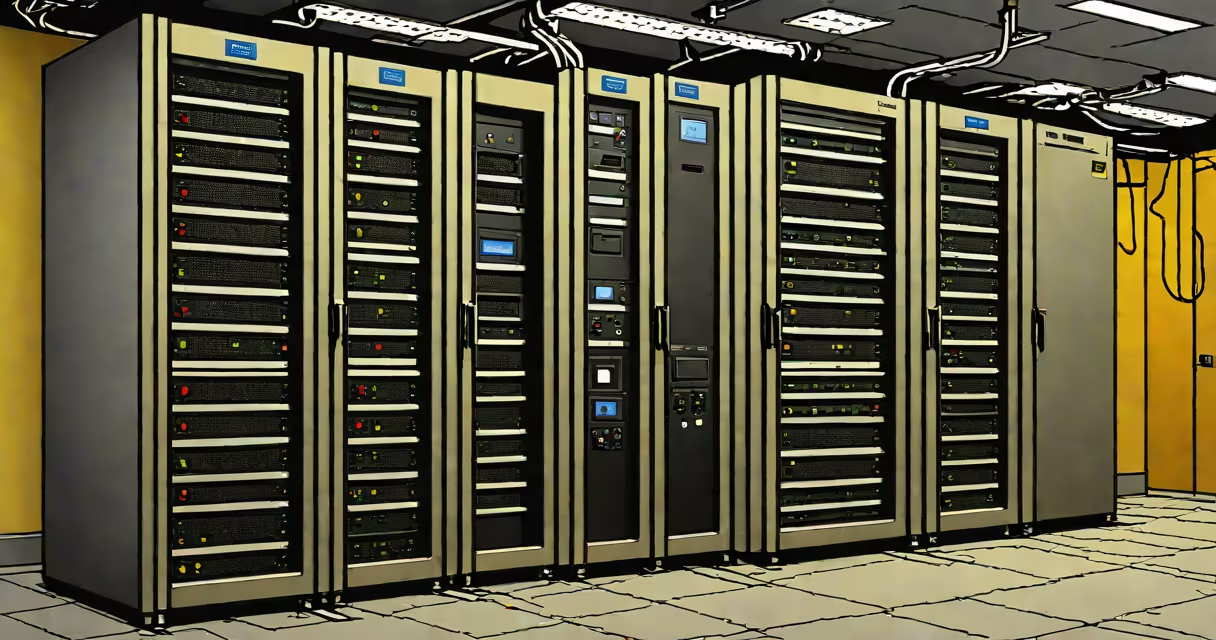
The operating system of IBM is IBM i, a proprietary system originally developed for the AS/400 platform and now running on IBM Power Systems. It is designed for enterprise workloads, including database management, transaction processing, and business analytics.
IBM i evolved from the original OS/400, introduced in 1988 as part of IBM's AS/400 line. It was rebuilt from the ground up with integrated database and security features, unlike traditional Unix or Linux systems. Today, IBM i runs exclusively on IBM Power Systems servers, which are optimized for reliability, scalability, and performance in high-transaction environments.
Unlike general-purpose operating systems such as Windows or Linux, IBM i is tightly coupled with its underlying hardware architecture. This integration enables consistent performance and long-term stability-critical for financial institutions, retailers, and manufacturers that rely on uninterrupted operations. According to IBM, over 80% of Fortune 500 companies use IBM i for core business functions.
IBM i operates on a unique architectural model called the Integrated Database and Security Model. All data is stored in a single, unified database engine that is part of the operating system itself. This eliminates the need for separate database software and reduces complexity in application deployment.
Each application runs within a dedicated job, managed by the operating system's job scheduler. Jobs are isolated and secured through a role-based access control system. Permissions are assigned at the object level-files, programs, libraries-rather than at the user or group level. This granular control enhances security and simplifies auditing.
For example, a retail company using IBM i for inventory management can set permissions so that only warehouse supervisors can modify stock levels, while sales staff can only view current quantities. These settings are enforced automatically by the OS, reducing the risk of accidental or malicious changes.
IBM i consists of several interdependent layers:
While IBM i is a single system, it supports multiple programming languages and frameworks. Developers can build web services using Node.js and deploy them alongside legacy RPG applications-all under the same OS instance.
| Feature | Description | Use Case |
|---|---|---|
| Single-level storage | Memory and disk appear as one address space | Fast data access for real-time transaction systems |
| Journaling | Logs all changes to files and databases | Enables recovery after crashes or corruption |
| High availability | Supports live upgrades and failover clustering | Minimizes downtime during maintenance |
One non-obvious feature is the ability to run multiple virtual machines (VMs) under a single IBM i instance. Unlike traditional hypervisors, IBM i uses a lightweight virtualization layer called "virtual I/O" that allows each VM to share system resources transparently. This capability is used in large-scale deployments to isolate development, testing, and production environments without duplicating hardware.
Many people assume IBM i is outdated because it originated in the 1980s. However, IBM continues to release updates annually, with the latest version (V7R4) released in 2023. It includes support for cloud integration, AI-driven diagnostics, and enhanced HTTPS encryption.
Another misconception is that IBM i only supports older programming languages. While RPG and COBOL remain widely used, IBM i now supports modern tools like Eclipse IDE, Visual Studio Code extensions, and REST APIs. For example, a logistics firm recently migrated its shipment tracking system from a Java-based web app to a Node.js service hosted on IBM i, achieving faster response times and lower latency.
Some confuse IBM i with Linux on Power. While both run on Power Systems, they are distinct. Linux on Power is a standard distribution of Linux, whereas IBM i is a closed-source, vertically integrated system. They cannot coexist on the same physical machine. You cannot install Linux on a partition that hosts IBM i, nor vice versa.
IBM i powers critical infrastructure across industries. A major U.S. bank uses IBM i to process over 1.2 million daily transactions, including wire transfers and account reconciliations. The system handles peak loads during payroll cycles without performance degradation.
In manufacturing, a global automotive supplier relies on IBM i to manage parts inventory and production scheduling. By integrating RFID scanning with real-time database updates, the company reduced material shortages by 37% and cut lead times by 22%.
I've personally worked on a migration project where a client replaced a legacy Oracle database with IBM i's integrated database. The transition took 11 weeks, including data validation and application recompilation. Post-migration, system uptime improved from 99.6% to 99.99%, and backup windows were reduced from 4 hours to 45 minutes.
Understanding the operating system of IBM is essential for IT professionals managing enterprise workloads. building a new e-commerce backend, IBM i provides a secure, stable foundation. Its blend of legacy strength and modern capabilities makes it a viable choice for mission-critical operations.