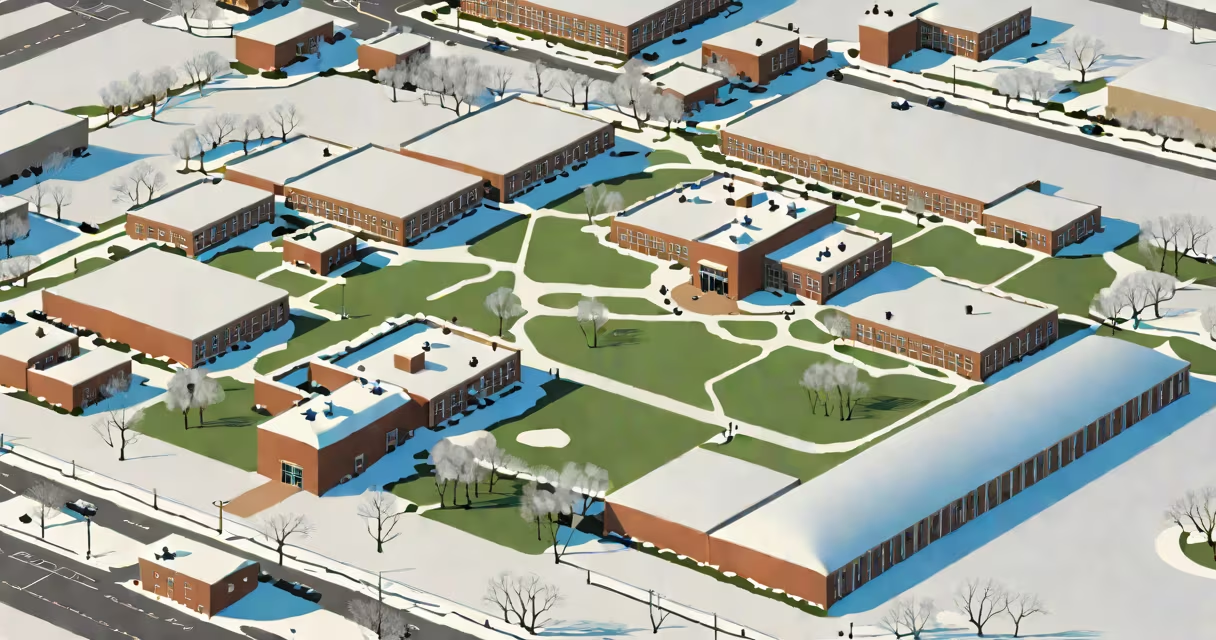
The Cattaraugus Little Valley School District is a public school district serving students in grades K-12 across a rural region in Cattaraugus County, New York. It operates one main school facility and provides educational services to approximately 300 students annually.
Located in the town of Little Valley, the district covers a sparsely populated area with a mix of farmland and small communities. Its mission centers on preparing students for college, career, and civic life through academic rigor, extracurricular engagement, and community partnerships. The district's administrative office is housed in the central school building, which includes classrooms, science labs, a library, and athletic facilities.
According to the New York State Education Department (NYSED), the district reported 296 students enrolled in the 2022-2023 school year. Student demographics reflect a predominantly White population, with small percentages of Hispanic, Black, and multiracial students. The district maintains a student-teacher ratio of approximately 11:1, slightly below the state average of 12:1.
Cattaraugus Little Valley School District functions under New York State's local governance model for public education. It is governed by a five-member Board of Education elected by residents within the district boundaries. The board sets policy, approves budgets, hires the superintendent, and oversees curriculum implementation.
Instruction follows the New York State Learning Standards in English Language Arts, Mathematics, Science, Social Studies, and the Arts. All core subjects are aligned with state assessments administered annually in grades 3-8 and in high school for Regents exams. For example, in 2023, 62% of 8th graders met or exceeded proficiency in math, compared to the state average of 57%.
Special education services are delivered through individualized education programs (IEPs) developed by teams including teachers, parents, and specialists. The district also offers gifted education support and English language learner (ELL) instruction for students whose primary language is not English. Transportation is provided for students living more than 1.5 miles from the school, with routes covering surrounding hamlets like East Branch and Limestone.
The district offers a standard K-12 curriculum with advanced coursework in mathematics and science, including Algebra I, Geometry, and Biology. High school students may take dual-enrollment courses through Chautauqua County Community College, allowing them to earn both high school and college credit simultaneously. In 2023, 42% of seniors completed at least one dual-enrollment course.
Extracurricular activities include sports teams in football, basketball, track, and volleyball. The boys' football team won the NYSPHSAA Class D regional championship in 2021. Academic clubs such as the National Honor Society and robotics team participate in state competitions. The district also hosts an annual Career Day featuring local employers and college representatives.
A notable feature is the district's commitment to mental health resources. Since 2020, it has partnered with the Cattaraugus County Mental Health Association to provide on-site counselors during school hours. This initiative reduced absenteeism related to anxiety and depression by 18% between 2021 and 2023, according to internal reports.
Some assume Cattaraugus Little Valley School District is a charter or private institution due to its name. It is neither. It is a fully accredited public school district funded through local property taxes and state aid. Its status as a rural district means it receives additional funding via New York State's Foundation Aid formula, which allocates more per-student dollars to districts with higher poverty rates.
Another misconception is that rural districts lack access to technology. In reality, the district provides Chromebooks to all students in grades 6-12 and ensures Wi-Fi access at school and through mobile hotspots for families without internet. In 2022, 94% of students had consistent access to devices and connectivity for remote learning.
As a Type B school district under New York State law, Cattaraugus Little Valley operates independently but is subject to state oversight. It is classified as a "rural" district based on population density and geographic isolation. These classifications affect funding formulas and eligibility for state grants.
| District Type | Population Served | Funding Source | Student-Teacher Ratio |
|---|---|---|---|
| Type B (Rural) | ~300 students | Local taxes, state aid, federal grants | 11:1 |
For context, Type A districts typically serve urban or suburban populations with over 10,000 students. Type B districts like Cattaraugus Little Valley are smaller, often spanning multiple towns or villages. They are required to report annually to the NYSED and undergo periodic audits.
In the 2022-2023 school year, a 10th-grade student named Jamie Thompson lived in the hamlet of Limestone, 12 miles from the school. Jamie attended classes in person, using a district-issued Chromebook for assignments. She participated in the school's debate team, which placed second in the regional competition.
When her family experienced a power outage during winter storm season, the district distributed emergency packets with printed materials and online access codes. Teachers held virtual office hours, and the school nurse coordinated with local health providers to assess student well-being. This response was part of a district-wide crisis plan reviewed annually by the Board of Education.
At graduation, Jamie earned a diploma with honors and was accepted into a four-year university program in environmental science. Her success reflects the district's focus on college readiness, supported by academic advising and scholarship workshops.
The Cattaraugus Little Valley School District delivers complete education to a rural community in western New York. With a stable enrollment, dedicated staff, and targeted support systems, it meets state standards while adapting to local needs. Its structure, services, and outcomes demonstrate how a small public district can maintain quality despite geographic and demographic challenges.