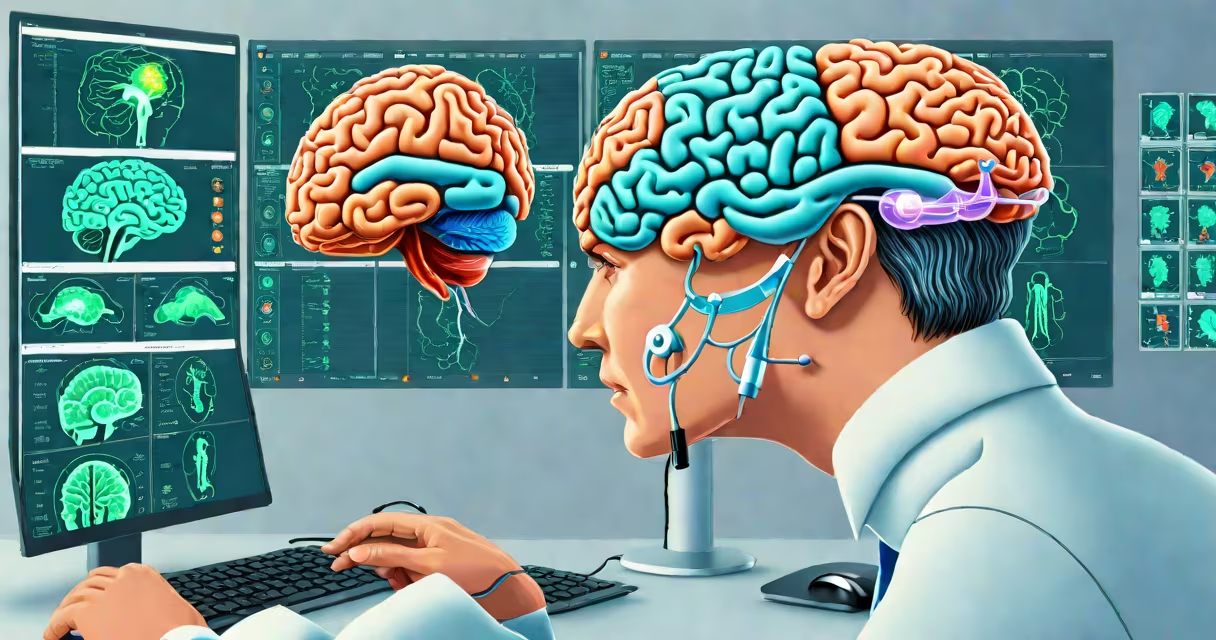
The term "neuro meaning medical" refers to the use of neurological terminology in clinical settings to describe conditions, procedures, and anatomical structures related to the central and peripheral nervous systems. These terms are standardized in medical practice and appear in diagnoses, imaging reports, and treatment plans.
Medical professionals use "neuro" as a prefix to denote anything involving the nervous system. This includes nerves, brain tissue, spinal cord, and associated disorders. For example, "neurological examination" describes a physical assessment of nerve function, while "neuroimaging" refers to scans like MRI or CT that visualize brain and spinal anatomy.
Standardized medical dictionaries such as the Merriam-Webster Medical Dictionary and the National Library of Medicine's Unified Medical Language System (UMLS) define "neuro" as relating to the nervous system. These sources confirm that "neuro" is not interchangeable with general terms like "brain" or "mental" in formal contexts.
In patient care, "neuro" prefixes clarify diagnostic intent. A "neurologist" specializes in diseases of the nervous system, while "neuropathy" indicates nerve damage. These terms allow precise communication among clinicians, reducing ambiguity in treatment planning.
For instance, a patient presenting with weakness and numbness may undergo a "neurological workup," which includes electromyography (EMG) and nerve conduction studies. The results are interpreted using neuro-specific terminology: "demyelination" indicates loss of protective sheath around nerves, often seen in multiple sclerosis.
When a physician writes "neuro deficit" in a chart, they mean a measurable loss of neurological function-such as reduced reflexes or impaired coordination-documented through standardized assessments like the Glasgow Coma Scale. This precision ensures consistent monitoring across shifts and facilities.
Neurological terms fall into distinct categories based on their clinical application. The table below outlines major types, their meanings, and real-world usage.
| Type | Definition | Example in Practice |
|---|---|---|
| Diagnostic | Terms identifying disease states | "Neurofibromatosis" diagnosed via genetic testing and skin lesions |
| Procedural | Terms describing interventions | "Neuroablation" used to treat chronic pain by disrupting nerve signals |
| Anatomical | Terms naming structures | "Neuronal axons" visible under electron microscopy in research |
| Functional | Terms describing processes | "Neuroplasticity" refers to the brain's ability to reorganize after injury |
Each category serves a distinct role. Diagnostic terms guide classification, procedural terms inform treatment, anatomical terms support education and research, and functional terms explain physiological adaptation.
Neuro terminology appears in electronic health records (EHRs), surgical notes, and radiology reports. Its use ensures consistency across healthcare teams and supports accurate billing under ICD-10 coding standards.
A patient with suspected stroke may have a "CT neuro" ordered-a non-contrast computed tomography scan focused on the brain. The term "neuro" here specifies the scan's purpose: to detect hemorrhage or ischemia in neural tissue. Without this specificity, the request could be misinterpreted as a general abdominal CT.
During surgery, a neurosurgeon may perform a "neuroendoscopic procedure" to remove a cyst in the ventricles. The term "neuro" distinguishes this from general endoscopy, emphasizing the need for specialized training and equipment.
Many patients and even some non-specialists confuse "neuro" with mental health. While psychiatry involves the brain, "neuro" specifically refers to structure and function of the nervous system-not mood, behavior, or cognition alone.
For example, "neurotic" is a misused term. In clinical psychology, it historically described anxiety-related symptoms, but it is not a valid medical diagnosis today. The DSM-5 no longer includes "neurosis" as a category. Using "neurotic" incorrectly implies a neurological disorder when it may refer to emotional distress.
Another error is equating "neuro" with "brain only." The nervous system includes the spinal cord and peripheral nerves. A diagnosis of "peripheral neuropathy" affects limbs and organs, not just the brain. This distinction matters for treatment-some neuropathies respond to vitamin B12 supplementation, others require immunosuppressants.
I once observed a resident mislabel a scan report as "neuro" when the focus was on muscle atrophy. The original note read: "MRI shows atrophy in the left lower limb, likely due to nerve compression." The resident added "neuro" to the title, implying a primary neurological cause. But the imaging showed no spinal pathology-just a compressed sciatic nerve from a herniated disc. Correct labeling ensured the orthopedic team reviewed the case, not a neurologist.
This mistake highlights how misusing "neuro meaning medical" can lead to unnecessary referrals and delays. Proper terminology ensures the right specialist sees the right data.
One overlooked fact: "neuro" does not imply severity. A "neuro exam" can be normal in a patient with mild headache. The term describes the domain, not the outcome.
Another: many terms are derived from Greek roots. "Neuron" comes from *neuron*, meaning "sinew" or "nerve," from *neûron*, the Greek word for "sinew." Understanding etymology helps decode unfamiliar terms-e.g., "neurotomy" means cutting a nerve, while "neurotization" refers to transferring nerve function.
Also, not all "neuro" terms are clinical. In research, "neuro" appears in fields like neuroethology (study of neural basis of animal behavior) or neuroeconomics (how brain activity influences economic decisions). These uses extend beyond medicine but still rely on the core definition: relating to the nervous system.
Laxity, meaning looseness or instability, often appears in orthopedic reports. "Neuro-laxity" is not a standard term. However, "neurogenic laxity" may describe joint instability caused by nerve damage-such as in diabetic foot ulcers. Distinguishing between structural and neurological causes prevents misdiagnosis.
These distinctions reinforce that "neuro meaning medical" is not a standalone concept-it functions within a network of precise terminology.
Understanding "neuro meaning medical" enables clearer communication between patients and providers, reduces diagnostic errors, and supports accurate documentation. Whether in a clinic, operating room, or research lab, correct use of this terminology maintains clinical integrity and improves outcomes.