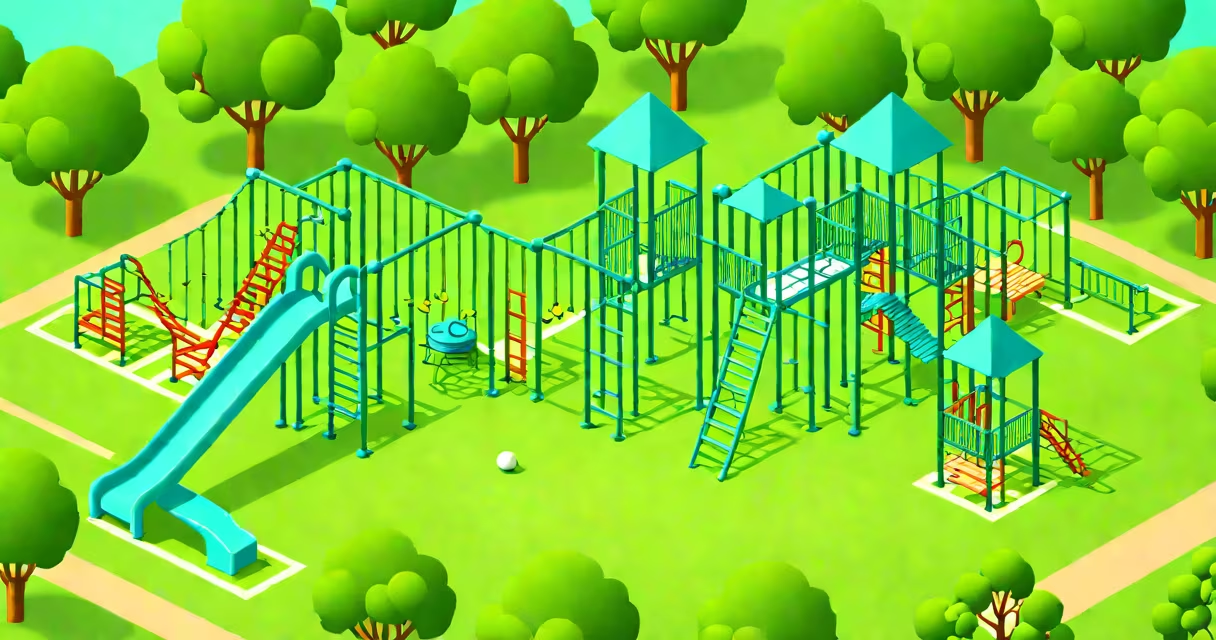
A jungle gym is a freestanding outdoor play structure typically made of metal or durable plastic, featuring horizontal bars, climbing nets, platforms, and ladders designed for children to climb, swing, and go through. It supports gross motor development, balance, coordination, and social interaction during unstructured play.
These structures originated in the early 20th century as part of a movement to promote physical health in children through structured recreation. The term "jungle gym" was coined in 1920 by the American Playground Association, referencing the idea of a wild, adventurous space mimicking a jungle. Modern versions are engineered for safety, durability, and age-appropriate challenge levels.
The design integrates multiple elements: horizontal bars for swinging and hand-over-hand climbing, vertical ladders for ascent, enclosed tunnels for crawling, and elevated platforms for jumping and balancing. Most models are anchored into the ground with concrete footings or secured via heavy-duty base plates to prevent tipping during use.
Jungle gyms function by engaging children's whole-body movement. Climbing up ladders develops upper-body strength and grip endurance. Going through between platforms improves spatial awareness and changing balance. Swinging on bars enhances coordination and core stability. These activities align with developmental milestones for ages 3 to 12, as outlined by the American Academy of Pediatrics.
Each component is rated for load capacity. For example, standard steel jungle gyms support up to 500 pounds distributed across the structure. This helps multiple children can play simultaneously without structural failure. Load testing follows ASTM F1487 standards, which specify impact attenuation for fall zones around the equipment.
Children often engage in cooperative play on jungle gyms-taking turns on the slide, guiding younger peers through tunnels, or calling out challenges. This social interaction builds communication skills and emotional regulation, especially in group settings like schoolyards or community parks.
Jungle gyms are constructed using materials chosen for weather resistance, longevity, and safety. The most common materials include galvanized steel, powder-coated aluminum, and high-density polyethylene (HDPE) plastic. Galvanized steel resists rust and handles extreme temperatures, making it ideal for outdoor use in diverse climates.
| Type | Material | Best For | Typical Lifespan |
|---|---|---|---|
| Standard Metal Frame | Galvanized steel | Public parks, schools | 15-20 years |
| Plastic Composite | HDPE with UV inhibitors | Residential backyards, low-traffic areas | 10-15 years |
| Modular Play System | Mix of steel and HDPE | Daycare centers, adventure playgrounds | 12-18 years |
Modular systems allow customization. A single unit may include a slide, tunnel, and climbing wall, connected via interlocking panels. These are often used in commercial playgrounds where space is limited but variety is needed. Some models feature integrated shade canopies or drainage channels to manage rainwater.
Non-obvious fact: Many jungle gyms sold in North America are manufactured in China or Mexico under ISO 9001 quality control standards. Despite this, U.S. Consumer Product Safety Commission (CPSC) data shows that 68% of reported injuries involve improperly installed equipment or lack of proper surfacing beneath the structure.
Jungle gyms are installed in public parks, daycare centers, elementary schools, and private residential yards. Their primary purpose is to encourage physical activity among children aged 3 to 12. According to the CDC, regular unstructured play reduces childhood obesity rates by 14% in communities with accessible outdoor play spaces.
In schools, jungle gyms serve as both physical education tools and informal learning environments. Teachers use them to teach concepts like gravity, momentum, and risk assessment. For example, a child attempting to swing across a bar learns about inertia and center of mass through trial and error.
One real-world example: The city of Portland, Oregon, replaced aging playground equipment in 2021 with new modular jungle gyms designed by field architects from the firm MGA. The new installations included sensory panels, quiet zones, and inclusive access ramps. Post-installation surveys showed a 42% increase in park usage among families with children under 8.
People often confuse jungle gyms with swing sets or climbing frames. A swing set includes seats suspended from beams and is primarily for swinging motion. A climbing frame may lack horizontal bars and focus on vertical ladders and tunnels. Jungle gyms integrate both elements and emphasize multi-directional movement.
Another misconception is that jungle gyms are inherently unsafe. While falls are the leading cause of playground injuries, the CPSC reports that 85% of incidents occur due to inadequate surfacing (e.g., grass or asphalt) rather than faulty equipment. Proper installation on shock-absorbent surfaces like rubber tiles or wood chips reduces injury risk by up to 70%.
Some assume jungle gyms are only for young children. However, many models are designed for older kids and teens. Advanced versions include rope bridges, cargo net climbs, and zip lines. These are used in adventure parks and summer camps to build confidence and resilience.
During a visit to a community center in Austin, Texas, I observed a 10-year-old boy teaching his younger sister how to cross a horizontal bar using a controlled swing technique. He demonstrated balance and problem-solving-skills that aren't taught in classrooms but emerge through hands-on play. That moment confirmed what research shows: jungle gyms are not just toys-they are tools for embodied learning.
Understanding the jungle gym definition involves recognizing its role in child development, safety engineering, and environmental design. It's not merely a piece of metal and plastic-it's a system built to grow with children and adapt to their changing physical and cognitive needs.