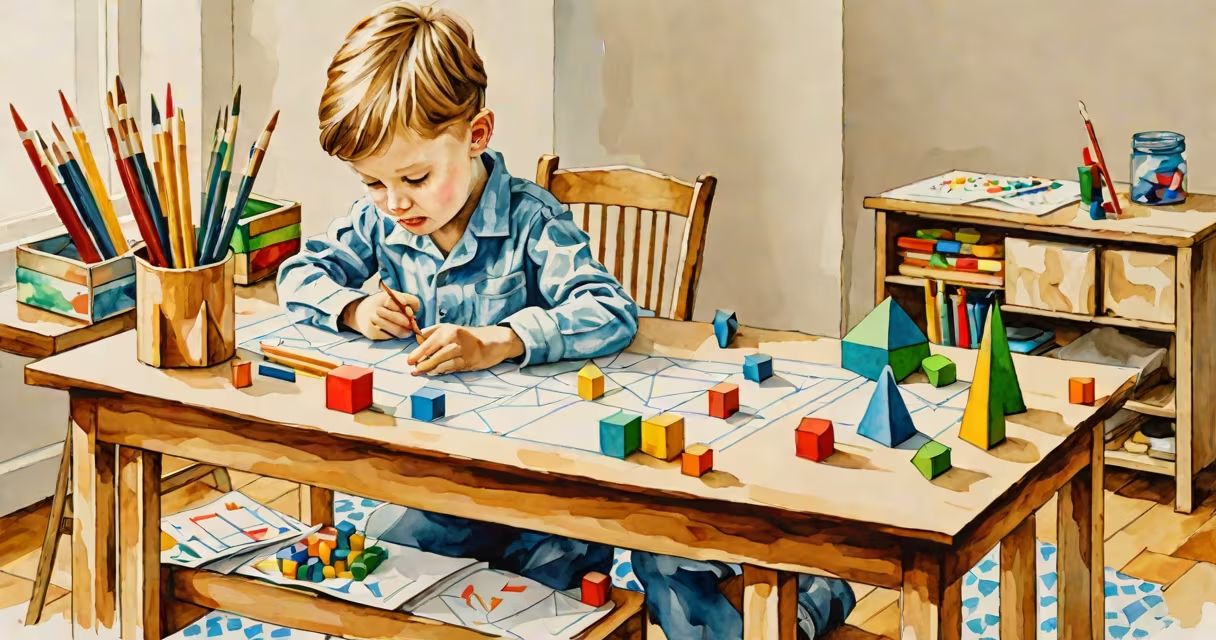
Montessori theory is an educational philosophy developed by Italian physician and educator Maria Montessori in the early 20th century. It centers on child-led learning, hands-on exploration, and structured independence within a carefully prepared environment. The approach emphasizes sensory-based materials, mixed-age classrooms, and uninterrupted work periods to support cognitive, emotional, and social development.
Montessori theory emerged from Montessori's observations of children's natural curiosity and capacity for self-directed learning. She believed that children learn best when they are free to choose activities based on their interests and developmental stage. This contrasts sharply with traditional models that rely on teacher-led instruction and rigid schedules. The core idea is that education should nurture autonomy, concentration, and intrinsic motivation rather than compliance.
Research from the American Psychological Association confirms that students in Montessori programs show stronger executive function skills-such as focus, planning, and self-regulation-than peers in conventional schools. These outcomes are linked directly to the structure of Montessori environments, which prioritize uninterrupted time for deep engagement.
The foundation of montessori theory lies in the belief that children progress through distinct developmental stages, each marked by specific psychological and physical needs. Montessori identified four planes of development: birth to age 6, 6 to 12, 12 to 18, and 18 to 24. Each phase requires tailored materials, guidance, and environmental design.
Classrooms are designed to be orderly yet flexible. Furniture is child-sized. Materials are arranged on low shelves so children can access them independently. Each item serves a specific purpose-like sandpaper letters for phonetic awareness or bead chains for multiplication. Children move freely between activities, choosing tasks based on interest and readiness.
Teachers act as guides, not lecturers. They observe closely, intervene only when necessary, and maintain a calm, consistent presence. Work periods last 2-3 hours, allowing children to engage deeply with complex tasks. For example, a 5-year-old may spend 45 minutes arranging colored beads to understand the concept of squaring numbers-a process that builds both mathematical reasoning and fine motor control.
Montessori theory is applied across several settings, each adapted to different age groups and goals. The most common types include:
| Type | Age Range | Key Features | Example Activity |
|---|---|---|---|
| Primary (Early Childhood) | 3-6 years | Practical life exercises, sensorial materials, language and math basics | Transferring water between pitchers using a small pitcher and cup |
| Elementary | 6-12 years | Integrated curriculum, cosmic education, collaborative projects | Creating a timeline of Earth's history using colored ribbons and cards |
| Secondary | 12-18 years | Project-based learning, community service, independent research | Designing a sustainable garden model for a local urban school |
Each level uses materials that isolate a single concept-like the pink tower for size discrimination or the movable alphabet for spelling. These tools are designed to be self-correcting: if a child makes a mistake, the result is immediately visible, prompting reflection and correction without adult intervention.
A lesser-known fact is that Montessori classrooms often avoid standardized testing. Instead, progress is assessed through observation, portfolios, and student-led conferences. This aligns with her view that external rewards and grades undermine internal motivation.
Montessori theory is implemented in over 20,000 schools globally, including public charter schools in the U.S., private institutions in Europe, and community-based programs in Latin America and Asia. In the U.S., states like California and New York have accredited Montessori programs in public school districts, such as the Montessori School of San Diego and the Brooklyn Montessori Charter School.
Its popularity stems from evidence showing improved academic performance, social-emotional regulation, and long-term self-efficacy. A 2017 longitudinal study published in the journal *Frontiers in Psychology* found that Montessori students outperformed peers in reading and math at ages 5 and 8, even when controlling for socioeconomic status.
Parents often choose Montessori for its emphasis on respect, responsibility, and individual pacing. One parent in Portland, Oregon, described how her daughter-previously overwhelmed in a traditional kindergarten-began thriving after switching to a Montessori setting. "She started asking questions about the solar system, then built a model using clay and sticks. That kind of curiosity didn't exist before."
Montessori theory is frequently misunderstood as simply "free play" or "unstructured learning." In reality, it is highly structured. The environment is deliberately organized to promote independence, but within clear boundaries. Children are free to choose their work-but not to disrupt others or skip essential routines.
Another misconception is that Montessori is only for young children. While it originated in preschool settings, the elementary and secondary levels are equally rigorous. The curriculum covers advanced topics like fractions, algebra, and planetary science, taught through inquiry and material manipulation.
Montessori is not synonymous with homeschooling. Many families use Montessori principles at home, but the formal method requires trained teachers and certified materials. Programs labeled "Montessori-inspired" may lack accreditation and fail to meet core standards. The American Montessori Society (AMS) and the Association Montessori Internationale (AMI) provide certification for educators and schools.
It's also important to distinguish montessori theory from other progressive models. Unlike Waldorf education-which emphasizes imagination and artistic expression-Montessori prioritizes concrete experiences and logical progression. Unlike Reggio Emilia, which values project-based learning and community collaboration, Montessori focuses on individual mastery and sequential skill acquisition.
For example, while both approaches teach biology, a Montessori classroom might use a three-dimensional model of a cell with labeled parts, whereas a Reggio Emilia class might explore the concept through storytelling and art. The difference lies in the method: Montessori builds understanding through tactile, step-by-step discovery.
What is montessori theory? It is a research-backed, child-centered educational structure that fosters independence, critical thinking, and lifelong learning. Its success lies in intentional design-not chaos. From sensorial materials to mixed-age grouping, every element supports development in context. As global interest grows, so does the demand for properly trained educators and accredited programs. For those exploring alternatives to traditional schooling, montessori theory offers a proven path rooted in dignity, curiosity, and respect for the child.