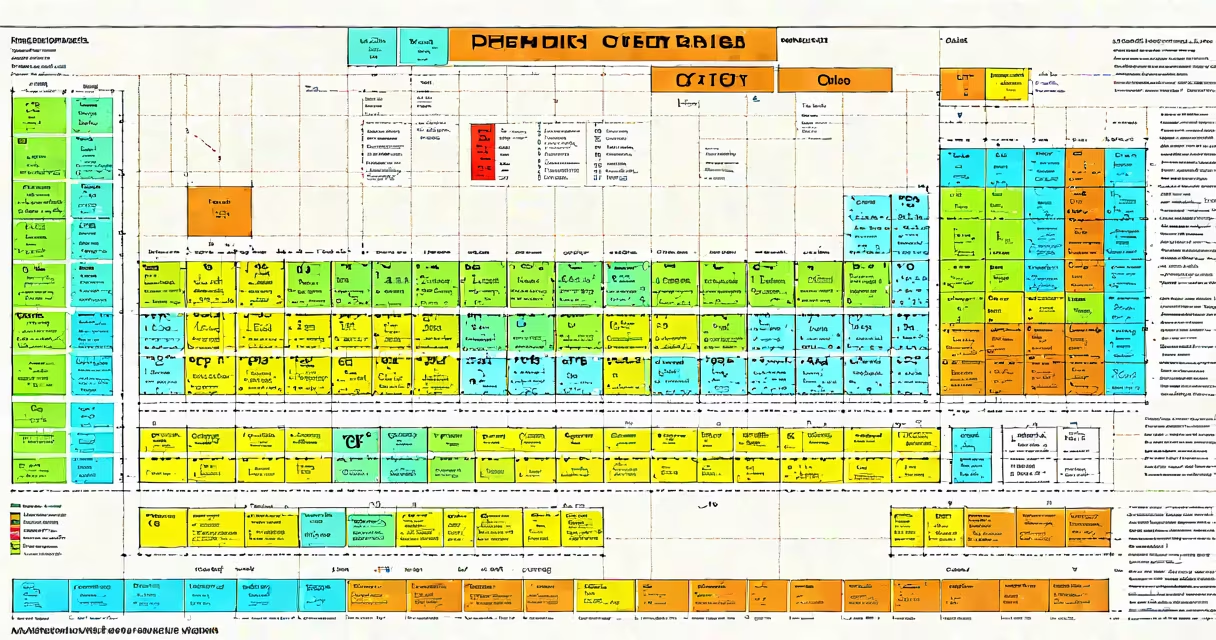
The periodic table is a systematic arrangement of all known chemical elements, ordered by increasing atomic number and grouped by similar chemical and physical properties. It reflects the periodic law: when elements are arranged by atomic number, their properties recur at regular intervals.
Developed by Dmitri Mendeleev in 1869, the table predicts undiscovered elements based on gaps in the pattern. Today's version includes 118 confirmed elements, from hydrogen (atomic number 1) to oganesson (118). Each element occupies a unique cell containing its symbol, atomic number, and average atomic mass.
Elements are organized into rows called periods and columns called groups. Periods represent energy levels; groups indicate valence electrons and shared reactivity. For example, Group 1 (alkali metals) all have one valence electron and react vigorously with water. This structure allows scientists to infer properties of unknown or synthetic elements.
Each element's position is determined by its atomic number-the number of protons in its nucleus. This number defines the element. For example, carbon has six protons, so its atomic number is 6. Changing the proton count changes the element entirely.
Electron configuration follows a predictable pattern across periods. As atomic number increases, electrons fill orbitals in shells and subshells (s, p, d, f). Elements in the same group share the same outer electron configuration, which explains why they behave similarly. Sodium (Na) and potassium (K), both in Group 1, form +1 ions and burn with bright flames.
The table divides into metals, metalloids, and nonmetals. Metals dominate the left and center-copper, iron, gold. Nonmetals occupy the upper right-oxygen, nitrogen, chlorine. Metalloids like silicon and germanium lie along the zigzag line and exhibit mixed properties, making them essential in semiconductors.
The periodic table consists of four main blocks based on electron subshell filling:
| Block | Subshell | Elements | Examples |
|---|---|---|---|
| s-block | s | Groups 1-2 and helium | Lithium (Li), calcium (Ca) |
| p-block | p | Groups 13-18 | Oxygen (O), bromine (Br), xenon (Xe) |
| d-block | d | Groups 3-12 (transition metals) | Iron (Fe), copper (Cu), zinc (Zn) |
| f-block | f | Actinides and lanthanides | Uranium (U), neodymium (Nd) |
Periods vary in length: Period 1 has 2 elements (H, He), Period 2 and 3 have 8 each, Period 4 and 5 have 18, and Period 6 and 7 include 32 elements due to the inclusion of f-orbitals. The f-block elements are often shown separately below the main table to save space.
A notable feature is the diagonal relationship between certain elements. For example, lithium (Group 1) shows similarities to magnesium (Group 2), such as forming nitrides and having high melting points. These anomalies arise from comparable charge density and ionic size.
Many assume the periodic table is static. In reality, it evolves. Elements beyond uranium (atomic number 92) are synthetic and unstable. Tennessine (element 117), discovered in 2010, decays within milliseconds. Its placement in Group 17 was predicted using periodic trends, not direct observation.
Another error is thinking all elements in a group behave identically. While Group 17 (halogens) all gain one electron to form -1 ions, fluorine differs dramatically from iodine. Fluorine is the most electronegative element and reacts violently with water, while iodine is less reactive and forms diatomic molecules that sublime easily.
Some believe the table was designed purely for aesthetics. Mendeleev left gaps for elements not yet discovered-like gallium (predicted as eka-aluminum) and germanium (eka-silicon)-and accurately forecast their densities, melting points, and formulas. His predictions were verified decades later, proving the table's predictive power.
Chemists use the periodic table to design materials. Titanium (Ti, atomic number 22) is lightweight and corrosion-resistant, making it ideal for aerospace and medical implants. Its position in Group 4 explains its ability to form stable oxides and alloys.
In medicine, technetium-99m (Tc-99m), derived from molybdenum (Mo, atomic number 42), is used in over 80% of nuclear imaging procedures. Molybdenum's location in the d-block gives it multiple oxidation states, enabling it to bind to radiopharmaceuticals.
For a concrete example: consider sodium (Na, atomic number 11). It lies in Period 3, Group 1. Its electron configuration is 1s² 2s² 2p⁶ 3s¹-just one electron in the outer shell. This explains why it loses that electron to form Na⁺, reacts explosively with water, and is stored under oil to prevent reaction with moisture. These behaviors are consistent across all alkali metals.
I once used the periodic table to troubleshoot a failed electrolysis experiment. My solution produced gas bubbles at both electrodes, but the ratio didn't match theoretical values. Consulting the table revealed that chloride ions (Cl⁻, Group 17) were competing with hydroxide ions (OH⁻) at the anode. Chlorine gas formed instead of oxygen, altering the expected stoichiometry. Adjusting voltage and concentration restored the correct product ratio.
Understanding the periodic table is foundational to chemistry, materials science, and environmental research. It's not just a chart-it's a map of matter itself.