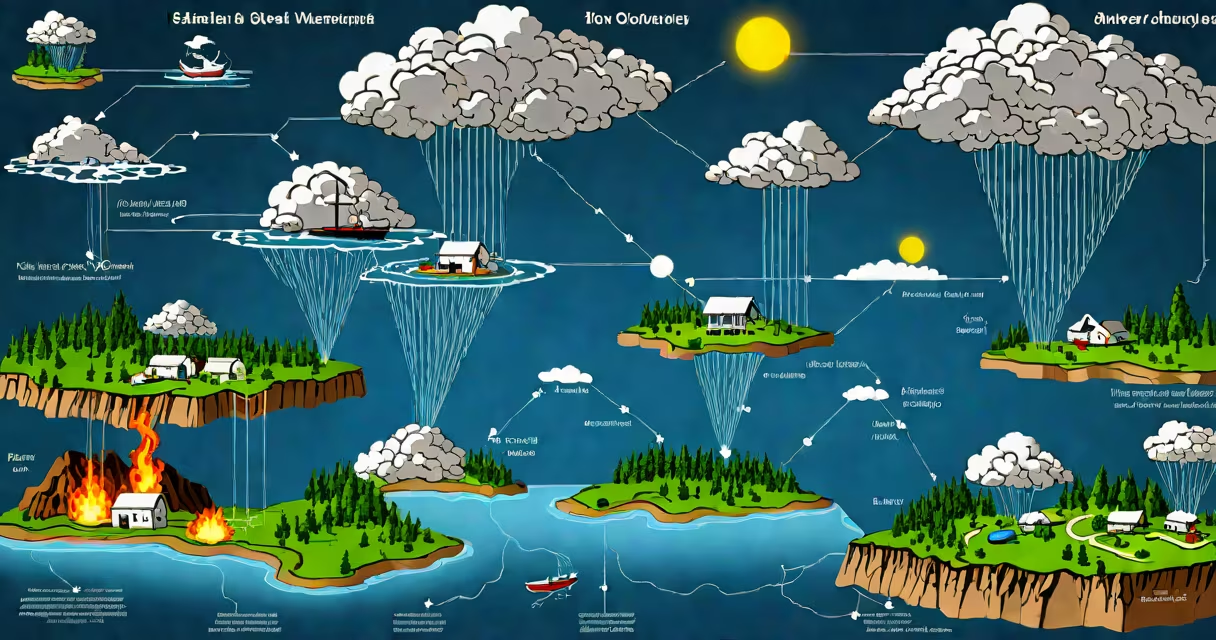
Global warming accelerates the water cycle by increasing evaporation rates and altering precipitation distribution, leading to more intense droughts, floods, and storms. Warmer air holds more moisture-about 7% more per 1°C rise-intensifying both dry spells and heavy rainfall events.
The water cycle, also known as the hydrological cycle, involves evaporation, condensation, precipitation, and runoff. As global temperatures rise due to greenhouse gas accumulation, each stage changes in measurable ways. The Intergovernmental Panel on Climate Change (IPCC) reports that global surface temperatures have increased by 1.1°C since pre-industrial times, directly affecting atmospheric moisture content and storm dynamics.
Warmer oceans evaporate faster, injecting more water vapor into the atmosphere. This vapor fuels stronger storms and heavier rainfalls. For example, Hurricane Harvey in 2017 dropped nearly 60 inches of rain in Texas-research published in *Nature* linked the extreme rainfall to warmer Gulf of Mexico waters caused by climate change. The storm's intensity was amplified by 15-30% due to higher sea surface temperatures.
Evaporation increases globally, especially over tropical and subtropical oceans. The U.S. National Oceanic and Atmospheric Administration (NOAA) observes that evaporation rates have risen by 1-2% per decade since 1970, driven by temperature increases. This shifts moisture from oceans to the atmosphere, disrupting regional balances.
Condensation occurs at higher altitudes in warmer air masses, forming denser cloud layers. These clouds trap heat but also release precipitation more intensely. A 2022 study in *Science Advances* found that for every 1°C increase in temperature, precipitation intensity rises by approximately 7%, exceeding the 1-2% rate of global rainfall increase. This imbalance causes wet regions to get wetter and dry regions drier.
Runoff patterns shift too. Snowpacks in mountainous regions, such as the Sierra Nevada and Himalayas, melt earlier in spring. Earlier melt reduces summer streamflow, threatening water supplies for agriculture and urban areas. In California, snowmelt now arrives 3-4 weeks earlier than in the 1950s, reducing reservoir storage capacity during peak demand months.
Not all regions respond the same way. Arid zones like the southwestern United States face prolonged droughts, while equatorial regions see more frequent and severe monsoon events. The table below summarizes key changes by region:
| Region | Change in Evaporation | Change in Precipitation | Primary Impact |
|---|---|---|---|
| Southwest U.S. | ↑ 15-20% | ↓ 10-15% | Prolonged droughts, reduced reservoir levels |
| Tropics (e.g., Amazon) | ↑ 10-12% | ↑ 5-8% | More frequent flooding, soil saturation |
| High latitudes (Arctic) | ↑ 25-30% | ↑ 15-20% | Accelerated ice melt, permafrost thaw |
| South Asia (monsoon zone) | ↑ 8-10% | ↑ 12-18% | Extreme rainfall events, flash floods |
A lesser-known consequence is the weakening of atmospheric circulation patterns. The jet stream, which guides storm tracks, slows down under warming conditions. This causes weather systems to stall, prolonging rainfall or droughts. In 2021, a stalled high-pressure system over the Pacific Northwest led to a heat dome that raised temperatures above 40°C for days-an event tied to disrupted atmospheric flow.
Many assume global warming means more rain everywhere. That's incorrect. While total global precipitation may increase slightly, the distribution becomes uneven. Some areas receive more rain, others less. The IPCC notes that 40% of the world's population lives in regions projected to experience reduced rainfall by 2050.
Another misconception is that melting glaciers contribute primarily to sea level rise. While they do, their role in the water cycle is indirect. Glacial melt adds freshwater to oceans, altering salinity and ocean currents. The Atlantic Meridional Overturning Circulation (AMOC) weakens when freshwater dilutes North Atlantic waters-this could slow heat transfer and alter global weather patterns.
The water cycle doesn't "break" under warming-it intensifies and distorts. The core processes remain, but their timing, location, and magnitude shift. A 2023 study in *Environmental Research Letters* confirmed that the water cycle's efficiency-how quickly water moves through evaporation, transport, and precipitation-has decreased in some regions due to altered wind patterns and cloud formation.
In summer 2023, Western Europe experienced record-breaking heat and low rainfall. France recorded its driest June since 1950, with precipitation 40% below average. Soil moisture dropped to 30-year lows, affecting crop yields. Meanwhile, the Mediterranean Sea warmed to 29°C-above normal-increasing evaporation and drying out surrounding lands.
By July, rivers like the Rhône saw water levels drop to 20% of normal. Farmers in Provence reported crop failures in sunflower and olive fields. The French government declared a state of emergency in several departments. This sequence-warmer seas → enhanced evaporation → reduced soil moisture → lower river flows-illustrates how global warming alters the water cycle step-by-step.
When I visited the Rhône River basin in August 2023, I saw exposed riverbeds where boats once navigated. Local farmers described the drought as "new in memory." The event wasn't isolated-it mirrored patterns seen in the 2018 European drought, which scientists now attribute to climate-driven changes in atmospheric circulation.
Changes in the water cycle threaten food security, public health, and biodiversity. Reduced snowpacks in the western U.S. have diminished summer water availability for irrigation. In India, erratic monsoon timing has disrupted rice planting cycles, affecting millions of smallholder farmers.
Wetlands, which buffer floods and filter pollutants, degrade under shifting water regimes. The Everglades in Florida have lost 50% of their original wetland area since the 1950s due to altered rainfall and drainage patterns. Restoration efforts now require modeling future climate scenarios to succeed.
Understanding how global warming affects the water cycle is essential for infrastructure planning. Cities must redesign stormwater systems to handle heavier rainfall. Agricultural systems need adaptive irrigation models. These adjustments rely on accurate projections from climate models, such as those used in the Coupled Model Intercomparison Project Phase 6 (CMIP6).
Climate change is not a distant threat-it is reshaping the water cycle now. The evidence shows that rising temperatures amplify evaporation, concentrate precipitation in fewer events, and destabilize regional water availability. Addressing this requires action based on science, not speculation.