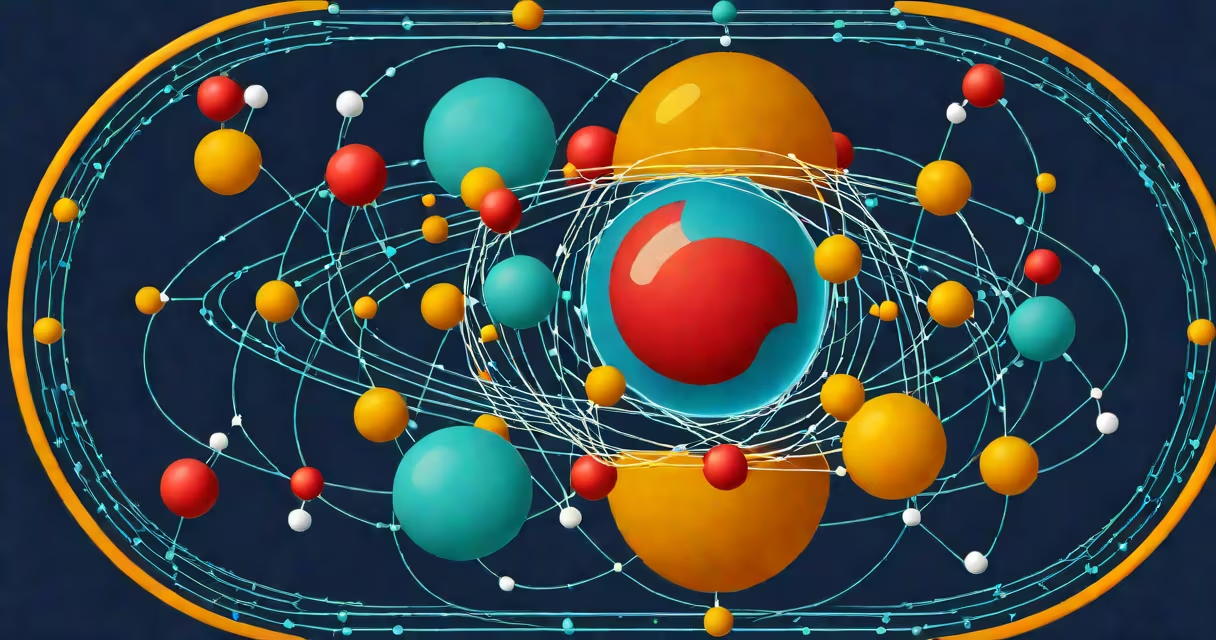
The structure of the atom consists of a dense central nucleus made of protons and neutrons, surrounded by a cloud of electrons occupying energy levels. This arrangement defines the element's identity and chemical behavior.
Atoms are the basic units of matter. They are invisible to the naked eye-about 0.1 nanometers wide-but their internal organization determines everything from the color of fire to the strength of steel. The structure of the atom was first described in detail by Ernest Rutherford in 1911 based on gold foil experiments, which revealed that most of an atom's mass is concentrated in a tiny central region.
Modern quantum mechanics refined this model. Today, we understand that electrons do not orbit like planets. Instead, they exist in probability zones called orbitals, where their presence is likely but not certain. The nucleus remains stable due to the strong nuclear force, which overcomes the repulsion between positively charged protons.
Every atom contains three types of subatomic particles: protons, neutrons, and electrons. Protons carry a positive charge and determine the atomic number-the unique identifier of an element. For example, all carbon atoms have six protons. Change that number, and you change the element.
Neutrons are electrically neutral and reside in the nucleus alongside protons. They stabilize the nucleus by adding strong force without increasing electrostatic repulsion. An atom of carbon can have six neutrons (carbon-12) or seven (carbon-13), making different isotopes. Isotopes behave similarly in chemistry but differ in mass and stability.
Electrons are negatively charged and move rapidly around the nucleus in regions known as electron shells or energy levels. These levels hold specific numbers of electrons: the first shell holds up to two, the second up to eight. The outermost electrons-valence electrons-control how atoms bond. Oxygen has six valence electrons and gains two during bonding, forming water (H₂O).
Electrons occupy orbitals, not fixed paths. These orbitals are mathematical solutions to the Schrödinger equation, describing where an electron is likely to be found. A 1s orbital is spherical and centered on the nucleus. The 2p orbitals form dumbbell shapes along x, y, and z axes.
When atoms interact, electrons rearrange. In covalent bonds, atoms share electrons to fill their outer shells. Sodium (Na) has one valence electron. Chlorine (Cl) needs one. When they meet, sodium donates its electron to chlorine, forming Na⁺ and Cl⁻ ions. The resulting ionic compound, sodium chloride (table salt), crystallizes into a repeating lattice structure.
Energy levels explain atomic emission spectra. When heated, electrons absorb energy and jump to higher levels. As they fall back, they emit light at precise wavelengths. Hydrogen emits four visible lines in the Balmer series: red (656 nm), blue-green (486 nm), blue-violet (434 nm), and violet (410 nm). This pattern is unique to hydrogen and confirms the quantized nature of electron energy.
Many people picture electrons as tiny balls orbiting the nucleus like satellites. That model, called the Bohr model, was useful in the early 20th century but is inaccurate. Electrons are not particles in motion-they are wave-particle duality entities whose location is probabilistic.
Another error is assuming the nucleus is solid. It is not. The nucleus is held together by the strong force, which acts only at femtometer-scale distances (10⁻¹⁵ meters). Protons and neutrons are themselves composed of quarks bound by gluons-making the nucleus a complex system of smaller particles.
A lesser-known fact: atoms are mostly empty space. If an atom were the size of a football stadium, the nucleus would be a marble at center field. The electrons would be flying near the upper seats, moving so fast they're blurred. This emptiness explains why light passes through glass and why matter feels solid-it's due to electromagnetic forces between electrons, not physical contact.
Consider a single carbon atom. Its nucleus contains six protons and six neutrons. Around it, six electrons occupy two shells: two in the 1s orbital and four in the 2s and 2p orbitals. The four valence electrons allow carbon to form four covalent bonds, enabling the vast diversity of organic molecules.
Carbon's versatility underpins life. In graphite, each carbon forms three bonds in a flat layer, allowing electrons to flow-making it conductive. In diamond, each carbon bonds to four others in a rigid 3D network, creating extreme hardness. Both are pure carbon, but their atomic arrangements produce vastly different materials.
Radioactive decay relies on nuclear instability. Carbon-14, with six protons and eight neutrons, decays over time by emitting a beta particle (electron). This process allows radiocarbon dating of ancient artifacts. A sample with half the original carbon-14 content is about 5,730 years old-the half-life of carbon-14.
| Element | Protons | Neutrons | Electrons | Isotope |
|---|---|---|---|---|
| Hydrogen | 1 | 0 | 1 | Hydrogen-1 |
| Helium | 2 | 2 | 2 | Helium-4 |
| Oxygen | 8 | 8 | 8 | Oxygen-16 |
| Uranium | 92 | 146 | 92 | Uranium-238 |
Understanding the structure of the atom enables technologies from MRI machines to solar cells. MRI uses magnetic fields to align hydrogen nuclei in the body. When radio waves are applied, the nuclei emit signals based on their environment-creating detailed images of soft tissues.
I once built a simple cathode ray tube using a vacuum jar and electrodes. When high voltage was applied, a beam of electrons moved from cathode to anode, glowing green where it hit the glass. The deflection of the beam by magnets confirmed that electrons are negatively charged and lightweight-supporting the idea that they are distinct from the nucleus.
Scientific consensus from the National Institute of Standards and Technology (NIST) and the American Physical Society confirms that the current model of the atom is consistent with experimental data across scales-from atomic clocks to fusion reactors. No observation contradicts the existence of protons, neutrons, and electrons in their described roles.
Knowing the structure of the atom isn't just academic. It's essential for understanding everything from climate models to medical imaging. The behavior of electrons in semiconductors powers smartphones. The binding of electrons in DNA maintains genetic information. The structure of the atom is not just science-it's the blueprint of reality.