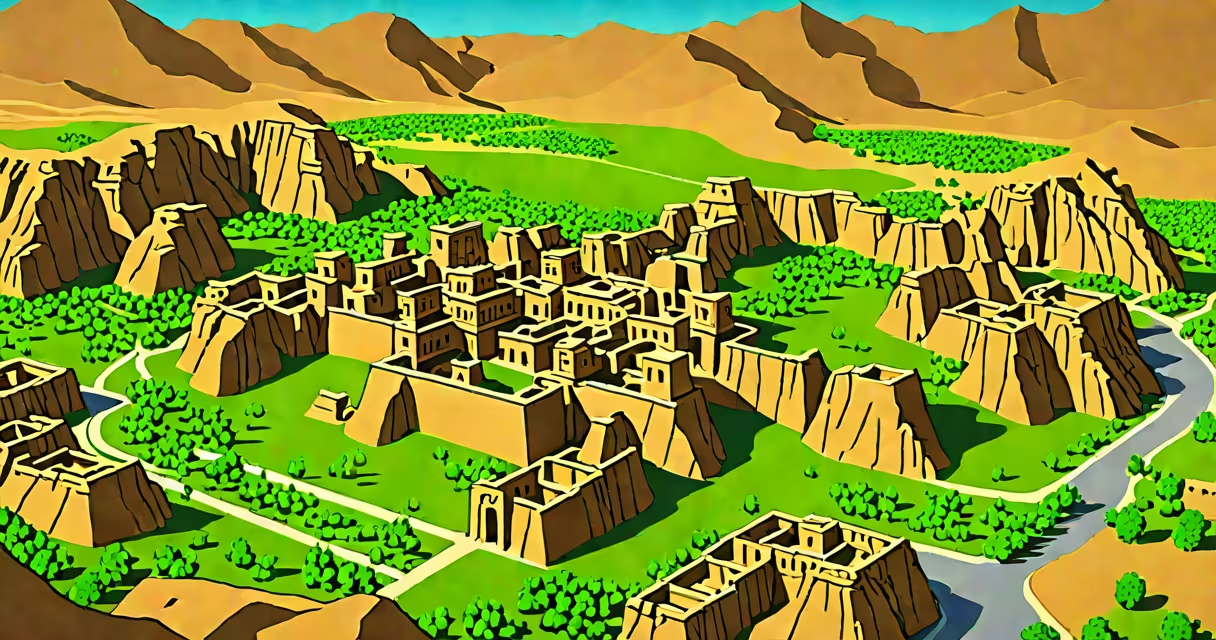
The history of Afghanistan traces back over 5,000 years, encompassing the rise and fall of empires, the spread of major religions, and repeated foreign invasions. It is a land where Central Asia, South Asia, and the Middle East intersect, producing a complex cultural and political legacy.
Afghanistan's earliest known settlements date to the Neolithic period, around 5000 BCE, with archaeological sites like Shahr-i Sokhta and Tepe Fullol revealing early urban development. By 1500 BCE, the region was home to Indo-Iranian tribes who contributed to the formation of the Avesta, the sacred text of Zoroastrianism. The area later became part of the Achaemenid Persian Empire under Darius I, who ruled from 522 to 486 BCE. This marked the beginning of recorded history in the region, with inscriptions found at Persepolis referencing territories in what is now eastern Afghanistan.
After the conquests of Alexander the Great in 327 BCE, the region fell under Hellenistic influence. Greek administrative systems were adopted in cities like Ai-Khanoum, where archaeologists have uncovered Greek-style temples, theaters, and coins. These findings confirm that Greco-Bactrian culture flourished in northern Afghanistan until the 1st century BCE, when the region came under control of the Kushan Empire. The Kushans, a mix of Saka and Yuezhi peoples, established a useful state that promoted Buddhism across Central Asia. The Bamiyan Valley, with its colossal Buddha statues carved into cliffs between the 5th and 6th centuries CE, stands as proof of this era.
| Period | Key Events | Major Powers |
|---|---|---|
| 1500 BCE - 500 BCE | Indo-Iranian migrations; early Zoroastrian influence | Persian Achaemenids |
| 327 BCE - 1st century BCE | Conquest by Alexander; Hellenistic city-states | Greek successors (Diadochi) |
| 1st century BCE - 3rd century CE | Kushan Empire; spread of Mahayana Buddhism | Kushan rulers |
| 7th century CE - 12th century CE | Arab-Muslim conquest; Islamicization begins | Abbasid Caliphate |
Islam arrived in the 7th century through Arab conquests, but conversion was gradual. By the 10th century, the Ghaznavid dynasty, based in Ghazni, had established a useful Islamic empire stretching from Iran to northern India. Mahmud of Ghazni led 17 raids into India between 1000 and 1027 CE, targeting Hindu temples and enriching his capital. His reign marked the peak of Persian-influenced Islamic culture in the region, with poetry, architecture, and scholarship flourishing.
The Mongol invasion in the 13th century devastated much of the country. Genghis Khan's grandson Hulagu Khan destroyed cities like Herat and Balkh. However, the Timurid Empire under Timur (Tamerlane) in the late 14th century revived cultural life. Samarkand and Herat became centers of art and science, with Persian literature and miniature painting reaching their height. Timur's descendants ruled parts of eastern Afghanistan until the 16th century.
The modern state of Afghanistan emerged in 1747 when Ahmad Shah Durrani united Pashtun tribes into a centralized kingdom. He founded the Durrani Empire, which extended from modern-day Pakistan to parts of western India. This marked the beginning of a nation-state identity rooted in Pashtun ethnicity and Sunni Islam. The Durranis ruled until the 19th century, when British colonial ambitions led to the Anglo-Afghan Wars.
The First Anglo-Afghan War (1839-1842) ended in disaster for Britain. A British-backed ruler was installed, but local resistance led by Akbar Khan and the Battle of Kabul resulted in the annihilation of a British force during retreat. The Second Anglo-Afghan War (1878-1880) saw British forces occupy Kabul again, leading to the Treaty of Gandamak, which gave Britain control over Afghan foreign policy. This arrangement lasted until 1919, when King Amanullah Khan declared independence after defeating British troops in the Third Anglo-Afghan War.
Modern Afghanistan began in earnest in 1929 when Muhammad Nadir Shah restored monarchy and later founded the Kingdom of Afghanistan. His son, Zahir Shah, ruled from 1933 to 1973. During his reign, Afghanistan pursued neutrality and modernization, building schools, roads, and a constitution. However, political instability returned after his overthrow in a coup by General Mohammad Daoud Khan, who declared a republic in 1973.
Daoud's government collapsed amid civil unrest and Soviet intervention. In 1979, the Soviet Union invaded Afghanistan to support a communist regime. The war lasted nearly a decade, with mujahideen fighters receiving U.S. and Pakistani aid. The conflict displaced millions and left the country in ruins. The Soviets withdrew in 1989, but internal fighting continued among mujahideen factions.
In 1996, the Taliban seized control of Kabul and imposed a strict interpretation of Sharia law. They banned music, education for girls, and public gatherings. The Taliban harbored al-Qaeda, which carried out the 9/11 attacks. In response, the U.S. launched Operation Enduring Freedom in October 2001, toppling the Taliban regime. A new government was formed under Hamid Karzai, backed by NATO forces.
U.S. and NATO presence lasted 20 years. Despite infrastructure development and increased female education, corruption and insurgency persisted. The Taliban regrouped and launched a rapid offensive in 2021. By August, they captured Kabul, ending the U.S.-backed government. The return of the Taliban triggered mass evacuations and a humanitarian crisis. As of 2024, the country remains under Taliban rule, with international recognition limited and women barred from most public roles.
One lesser-known fact is that Afghanistan hosted the largest Buddhist monastic complex in the world during the 5th century. The site at Mes Aynak, near Kabul, contained over 100 caves, monasteries, and a 10-meter-tall Buddha statue. Mining operations threatened the site in 2007, prompting UNESCO to list it as endangered. Archaeological work revealed artifacts dating to the 1st century BCE, including Greco-Buddhist sculptures and manuscripts in Greek and Bactrian languages.
I visited the Bamiyan Valley in 2016. Standing before the empty niches where the Buddhas once stood, I felt the weight of loss. The statues were destroyed in 2001 by the Taliban, who called them idolatrous. Their absence is not just physical-it represents the erasure of a shared human heritage. The valley now hosts a reconstruction project using 3D scanning and light projections to simulate the original figures, offering a glimpse of what was lost.
Understanding the history of Afghanistan requires recognizing that it is not a single narrative but a mosaic of empires, faiths, and identities. From the Silk Road trade routes that passed through Balkh to the 20th-century Cold War proxy battles, Afghanistan has repeatedly been a crossroads of global power. Its people have endured invasions, ideological shifts, and displacement. Yet cultural resilience persists in oral traditions, poetry, and craftsmanship.