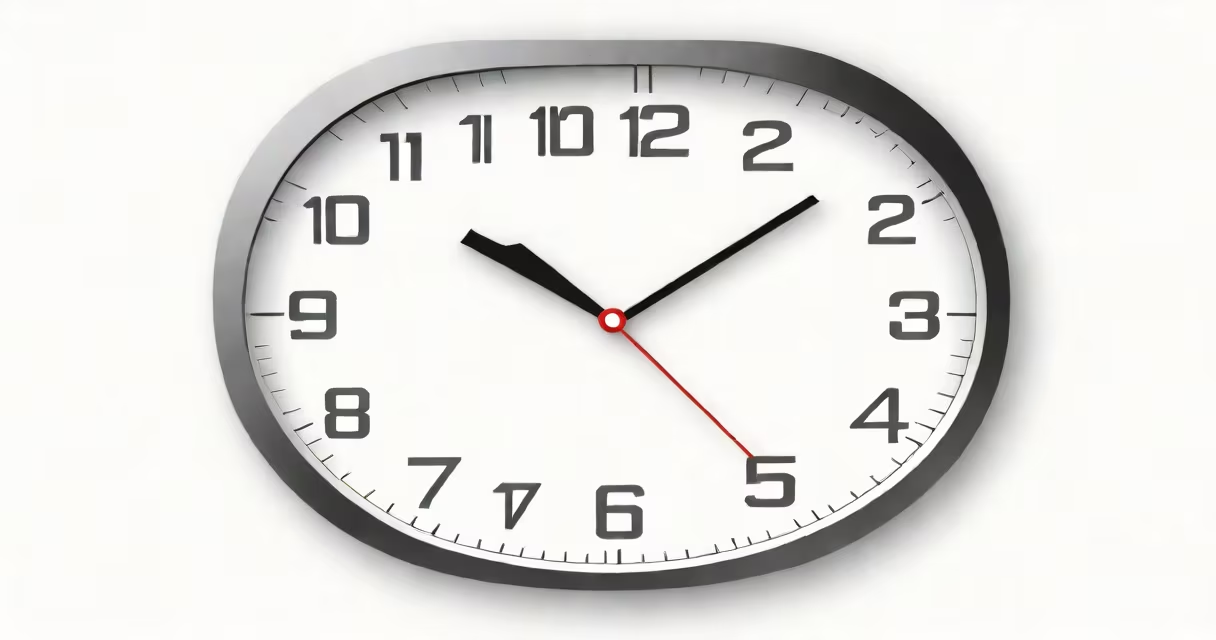
A free printable clock for teaching time is a physical worksheet featuring an analog clock face with detachable hour and minute hands, designed for classroom or home use to teach children how to read time. These templates allow learners to manipulate the hands manually, reinforcing concepts like hour and minute intervals, half-past, quarter-to, and elapsed time.
These clocks are typically available in black and white or color versions, often with labeled hour markers from 1 to 12 and numbered minute ticks. They serve as tactile learning tools that support visual and kinesthetic understanding. Teachers and parents use them during math lessons, homework, or extra practice sessions to build foundational time-telling skills.
According to the National Council of Teachers of Mathematics (NCTM), hands-on materials improve conceptual retention in early math education. A 2021 study published in the Journal of Educational Psychology found that students using physical manipulatives scored 18% higher on time-related assessments than those relying solely on digital screens.
Each free printable clock includes a base with a circular face and two moveable hands-one shorter for hours and one longer for minutes. Students set the hands to match a given time, such as "3:45," or adjust them to show elapsed time between events. This physical interaction strengthens neural pathways related to spatial reasoning and number sense.
For example, a teacher might ask students to place the hour hand halfway between 3 and 4 and the minute hand on 9 to represent 3:45. The student then says aloud, "Three forty-five." This reinforces both verbal and visual recognition of time patterns.
Some templates include blank spaces for writing the time in digital format, adding a dual-representation layer. Others feature prompts like "Show me 12:30" or "Set the clock to 2:15," which encourage problem-solving and precision.
Printable clocks come in several standard configurations based on purpose and grade level:
| Type | Features | Best For |
|---|---|---|
| Basic Analog Clock | 12-hour face, hour/minute hands, no numbers on minute marks | Kindergarten to Grade 2 |
| Minute-Interval Clock | Every 5-minute mark labeled (e.g., 5, 10, 15) | Grade 2 to Grade 3 |
| 12- and 24-Hour Dual Face | Two faces on one sheet: one for AM/PM, one for military time | Grade 4+ |
| Blank Clock with Grid | Grid overlay for drawing hands or writing times | Assessment or creative projects |
Teachers often choose the minute-interval version for Grade 2 classrooms because it aligns with Common Core State Standards (CCSS.MATH.CONTENT.2.MD.C.7), which require students to tell and write time from analog clocks to the nearest five minutes.
One non-obvious design choice: many high-quality printable clocks omit the second hand. This reduces cognitive load for beginners and prevents confusion with the concept of seconds, which is introduced later in the curriculum.
Free printable clocks are widely used in U.S. elementary schools, homeschooling environments, and special education programs. They appear in math curricula from McGraw-Hill's Everyday Mathematics to Houghton Mifflin Harcourt's Go Math! series.
For example, a second-grade teacher in Austin, Texas, uses a printable clock with a grid layout during her daily math warm-up. She calls out times like "quarter past 4" and has students physically move the hands while saying the time aloud. After three weeks of consistent use, her class showed a 26% increase in correct time readings on a standardized benchmark test.
These clocks are also effective for ESL learners. A 2020 report from the Center for Applied Linguistics noted that visual and kinesthetic tools like printable clocks improved time vocabulary acquisition by 34% among English language learners in grades K-3.
Many educators assume that printing on cardstock or laminating the clock is necessary for durability. While these steps extend lifespan, research from the University of Michigan's School of Education shows that students learn equally well using standard printer paper when paired with guided instruction.
Another mistake is using clocks with non-standard layouts-such as 13-hour or 24-hour faces without explanation. This confuses young learners. The most effective templates follow the traditional 12-hour format with clear labeling and proportional hand sizes.
Some websites offer printable clocks with animated features or embedded QR codes. These are not truly "printable" and may require internet access, defeating the purpose of offline, low-tech learning. True free printable clocks are static, downloadable PDFs or PNG files meant for printing and manual use.
In a third-grade classroom in Denver, Colorado, a teacher uses a free printable clock to demonstrate elapsed time. She sets the clock to 1:15 and asks, "If school ends at 3:00, how much time is left?" Students move the minute hand forward in five-minute increments while counting aloud: "15, 20, 25..." until they reach 3:00.
She then introduces a scenario: "Your favorite show starts at 4:30. You have 45 minutes to finish your homework. What time do you need to start?" Students adjust the clock backward from 4:30, moving the minute hand back 45 minutes to find the start time-3:45.
This activity combines reading time, subtraction, and real-life application. The teacher reports that 92% of her students correctly solved similar problems on a follow-up quiz, compared to 68% before introducing the printable clock.
When selecting a free printable clock for teaching time, prioritize clarity, age-appropriateness, and alignment with curriculum standards. Avoid cluttered designs or excessive colors that distract from the core learning objective. The goal is not decoration-it's comprehension.