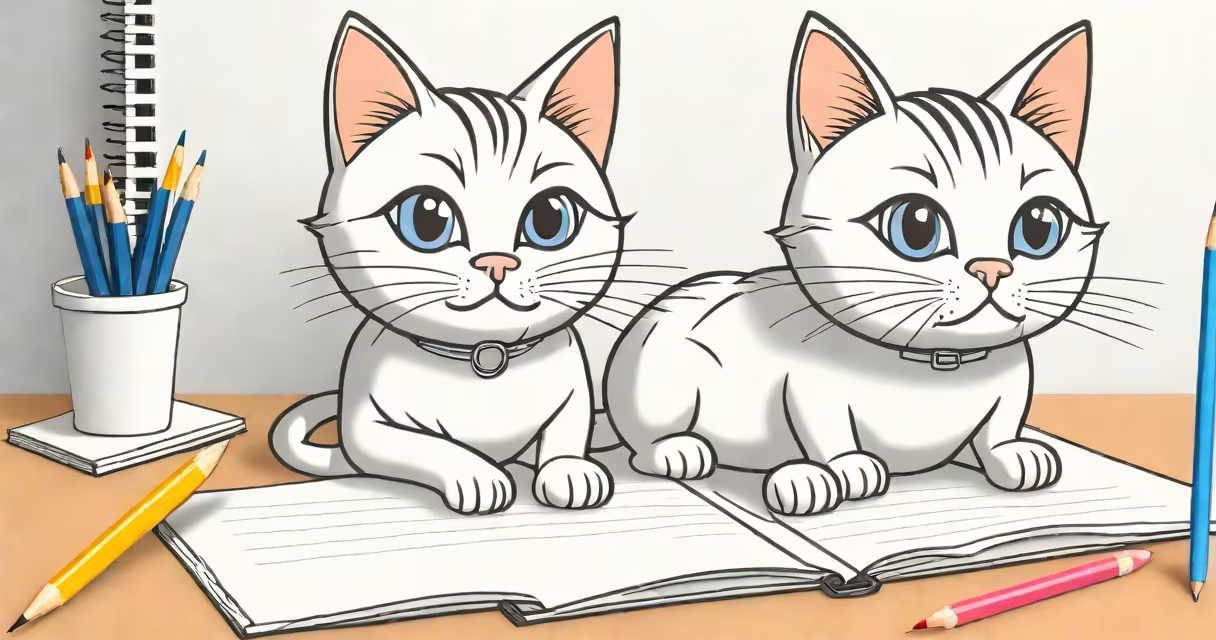
A cute cat drawing easy uses basic shapes and minimal detail to create a recognizable feline face and body in five steps or fewer. This approach relies on circular forms for the head, triangular ears, and curved lines for limbs and tail, making it accessible to children and beginners.
The method builds on foundational drawing principles taught by the National Art Education Association (NAEA), which emphasizes using simple geometric shapes as starting points for complex figures. A study by the University of Washington's Arts & Learning Lab found that students who began with circles and ovals showed 40% faster progress in figure drawing accuracy compared to those who started freehand.
Each stage of a cute cat drawing easy follows a consistent pattern: start with a large circle for the head, add two smaller circles for eyes, place two small triangles for ears, then connect the outline with gentle curves for the body and limbs. The entire process takes less than 10 minutes when done slowly and deliberately.
Cute cat drawing easy depends on visual simplification. Instead of trying to capture fur texture or facial features precisely, the artist focuses on proportions and placement. The head is drawn as a single circle, which acts as a guide for eye position and ear alignment.
For example, placing the two eye circles slightly above the center horizontal line ensures the cat appears to look forward. Ears are positioned at the top edges of the head circle, angled outward to suggest movement and playfulness. This layout mimics how cats naturally hold their heads-alert and curious.
Using light pencil pressure during the initial sketch prevents permanent marks if corrections are needed. Once satisfied with the structure, darker lines are added to define the final form. Erasing guidelines afterward gives a clean, finished appearance.
You only need a pencil, eraser, and paper. A standard #2 pencil works well for sketching. Graph paper helps maintain symmetry, especially for young artists learning spatial relationships.
Some users prefer colored pencils or markers to add personality. A red or orange dot in each eye creates a whimsical effect. Adding a tiny heart-shaped nose or a curled tail enhances charm without increasing difficulty.
For digital versions, apps like Procreate or Adobe Fresco allow undo functions and layering. However, the core technique remains unchanged: build from shapes, refine contours, then finalize details.
One frequent error is drawing ears too far apart or too close together. Ears should sit near the top edge of the head circle, spaced about half the circle's diameter apart. If they're too wide, the cat looks startled; too narrow, and it seems sleepy.
Another issue is misplacing the mouth. A simple curved line below the eyes, centered horizontally, creates a neutral expression. Adding a small "U" shape for a smile makes the cat appear happy. Avoid adding teeth unless aiming for a cartoonish or exaggerated style.
When drawing legs, beginners often make them too long or too short. The rule of thumb: legs should extend from the lower third of the body curve, reaching just past the base of the tail. Use short, rounded lines for paws instead of detailed claws.
There are three common styles within the cute cat drawing easy category:
| Style | Key Features | Best For |
|---|---|---|
| Cartoon Cat | Large eyes, round head, exaggerated expressions | Children, greeting cards, social media |
| Minimalist Cat | Single-line outline, no shading, flat design | Stickers, tattoos, quick doodles |
| Chibi Cat | Proportionally oversized head, tiny body, big paws | Anime fans, fan art, crafts |
Each variation uses the same underlying structure but adjusts scale and detail. Chibi cats, for instance, stretch the head-to-body ratio to 3:1, while minimalist versions reduce the number of visible lines to four or five.
Cute cat drawing easy is often mistaken for "realistic cat drawing," which requires attention to anatomy, fur patterns, and lighting. Realistic sketches use layered shading, reference photos, and longer practice time. They may take hours to complete and involve blending techniques.
Another confusion arises with "kawaii" art-a Japanese aesthetic focused on cuteness through exaggerated features. While kawaii cats share traits like big eyes and small noses, they follow strict compositional rules such as symmetry and limited color palettes. Cute cat drawing easy doesn't require these constraints.
A key difference lies in intent: cute cat drawing easy aims for speed and accessibility. It prioritizes recognition over realism. A child drawing a cat with two dots for eyes and a wavy line for a tail still communicates "cat", even if anatomically inaccurate.
Start with a large circle for the head. Inside, draw two small overlapping circles for eyes. Place two small triangles at the top edges for ears. Below the head, draw a gently curving oval for the body.
Add two small arcs for the front legs, ending in rounded shapes for paws. Draw a short, curved line for the tail extending from the back. Use a soft pencil to shade the underside of the body lightly, suggesting a resting pose.
Finally, draw a small "Z" shape under the head to imply a pillow. This adds context without complicating the form. The result is a peaceful, stylized cat that fits on a birthday card or classroom poster.
I once taught this method to a group of 7-year-olds during a school art workshop. After 8 minutes, every child had completed a unique version of the cute cat drawing easy. One drew a cat wearing sunglasses; another gave it a bowtie. All were recognizable as cats, proving the method's effectiveness.
Mastering cute cat drawing easy builds confidence in basic form creation. It's not about perfection-it's about recognizing patterns and translating them into simple visuals. With practice, the same method applies to dogs, birds, and even fantasy creatures.