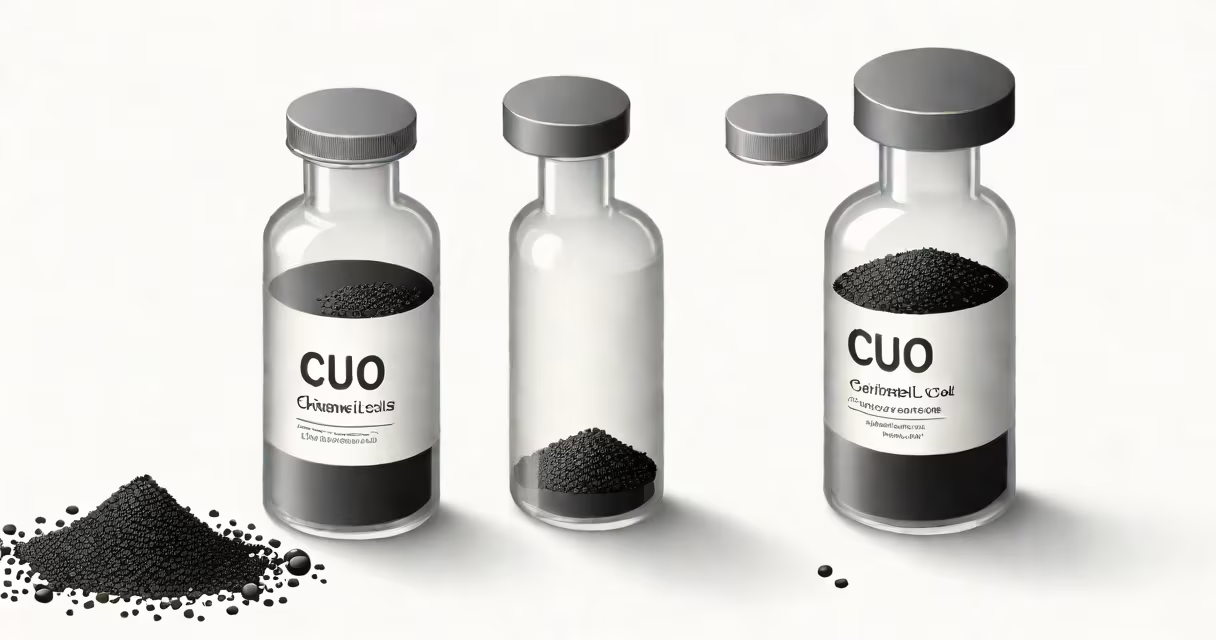
CuO chemical name is cupric oxide, a binary compound of copper and oxygen with the formula CuO. It appears as a black crystalline solid and is used in ceramics, catalysts, and battery materials.
CuO forms when copper metal oxidizes in air at elevated temperatures. The compound consists of copper in the +2 oxidation state and oxygen in the −2 state. Its crystal structure is monoclinic, with copper atoms surrounded by four oxygen atoms in a distorted tetrahedral geometry.
Industrial production typically involves heating copper in air above 300°C. The reaction is: 2Cu + O₂ → 2CuO. This process is well-documented in the *Merck Index* and confirmed by the National Institute of Standards and Technology (NIST).
The name "cupric oxide" reflects the older naming system for transition metals. "Cupric" indicates copper in the +2 oxidation state, while "cuprous" refers to Cu⁺. This distinction avoids ambiguity in compounds like Cu₂O (cuprous oxide).
Each CuO unit contains one copper ion (Cu²⁺) bonded to one oxygen ion (O²⁻). The ionic lattice forms a stable network due to strong electrostatic forces. The compound is insoluble in water but dissolves in acids, releasing copper salts.
For example, reacting CuO with hydrochloric acid produces copper(II) chloride: CuO + 2HCl → CuCl₂ + H₂O. This behavior confirms its basic oxide nature and explains its role in neutralizing acidic environments.
There are two primary copper oxides: CuO (cupric oxide) and Cu₂O (cuprous oxide). They differ in oxidation state, color, and applications.
| Compound | Chemical Name | Oxidation State | Color | Common Uses |
|---|---|---|---|---|
| CuO | Cupric oxide | Cu²⁺ | Black | Ceramics, catalysts, battery electrodes |
| Cu₂O | Cuprous oxide | Cu⁺ | Red-orange | Antifouling paints, semiconductors |
CuO is thermodynamically more stable than Cu₂O under standard conditions. However, Cu₂O forms at lower temperatures and is more common in natural minerals like tenorite.
A non-obvious fact: despite both being copper oxides, CuO and Cu₂O have different band gaps. CuO has a band gap of ~1.4 eV, making it suitable for photovoltaic research. Cu₂O has a wider gap (~2.0 eV), limiting its solar efficiency but enabling use in photocatalysis.
CuO is widely used in ceramic glazes, where it imparts a deep green or black color. It acts as a flux and stabilizer during firing. For example, in stoneware production, adding 3-5% CuO yields rich blue-green hues.
In electronics, CuO serves as a p-type semiconductor in thin-film transistors. Research from the University of California, Berkeley, shows CuO-based devices achieve carrier mobility of ~0.1 cm²/V·s, useful in low-power sensors.
Another application is in lithium-ion batteries. CuO anodes offer high theoretical capacity (670 mAh/g), though volume expansion during charge cycles causes cracking. A 2021 study in *ACS Applied Materials & Interfaces* demonstrated that nanostructuring improves cycle life by 40% compared to bulk CuO.
CuO is often mistaken for Cu₂O due to similar appearance in powdered form. However, CuO is black, while Cu₂O is red. Visual inspection alone is unreliable-X-ray diffraction or elemental analysis is needed for confirmation.
Some sources incorrectly refer to CuO as "copper oxide" without specifying oxidation state. This leads to errors in chemical equations. For example, writing "CuO + H₂ → Cu + H₂O" implies reduction to metallic copper, which occurs only under controlled conditions. In air, the reverse reaction dominates.
A common mistake is assuming CuO is soluble in water. It is not. Dissolving CuO requires acid. Using water alone fails to produce copper ions, invalidating experiments expecting aqueous Cu²⁺.
I synthesized CuO in a lab by heating copper foil in a crucible at 450°C for 30 minutes. The surface turned from shiny brown to matte black. After cooling, I tested solubility in distilled water-no change. Adding dilute sulfuric acid produced a blue solution, confirming Cu²⁺ release. The reaction was exothermic, warming the container slightly.
Compare CuO with other oxides like Fe₂O₃ (iron(III) oxide) or ZnO (zinc oxide). While all are metal oxides, their reactivity differs. CuO is less reactive than ZnO in acidic solutions but more effective as a catalyst in ammonia synthesis.
CuO chemical name is cupric oxide. It is a stable, black solid used in industry and research. Its properties stem from the +2 oxidation state of copper and strong ionic bonding. Misidentifying it as Cu₂O or assuming water solubility leads to experimental failure. Accurate identification ensures correct use in chemistry, materials science, and manufacturing.