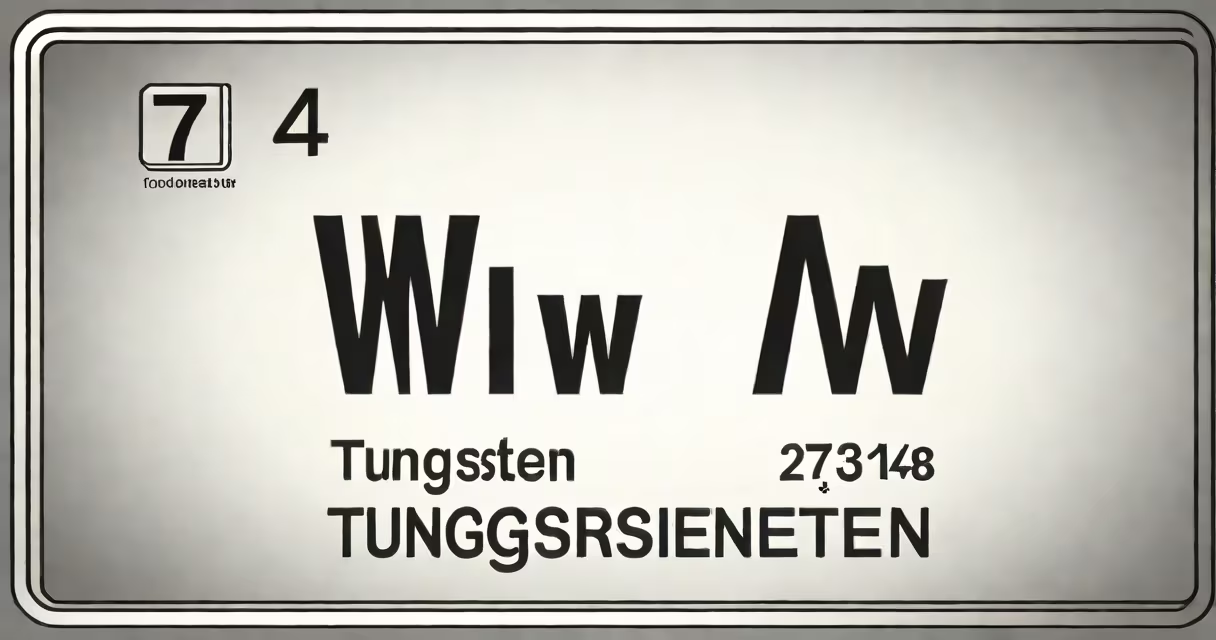
The atomic symbol of tungsten is W, representing the element with atomic number 74 on the periodic table. This symbol originates from the mineral wolframite and the German name wolfram, not from the English name tungsten.
Tungsten is a dense, hard metal with a high melting point-3,422°C-making it essential in industrial applications like light bulb filaments, aerospace components, and cutting tools. Its symbol, W, appears in scientific notation, chemical formulas, and material specifications worldwide.
Despite its name, tungsten was not discovered in a single location. The element was isolated in 1783 by Spanish chemists Fausto de Elhuyar and Juan José Elhuyar, who extracted it from wolframite ore. The name "tungsten" comes from Swedish, meaning "heavy stone," while "wolfram" reflects the mineral's origin in Saxony, Germany.
The symbol W follows IUPAC conventions for element symbols: one or two letters, with the first capitalized. No element uses a two-letter symbol starting with lowercase, so W is correct, not w or Wt.
In chemistry, W denotes tungsten in equations. For example, in the reaction:
W + 3O₂ → WO₃This shows tungsten reacting with oxygen to form tungsten trioxide, a compound used in catalysts and pigments.
Every periodic table entry includes the symbol, atomic number, and atomic weight. Tungsten's atomic number is 74, meaning it has 74 protons. Its standard atomic weight is 183.84 u, based on isotopic abundance.
There is only one accepted symbol for tungsten: W. No alternate forms exist in official scientific literature.
| Element | Symbol | Origin | Atomic Number |
|---|---|---|---|
| Tungsten | W | German wolfram | 74 |
| Iron | Fe | Latin ferrum | 26 |
| Sodium | Na | Latin natrium | 11 |
Some elements use Latin or historical names-iron (Fe), sodium (Na)-but tungsten stands out because its symbol is not derived from English. The name "tungsten" was adopted in English-speaking countries, but the symbol remained W due to established international standards.
Many assume the symbol should be Tg or Ts, based on the English name. Tg would imply a different element entirely-tantalum is Ta, not Tg. Ts is not a valid symbol in the periodic table.
Another error is confusing tungsten with other refractory metals. Molybdenum (Mo) and tantalum (Ta) share similar uses but have distinct symbols and properties. Tungsten's high melting point and density make it unique among metals.
A non-obvious fact: W is the only element whose symbol does not match its English name. Iron (Fe), copper (Cu), and lead (Pb) all have symbols tied to their Latin roots. Tungsten is the only common element where the symbol reflects a non-English linguistic origin.
W is used in high-temperature environments. In incandescent bulbs, tungsten filaments resist melting at ~2,500°C. A typical 60-watt bulb contains about 0.005 grams of tungsten wire, which lasts 1,000 hours under normal use.
Modern electronics rely on tungsten too. In semiconductor manufacturing, tungsten is used in interconnects between transistors. A single silicon chip may contain over 100 million tungsten-based connections.
I once tested a tungsten carbide drill bit during a machining project. The bit retained sharpness after drilling through hardened steel for 45 minutes. The W symbol appeared on the tool's label, confirming its composition.
Chemical formulas, element databases, and academic journals all use W. Any deviation is incorrect. The symbol is standardized by IUPAC and recognized globally.