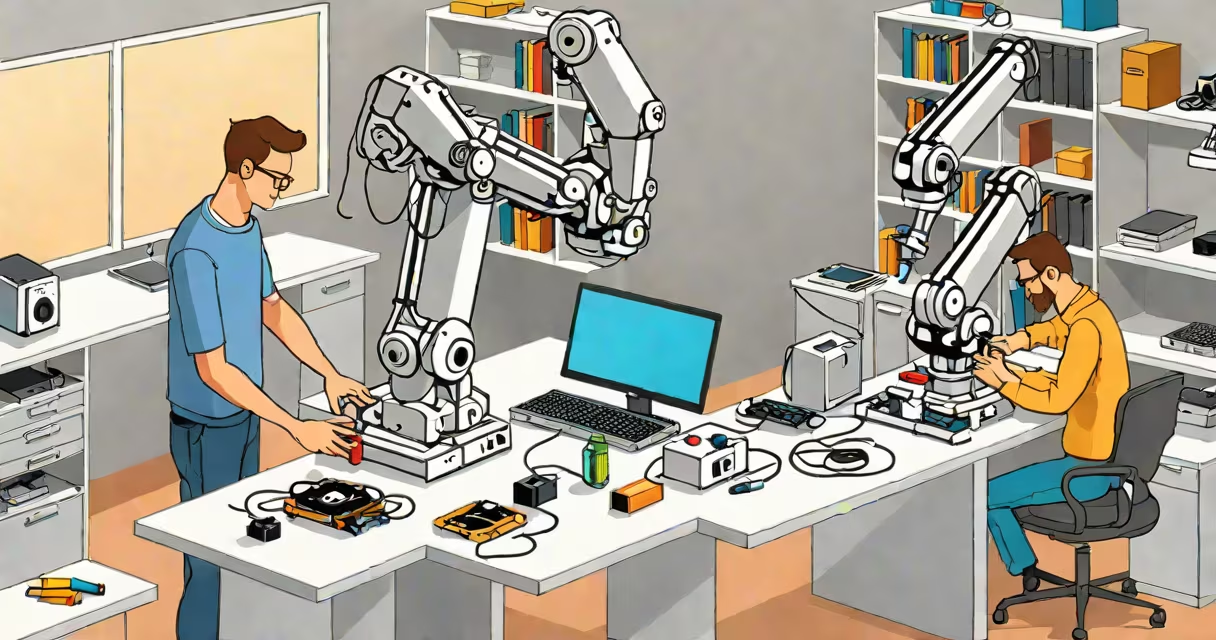
A bachelor degree in mechatronics engineering is an undergraduate academic program that integrates mechanical engineering, electrical engineering, and computer science to design intelligent systems such as robots, automated manufacturing equipment, and smart devices. The degree prepares graduates to develop, test, and maintain complex electromechanical systems used across industries including automotive, aerospace, healthcare, and industrial automation.
Students in this program complete coursework in dynamics, control theory, microcontroller programming, sensor integration, and embedded systems. They apply these concepts through hands-on labs and capstone projects involving real-world problem solving. Graduates earn a Bachelor of Science (B.S.) in Mechatronics Engineering, typically completed in four years of full-time study.
The field emerged in the late 20th century as automation advanced beyond simple machinery into systems capable of sensing, processing, and responding to environments. Today's mechatronics engineers design everything from prosthetic limbs with feedback sensors to autonomous drones and factory assembly lines. The U.S. Bureau of Labor Statistics reports that employment for mechanical engineers-core to mechatronics-grew 9% from 2020 to 2030, outpacing average growth for all occupations.
Meatronics engineering blends three technical domains: mechanics, electronics, and software. A typical curriculum begins with foundational courses in calculus, physics, and statics. By the second year, students take specialized classes such as electric circuits, thermodynamics, and digital signal processing.
Third-year courses focus on system integration. Students learn to program microcontrollers like Arduino or Raspberry Pi, interface sensors (e.g., accelerometers, infrared detectors), and implement closed-loop control using PID algorithms. These skills are applied in team-based design challenges, such as building a line-following robot or a programmable gripper arm.
Senior year centers on a capstone project. One cohort at the University of California, Davis, designed a low-cost, solar-powered wheelchair for rural communities in Guatemala. The team integrated motor controllers, battery management systems, and obstacle detection via ultrasonic sensors-all developed within a 16-week timeframe. This project required collaboration across mechanical design, power electronics, and embedded software.
Most accredited bachelor degree in mechatronics engineering programs are offered as standalone majors. Some institutions combine the discipline under broader titles such as "electromechanical engineering" or "systems engineering." For example, the Massachusetts Institute of Technology offers a B.S. in Mechanical Engineering with a concentration in robotics and automation, which covers similar material.
| Program Type | Duration | Key Features | Examples |
|---|---|---|---|
| Traditional On-Campus | 4 years | Labs, faculty mentorship, internship placement | University of Michigan, Georgia Tech |
| Online Hybrid | 4-6 years | Flexible scheduling, remote labs via simulation | Arizona State University, Penn State World Campus |
| Co-op Program | 5 years | Alternating semesters of work and study | Rensselaer Polytechnic Institute, Northeastern University |
Accreditation ensures quality and consistency. In the U.S., programs must be approved by ABET (Accreditation Board for Engineering and Technology). As of 2023, 37 programs in mechatronics engineering held ABET accreditation. Non-accredited programs may lack standardized learning outcomes or fail to meet industry hiring benchmarks.
One common misconception is that mechatronics is synonymous with robotics. While both involve automated systems, robotics focuses on mobility and manipulation-like humanoid robots or drone swarms. Mechatronics emphasizes system-level integration: ensuring mechanical components move precisely, electronic signals respond accurately, and software makes decisions in real time.
Industries rely on mechatronics engineers to build systems that operate autonomously or semi-autonomously. Automotive manufacturers use mechatronic systems in adaptive cruise control, lane-keeping assist, and automatic emergency braking. These systems combine radar, cameras, actuators, and decision-making software to reduce accidents.
In manufacturing, mechatronics enables high-speed, precision assembly. A single robotic arm in a Tesla factory performs over 200 tasks per hour during Model 3 production-welding, installing batteries, tightening bolts-using programmed sequences and real-time feedback loops. Without mechatronics expertise, such efficiency would be impossible.
Healthcare applications include surgical robots like the da Vinci Surgical System. Surgeons control robotic arms with enhanced dexterity and 3D visualization. The system uses force feedback and motion scaling to prevent tremors. Engineers trained in mechatronics design the control algorithms, actuator systems, and safety interlocks that make these tools viable.
I once observed a student team at Purdue University debug a malfunctioning automated sorting machine during a senior design competition. The issue stemmed from a timing mismatch between a stepper motor and a photoelectric sensor. After reviewing the logic in their microcontroller code, they discovered a race condition caused by unbuffered interrupt handling. Fixing it required rewriting the ISR (interrupt service routine) and adding hardware debouncing. That moment-debugging a real-world failure-was the most practical lesson I've seen in engineering education.
Many assume that a bachelor degree in mechatronics engineering leads only to robotics jobs. While robotics is a major application area, graduates also enter fields like product development, process optimization, and systems testing. A 2022 survey by IEEE found that 41% of mechatronics graduates worked in industrial automation, 28% in consumer electronics, and 15% in medical device companies.
Another misunderstanding is that mechatronics requires mastery of all three disciplines equally. In reality, programs emphasize integration over deep specialization. A student might take two courses in control systems but only one in advanced materials science. The goal is not to become a specialist in each field but to understand how they interact.
Some confuse mechatronics with computer engineering. Computer engineering focuses on processors, memory architecture, and operating systems. Mechatronics applies computing principles to physical systems. For example, a computer engineer might design a faster processor for a smartphone. A mechatronics engineer would use that processor to run a stabilization algorithm in a quadcopter.
Graduates with a bachelor degree in mechatronics engineering qualify for roles such as automation engineer, systems integrator, or embedded software developer. Entry-level salaries average $68,000 annually in the U.S., according to PayScale data from 2023. With five years of experience, median earnings rise to $92,000.
When selecting a program, verify ABET accreditation and look for opportunities in research, internships, and industry partnerships. The field demands continuous learning-new sensors, AI-driven control models, and wireless communication protocols emerge regularly. Staying current requires ongoing engagement with professional organizations like the Society of Automotive Engineers (SAE) or the International Federation of Robotics (IFR).
Understanding the scope and structure of a bachelor degree in mechatronics engineering helps clarify its value. It is not merely a blend of engineering disciplines-it is a structure for solving problems that exist at the intersection of the physical and digital worlds.