Martin Luther King Jr. was a Baptist minister and social justice activist who became the most visible leader of the American civil rights movement from 1955 until his assassination in 1968. He advocated for racial equality using nonviolent civil disobedience inspired by Mahatma Gandhi's methods.
King emerged as a national figure during the Montgomery bus boycott, a 381-day protest against segregated public transportation in Alabama. His leadership in organizing the boycott, which began after Rosa Parks' arrest, demonstrated the power of sustained peaceful protest. The U.S. Supreme Court later ruled that segregation on public buses violated the Constitution.
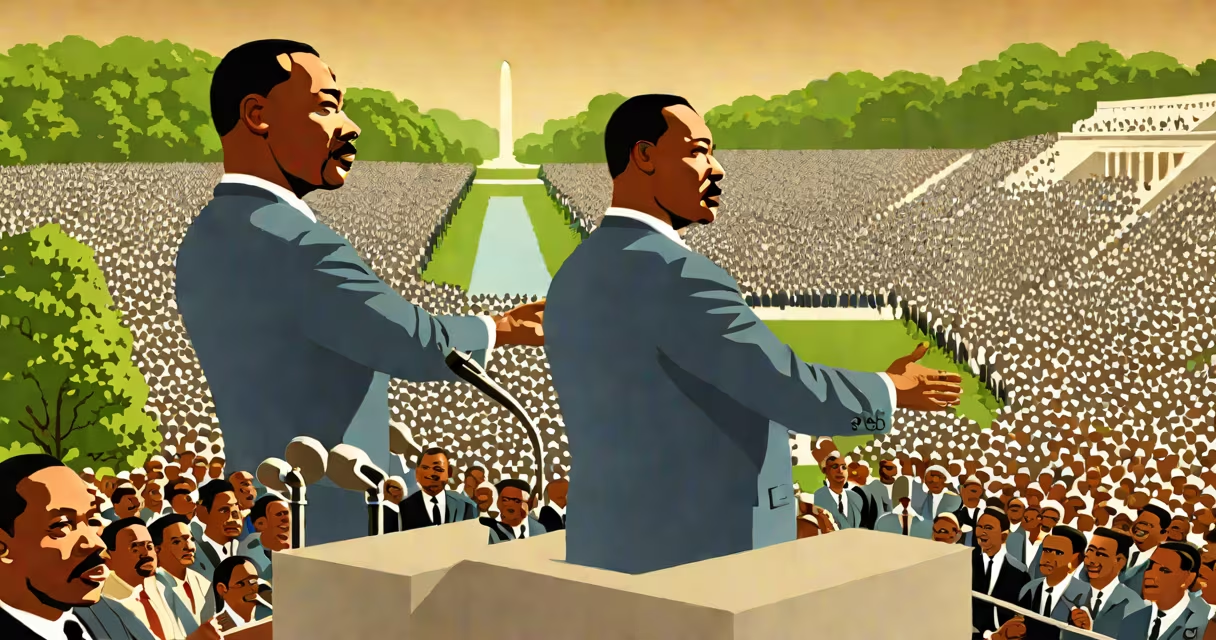
He founded the Southern Christian Leadership Conference (SCLC) in 1957 to coordinate nonviolent direct action across the South. Through speeches, marches, and sit-ins, King challenged Jim Crow laws and systemic discrimination. His 1963 "I Have a Dream" speech at the March on Washington drew over 250,000 people and helped build momentum for the Civil Rights Act of 1964.
King's strategy relied on moral persuasion and disciplined nonviolence. He believed that confronting injustice with peace exposed the immorality of segregation and appealed to the conscience of the nation. This approach contrasted sharply with more militant voices in the movement, such as Malcolm X, who emphasized Black self-defense.
He organized mass demonstrations under the principle that peaceful protests would draw media attention and pressure lawmakers. During the 1965 Selma to Montgomery marches, televised images of police attacking unarmed marchers shocked the country. These events contributed directly to the passage of the Voting Rights Act of 1965.
King's philosophy was rooted in Christian ethics and the teachings of Jesus, particularly the Sermon on the Mount. He argued that love-not hatred-was the only force capable of transforming society. In his 1963 "Letter from Birmingham Jail," he defended civil disobedience, stating that unjust laws must be challenged openly and peacefully.
King's influence extended beyond speeches. He played a central role in several landmark campaigns:
His work earned him the Nobel Peace Prize in 1964, making him the youngest recipient at age 35. The award recognized his commitment to nonviolence and racial justice.
Many assume King's activism was limited to the South. In reality, he expanded his focus to economic inequality and opposition to the Vietnam War. In 1967, he publicly denounced U.S. involvement in Vietnam, calling it "an enemy of the poor." This stance alienated some allies and led to increased surveillance by the FBI.
Another misconception is that King's message was universally accepted. The FBI monitored him closely, wiretapped his phones, and attempted to discredit him. A 1964 FBI memo labeled him a "potential security risk" due to his growing influence and criticism of U.S. foreign policy.
His legacy is sometimes oversimplified into a single iconic speech. But King's work spanned over a decade, involved complex coalition-building, and required constant negotiation with local leaders, federal agencies, and religious groups.
King was born in Atlanta, Georgia, in 1929. He studied sociology at Morehouse College, earned a divinity degree from Crozer Theological Seminary, and completed a doctorate in systematic theology at Boston University. His academic training shaped his rhetoric and ethical structure.
He married Coretta Scott King in 1955. Their marriage was both personal and political-she supported his work and continued advocating for civil rights after his death. She later founded the Martin Luther King Jr. Center for Nonviolent Social Change in Atlanta.
King's speeches were carefully crafted. The "I Have a Dream" address, delivered on August 28, 1963, included biblical references, historical allusions, and rhythmic repetition. He rehearsed it multiple times, adapting it based on audience response. The final version included the now-famous line: "I have a dream that my four little children will one day live in a nation where they will not be judged by the color of their skin but by the content of their character."
King's principles remain relevant in modern movements like Black Lives Matter. Protesters cite his methods when demanding accountability from law enforcement and calling for policy reform. His emphasis on dignity, justice, and nonviolence continues to inform grassroots activism.
His birthday is observed as a federal holiday in the United States since 1986. The holiday is observed on the third Monday of January each year. It marks the first time a federal holiday honors a man whose life was dedicated to peace and justice.
When I attended a commemoration event in Atlanta in 2019, I saw students reciting excerpts from his speeches. One young woman stood at the podium and said, "We're still waiting for that dream." Her voice cracked. The silence that followed was not empty-it was full of recognition.
Some claim King plagiarized parts of his speeches. Research by the King Center confirms that while he borrowed phrasing from earlier sermons and literature, he adapted them with original context and delivery. His use of rhetorical devices was deliberate and effective.
Another myth is that King's movement succeeded solely because of white support. In reality, Black communities organized the groundwork-churches hosted meetings, volunteers drove cars, and families provided food and shelter. White allies joined later, often after being moved by the courage of Black demonstrators.
King did not advocate for immediate integration. He sought desegregation through legal change and social transformation. He believed in gradual progress grounded in law and moral consensus, not forced assimilation.
Martin Luther King Jr. was not a mythical figure. He was a man who stood in the face of violence, fear, and institutional resistance. His life shows that change is possible when people organize, speak truth, and refuse to accept injustice. His legacy lives on in the ongoing struggle for equity and human dignity.