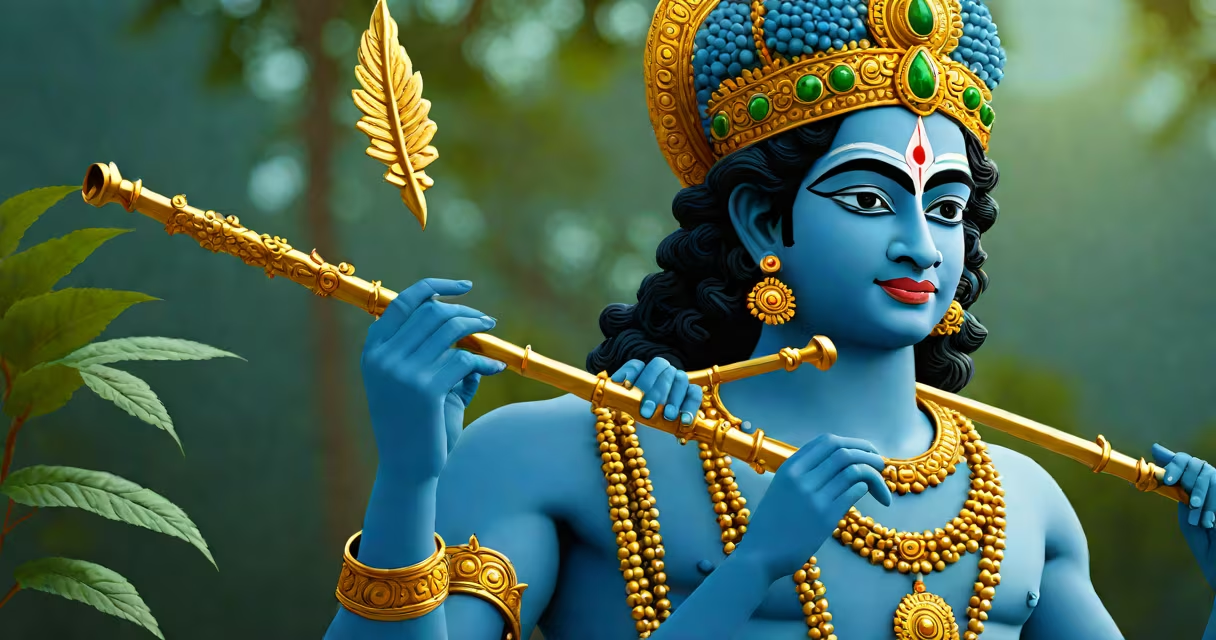
Krishna is a major deity in Hinduism, widely worshipped as the eighth avatar of Vishnu and a central figure in the Bhagavad Gita, where he delivers spiritual teachings to Arjuna on the battlefield of Kurukshetra. He embodies divine love, wisdom, and cosmic play (lila), appearing in both epic narratives and devotional traditions across India.
As an avatar, Krishna descends to restore dharma-moral order-during times of imbalance. His life spans childhood mischief, heroic deeds, and profound philosophical discourse. He is not merely a historical or mythical being but a living presence in temples, rituals, and daily worship across South Asia and the global Indian diaspora.
The Bhagavad Gita, part of the Mahabharata, records Krishna's dialogue with Prince Arjuna before the Kurukshetra War. In this exchange, Krishna teaches karma yoga-the path of selfless action-and jnana yoga, the way of knowledge. These teachings form the foundation of many modern interpretations of Hindu philosophy.
Primary sources describe Krishna through multiple roles. In the Harivamsa and Bhagavata Purana, he is portrayed as a mischievous child who steals butter (makhan chori), plays the flute, and lifts Govardhana Hill to shelter villagers from rain. These stories emphasize his divine nature and intimate connection with devotees.
In the Mahabharata, Krishna serves as a diplomat, charioteer, and strategic advisor to the Pandavas. He intervenes in critical moments-such as negotiating peace before war and guiding Arjuna's actions-showing his dual role as both a warrior and a sage.
His later life includes the destruction of the Yadava clan, which he foresees as inevitable due to internal conflict. Afterward, he retreats into solitude and eventually dies from a hunter's arrow wound, marking the end of the Dvapara Yuga and the beginning of Kali Yuga.
Krishna is often depicted with blue skin, symbolizing infinity and the infinite nature of the divine. He holds a flute (bansuri), representing the call of the soul to union with God. His iconography varies regionally: in Mathura and Vrindavan, he appears as a youthful cowherd; in Puri, he is shown in the form of Jagannath, a deified version with large eyes and simplified features.
Devotional movements centered on Krishna include Gaudiya Vaishnavism, founded by Chaitanya Mahaprabhu in the 15th century. This tradition emphasizes bhakti-devotional love-as the highest path to liberation. Chanting the Hare Krishna mantra remains a core practice in temples worldwide.
A lesser-known fact: Krishna's name appears in the Rigveda, though not as a full deity. The term "Krishna" (meaning "dark" or "all-attractive") occurs in hymns referring to a mysterious figure associated with fire and sacrifice. Over time, this evolved into the personal god known today.
Temples dedicated to Krishna span from the Himalayas to Tamil Nadu. The most famous is the Sri Krishna Temple in Udupi, Karnataka, established in the 13th century by Madhvacharya. This temple follows the Dvaita school of Vedanta, which teaches eternal separation between soul and God-a contrast to Advaita's non-dualism.
During festivals like Janmashtami, millions gather to celebrate Krishna's birth. In Vrindavan, processions feature costumed dancers portraying Krishna's youth, while in Bengal, dramatic enactments of his leelas (divine plays) draw large crowds. The festival includes fasting, singing, and midnight celebrations when the idol is bathed and dressed in new clothes.
Some assume Krishna is solely a romantic or playful figure due to his association with Radha and the gopis. However, his role extends beyond love and music-he is a moral guide, a political strategist, and a metaphysical teacher. The Bhagavad Gita is not a war manual but a treatise on duty, detachment, and inner freedom.
Another misconception is that Krishna was a historical person. While scholars debate whether he lived around 1500 BCE, archaeological evidence for him is indirect. The earliest textual references appear in the Mahabharata, composed between 400 BCE and 400 CE. The absence of direct physical evidence doesn't diminish his religious significance.
One key distinction: Krishna is not the same as Balarama, his elder brother and companion in many legends. Balarama is associated with plow and strength, while Krishna is linked to flute and compassion. They are distinct figures in the Puranas, though sometimes conflated in popular culture.
| Type | Description | Example |
|---|---|---|
| Childhood Krishna | Playful, mischievous, associated with butter theft and flute-playing | Vrindavan, Uttar Pradesh |
| Divine Statesman | Advisor and charioteer during the Mahabharata war | Kurukshetra battlefield, as described in the Bhagavad Gita |
| Philosophical Teacher | Delivers spiritual instruction in the Bhagavad Gita | Arjuna's chariot, 18 chapters of ethical and metaphysical discourse |
I once visited the Krishna Temple in Nathdwara, Rajasthan, during a morning puja. The air was thick with incense and the sound of bells. As the priest lifted the idol's hands in offering, a young boy nearby began chanting "Hare Krishna" in a high-pitched voice. The devotion wasn't performative-it was immediate, raw. That moment confirmed what texts only describe: Krishna is not a distant myth, but a presence felt in ritual, song, and silence.
Krishna is a multifaceted deity whose identity blends divine play, ethical teaching, and personal devotion. From the battlefield of Kurukshetra to the quiet gardens of Vrindavan, he remains a central figure in Hindu thought and practice. Whether seen as a lover, a warrior, or a philosopher, Krishna continues to inspire millions through scripture, art, and lived faith.