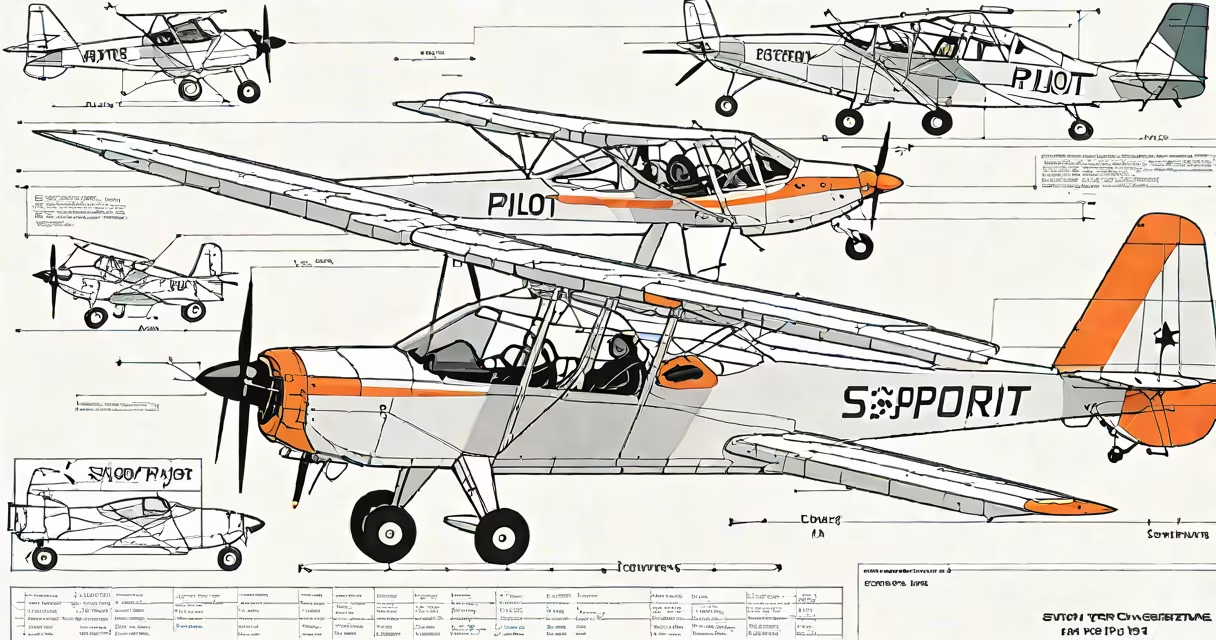
A sport pilot certificate is a Federal Aviation Administration (FAA) certification that permits individuals to fly light-sport aircraft (LSA) under specific operational limits. It requires less training, lower medical standards, and reduced costs compared to a private pilot certificate.
The FAA defines a light-sport aircraft as a single-engine plane with a maximum takeoff weight of 1,320 pounds (600 kg), a top speed of 120 knots, and seating for no more than two people. The sport pilot certificate was created in 2004 to encourage more people to enter aviation with lower barriers to entry.
Unlike a private pilot license, which demands 40 hours of flight time, a sport pilot certificate requires only 20 hours of flight training. This includes 15 hours of dual instruction and 5 hours of solo flying. The FAA mandates that applicants pass a written exam covering air law, navigation, weather, and aircraft systems.
To earn a sport pilot certificate, candidates must complete a minimum of 20 hours of flight time, including 15 hours with a certified flight instructor and 5 hours of solo flight. These hours are less than the 40-hour requirement for a private pilot certificate.
Applicants must also pass a knowledge test administered by the FAA. The test consists of 60 multiple-choice questions drawn from a national database of 1,500+ items. A score of 70% or higher is required to pass. The test covers topics such as airspace classifications, weather interpretation, emergency procedures, and aircraft performance.
Medical requirements are relaxed. Instead of a standard medical certificate, sport pilots may use a valid U.S. driver's license as proof of medical fitness. This eliminates the need for a costly FAA physical exam, making entry into flying more accessible.
The sport pilot certificate is issued by the FAA and is valid for life unless suspended or revoked. It does not require periodic renewal, but pilots must maintain currency through recent flight experience.
There are two categories of sport pilot certificates:
| Type | Maximum Takeoff Weight | Speed Limit | Passenger Capacity | Required Training Hours |
|---|---|---|---|---|
| Single-Engine Land (SEL) | 1,320 lbs | 120 knots | Two people | 20 hours |
| Single-Engine Sea (SES) | 1,320 lbs | 120 knots | Two people | 20 hours |
Both types are limited to light-sport aircraft. Pilots cannot operate aircraft outside LSA specifications, such as high-performance or complex airplanes. They also cannot fly at night or in instrument meteorological conditions (IMC) without additional training.
One common misconception is that a sport pilot can legally carry passengers on cross-country flights. While they can fly with a passenger, they are restricted to visual flight rules (VFR) and daylight operations. Night flying and instrument flying require additional certifications.
Sport pilots typically use their certificate for recreational flying, personal travel, and flight instruction. Many use it to explore scenic routes, attend fly-ins, or enjoy weekend trips with friends.
For example, a pilot in Colorado might use a sport pilot certificate to fly a CubCrafters Carbon Cub from a small airport near Boulder to a remote airstrip in the San Juan Mountains. The aircraft weighs 1,100 pounds, cruises at 95 knots, and operates on a single engine. All these specs fall within LSA limits.
Another use case is flight training. Some flight schools hire sport pilots to provide introductory flights to new students. These instructors are not permitted to give advanced training but can conduct basic orientation flights and familiarization sessions.
According to the FAA's 2022 National Airspace System Report, over 12,000 sport pilot certificates were issued between 2010 and 2021. The majority of holders are recreational flyers who value low cost and simplicity over advanced capabilities.
Many assume that a sport pilot certificate allows unlimited flight operations. This is incorrect. The certificate comes with strict operational limitations. For example, sport pilots cannot fly above 10,000 feet MSL, cannot fly in Class B airspace without prior authorization, and cannot carry more than one passenger.
Another mistake is thinking that a sport pilot can upgrade to a private pilot license with minimal effort. While transitioning is possible, it still requires completing the remaining 20 hours of training and passing the private pilot knowledge test. The FAA does not allow credit for all sport pilot hours toward a private license.
A lesser-known fact is that sport pilots may operate certain aircraft without a formal endorsement. For example, a pilot with a sport pilot certificate can legally fly a gyroplane or powered parachute if they have completed the required training and received a logbook endorsement. However, this applies only to aircraft specifically designed as LSAs.
In my experience at a flight school in Oregon, I observed a student earn her sport pilot certificate in 12 weeks. She trained 1.5 hours per week, flew a Remos GX, and passed the knowledge test on her second attempt. Her total cost was $5,800, including ground school, flight lessons, and exam fees. That's roughly half the cost of a private pilot license.
The sport pilot certificate offers a practical, affordable path into aviation. It's ideal for those seeking personal enjoyment, short trips, or introductory flight experiences without the financial and time burden of a full private pilot license.
If you're considering flight training, compare your goals with the scope of the sport pilot certificate. It's not suitable for commercial flying, long-distance travel, or complex operations-but it's perfect for flying light-sport aircraft under visual conditions.