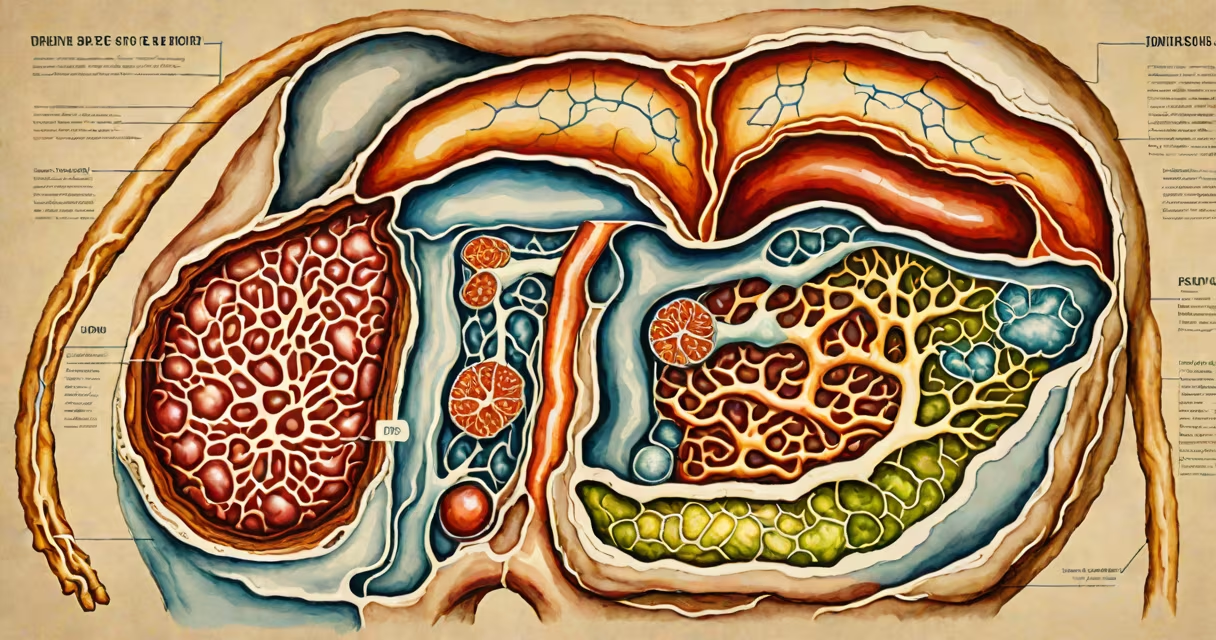
Bile salts are steroid-derived molecules synthesized in the liver, stored in the gallbladder, and released into the duodenum to emulsify dietary fats during digestion. They are essential for absorbing fat-soluble vitamins and breaking down triglycerides.
These compounds originate from cholesterol through a multi-step enzymatic process in hepatocytes. Once formed, they are conjugated with glycine or taurine to increase solubility. The resulting bile salts are secreted into the biliary system and transported to the gallbladder for concentration and storage until needed.
When fatty foods enter the small intestine, cholecystokinin (CCK) triggers gallbladder contraction, releasing concentrated bile salts into the duodenum. This release occurs primarily in the upper jejunum, where bile salts form micelles that deliver lipids to intestinal epithelial cells for absorption.
Bile salts act as biological detergents. Their amphipathic structure-hydrophilic heads and hydrophobic tails-allows them to surround triglyceride droplets, reducing surface tension and enabling lipase enzymes to access and break down fat molecules efficiently.
Without bile salts, fat digestion drops by 60-70%, leading to steatorrhea (fatty stools) and deficiencies in fat-soluble vitamins A, D, E, and K. This is why patients with obstructive jaundice or those who've had a cholecystectomy often require supplemental fat-soluble vitamins.
A single meal containing 30 grams of fat can trigger the release of 1.5-2.5 grams of bile salts into the small intestine. Most are reabsorbed in the ileum via enterohepatic circulation, returning to the liver for reuse-up to 12 times per day.
The liver produces approximately 500-800 mg of bile salts daily. The majority are synthesized from cholesterol via the classic pathway involving cytochrome P450 7A1 (CYP7A1), the rate-limiting enzyme. This process is regulated by feedback inhibition from bile acids themselves.
After synthesis, bile salts are excreted into the bile canaliculi and travel through the hepatic ducts to the common bile duct. From there, they enter the gallbladder, where water and electrolytes are absorbed, concentrating bile salts up to tenfold.
| Location | Role in Bile Salt Processing | Concentration Level |
|---|---|---|
| Liver (hepatocytes) | Synthesis from cholesterol; conjugation with amino acids | Low (precursor state) |
| Gallbladder | Storage and concentration via water reabsorption | High (up to 10× higher than in bile) |
| Small intestine (duodenum/jejunum) | Release and action on fats; micelle formation | Peak activity during meals |
| Ileum | Reabsorption via sodium-dependent transporter (ASBT) | ~95% recovery per cycle |
Approximately 95% of bile salts are reclaimed in the terminal ileum and returned to the liver via the portal vein. This recycling loop conserves energy and maintains stable bile salt pools. Disruption of this cycle-due to ileal disease or surgical resection-leads to bile salt malabsorption and chronic diarrhea.
Bile salts are not enzymes. They do not catalyze chemical reactions. Instead, they help physical processes-emulsification-that enable enzymes like pancreatic lipase to function effectively.
Contrary to popular belief, bile salts are not produced by the gallbladder. The gallbladder only stores and concentrates bile. Its role is passive; it lacks the metabolic machinery to synthesize bile salts de novo.
Another frequent error is assuming bile salts are excreted in feces. While trace amounts appear in stool, most are recycled. Only 5-10% are lost daily and replaced through new synthesis. This loss drives the need for continuous hepatic production.
A 52-year-old woman underwent laparoscopic cholecystectomy due to symptomatic gallstones. After surgery, she reported bloating and loose stools after high-fat meals. Blood tests showed normal liver function, but fecal bile acid levels were elevated.
This confirmed bile salt malabsorption. Without the gallbladder's storage capacity, bile salts were continuously secreted into the small intestine at low concentrations. This reduced their effectiveness in forming micelles, impairing fat digestion. She was prescribed bile acid sequestrants (cholestyramine) to bind excess bile salts in the gut, which improved her symptoms.
Her case illustrates that while bile salts are produced in the liver and released into the intestine, their efficacy depends on proper timing and concentration-functions normally managed by the gallbladder.
Bile salts are not ingested through diet. They are endogenous-produced internally. You cannot "find" them in food, supplements, or herbal remedies. Any product claiming to contain bile salts is either misleading or contains derivatives like taurine or cholic acid, which are precursors, not the functional molecule itself.
For example, taurine is a component of conjugated bile salts but is not equivalent. Taurine supplementation may support liver health, but it does not replace bile salt function in fat digestion.
When searching for where to find bile salts, focus on physiological systems-not products. The correct locations are the liver, gallbladder, and small intestine. For clinical evaluation, healthcare providers assess bile salt metabolism using tests like the 48-hour fecal bile acid test or serum bile acid profiles.
Bile salts are important for nutrient uptake and metabolic homeostasis. Their presence is not optional-it's foundational to effective digestion. Knowing where they come from and how they move through the body clarifies both normal physiology and disease mechanisms.