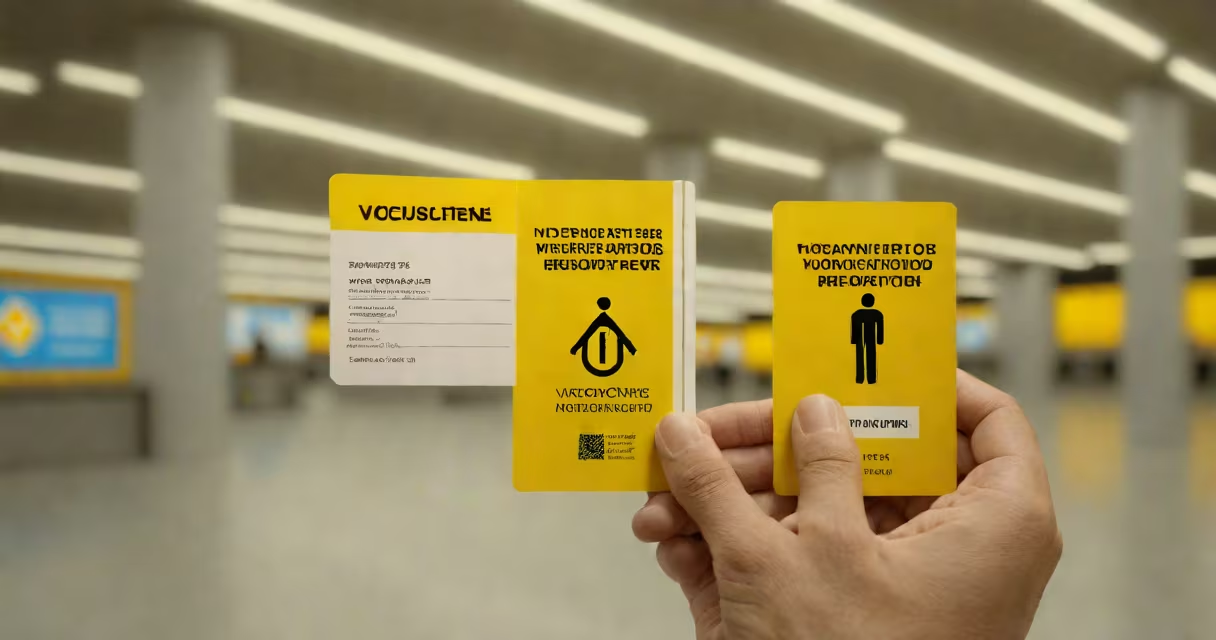
The yellow fever vaccine is required for entry into specific countries if you're arriving from a region with active transmission. This requirement applies regardless of your nationality and is enforced under international health regulations. You must show proof of vaccination via an official International Certificate of Vaccination or Prophylaxis (ICVP).
Travelers entering countries listed by the World Health Organization (WHO) as endemic for yellow fever must present a valid yellow fever vaccination certificate. The vaccine is administered at approved centers and becomes effective 10 days after injection. Countries may deny entry to unvaccinated travelers from affected areas.
According to the Centers for Disease Control and Prevention (CDC), 40 countries require yellow fever vaccination for travelers arriving from or transiting through designated risk zones. These rules apply even if you're only passing through the country. Failure to provide documentation can result in denial of entry or mandatory quarantine.
Entry rules are based on geographic risk, not individual immunity. If you're traveling from a country with ongoing yellow fever transmission, you must have received the vaccine at least 10 days before arrival. The vaccine is valid for life, so a single dose provides lifelong protection.
Health authorities define "risk zone" based on recent outbreaks, mosquito vector presence, and local surveillance. For example, countries in sub-Saharan Africa and tropical South America are classified as high-risk due to frequent cases and active transmission cycles. Even brief stops in these areas trigger the requirement.
Travelers who have previously been vaccinated do not need a booster unless they are returning to a risk zone after a long absence. The CDC confirms that a single dose remains effective for life, eliminating the need for revaccination.
Several nations enforce yellow fever vaccination as a condition of entry. The list includes Angola, Brazil, Colombia, Democratic Republic of the Congo, Ecuador, Gabon, Ghana, Kenya, Nigeria, Peru, Sierra Leone, Uganda, and Venezuela. Travelers arriving from these countries or transiting through them may be denied boarding or entry without a valid ICVP.
| Country | Region | Entry Rule |
|---|---|---|
| Brazil | South America | Required for travelers from risk zones |
| Ghana | West Africa | Mandatory for all arrivals from endemic areas |
| Peru | South America | Required if transiting through risk zones |
| Nigeria | West Africa | Enforced at major ports and airports |
Some countries, such as the United States and Canada, do not require the yellow fever vaccine for entry. However, if you're traveling from a country with yellow fever transmission, you may still be subject to screening at U.S. ports of entry. The CDC advises travelers to verify entry rules with the destination embassy before departure.
Many assume the yellow fever vaccine is only needed for long stays or jungle treks. This is incorrect. The requirement applies to all travelers, including business visitors and tourists, who enter a country from a risk zone. A short layover in a high-transmission area triggers the rule.
Another misconception is that the vaccine causes severe side effects. According to the WHO, serious adverse events occur in fewer than 1 in 100,000 doses. Most people experience mild reactions like soreness at the injection site or low-grade fever. The benefits far outweigh the risks in endemic areas.
A lesser-known fact: some countries accept a negative test result instead of vaccination. This is rare and only applies in emergency situations. The standard rule remains: proof of vaccination is required for entry into designated countries.
Consider a Nigerian citizen flying from Lagos to Rio de Janeiro with a 3-hour connection in Dakar, Senegal. Both Nigeria and Senegal are in yellow fever risk zones. The traveler must present a valid yellow fever vaccination certificate upon arrival in Brazil. Without it, Brazilian immigration officials may deny entry or require quarantine.
The traveler obtained the vaccine six weeks prior to departure at a WHO-approved center. The clinic issued an ICVP with the date of vaccination, the vaccine name, and the provider's signature. This document was presented at the airport check-in counter and verified by airline staff before boarding.
If the traveler had not been vaccinated, they would have faced delays, potential fines, or denial of boarding. The CDC states that airlines are required to refuse passengers without proper documentation, even if the destination country does not enforce the rule strictly.
Check the destination country's official website or contact the nearest embassy to confirm whether yellow fever vaccination is required. Use the WHO's interactive map of yellow fever risk zones or the CDC's travel health notice system for real-time updates.
Get vaccinated at a certified center. Not all clinics offer the vaccine. The CDC maintains a list of authorized yellow fever vaccination centers in the U.S. and abroad. You must receive the vaccine at a facility registered with national health authorities.
Keep your ICVP in a safe place. It is not replaceable if lost. Some countries require the original paper copy, not a digital version. Always carry the document with your passport during travel.
When in doubt, err on the side of caution. The yellow fever vaccine is one of the most effective tools in preventing a disease with a 20% fatality rate in untreated cases. Its global use has reduced outbreaks by over 90% since the 1950s, according to WHO data.
Travelers must meet international standards to ensure public health safety. The yellow fever vaccine is not optional in high-risk zones-it is a legal requirement for entry into dozens of countries. Compliance protects both individuals and communities.