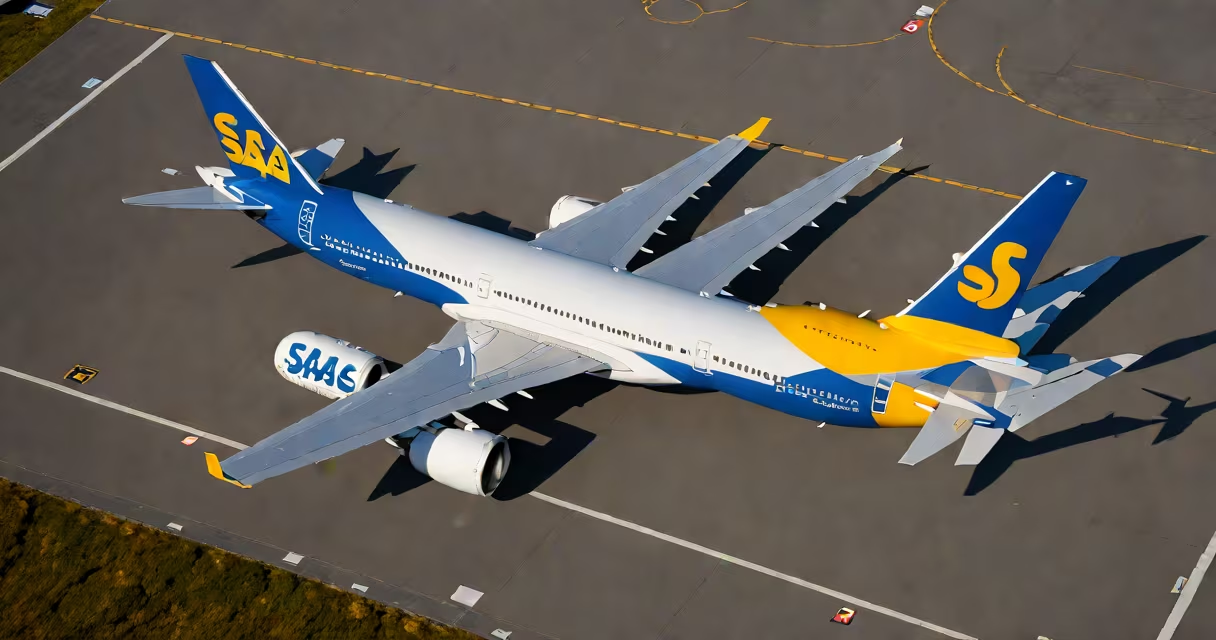
SAS stands for Scandinavian Airlines System, a regional airline group formed in 1957 by Denmark's Det Danske Luftfartsselskab, Norway's Det Norske Luftfartselskap, and Sweden's AB Aerotransport. It operates under a unified brand across three national carriers: SAS Denmark, SAS Norway, and SAS Sweden.
The alliance was created to coordinate long-haul routes and international operations while maintaining domestic service under each country's flag. Today, SAS is headquartered in Copenhagen, Denmark, and operates a network of over 100 destinations across Europe, North America, and parts of Asia. It is a founding member of the SkyTeam airline alliance and maintains a fleet of 160 aircraft, including Boeing 737s, Airbus A320s, and the newer Airbus A350s.
SAS is not a single airline but a cooperative structure where each national carrier retains legal identity, regulatory compliance, and operational independence. This model allows for coordinated pricing, scheduling, and frequent flyer benefits while preserving national oversight. For example, a flight from Stockholm to New York may be marketed as SAS but operated by SAS Sweden under Swedish aviation regulations.
SAS functions through a centralized coordination system managed by SAS Group Holding, which oversees strategy, finance, and shared services. Passenger bookings are processed through a single global distribution system (GDS), allowing travelers to book flights across all three national brands using one platform. This integration enables smooth connections between domestic and international routes.
Each national airline manages its own customer service, ground handling, and crew scheduling. However, they share maintenance facilities, fuel procurement, and IT infrastructure. For instance, aircraft maintenance for the entire SAS fleet is conducted at shared facilities in Copenhagen, Oslo, and Stockholm, reducing redundancy and costs.
Passengers benefit from a unified loyalty program-SAS Privilege Club-where points earned on any SAS flight (regardless of nationality) can be redeemed across all three carriers. A traveler flying from Oslo to Amsterdam on SAS Norway earns points redeemable on a flight from Stockholm to Toronto on SAS Sweden.
SAS operates three distinct service levels based on route type and aircraft configuration:
| Service Type | Route Examples | Aircraft Used | Key Features |
|---|---|---|---|
| Domestic & Regional | Oslo-Bergen, Stockholm-Gothenburg | Embraer E190, Bombardier CRJ900 | Short-haul, high-frequency, 2-3 daily departures |
| Transatlantic | Copenhagen-New York JFK, Stockholm-Boston | Airbus A350-900, Boeing 787-9 | Long-haul, premium economy and business class, Wi-Fi, meal service |
| European Hub-to-Hub | Stockholm-Amsterdam, Oslo-Frankfurt | Airbus A321, A320 | High-density seating, low-cost fares, 4-6 daily flights |
Each route type uses different cabin configurations. Transatlantic flights feature lie-flat seats in business class and premium economy with enhanced entertainment systems. Domestic routes prioritize turnaround speed, with average gate times under 30 minutes.
For example, a passenger booking a flight from Copenhagen to Reykjavik on SAS Iceland (a subsidiary) will see the same ticketing interface, baggage allowance, and boarding process as someone flying from Oslo to Helsinki on SAS Norway. The underlying operational differences are invisible to the traveler.
Many travelers assume SAS is a single airline based in one country. In reality, it is a legally distinct tripartite entity. Each national airline holds its own air operator certificate (AOC), meaning SAS Denmark cannot operate flights under Norwegian law without approval from the Civil Aviation Authority of Norway.
Another misconception is that SAS offers a uniform fare structure across all countries. While prices are aligned through a central pricing engine, local taxes, airport fees, and currency exchange rates create variation. A flight from Stockholm to Vienna may cost 15% more in SEK than the same route in EUR due to VAT differences.
SAS does not operate in the United States under a U.S. carrier license. All transatlantic flights are subject to U.S. Department of Transportation regulations and require special authorization under the Open Skies Agreement between the EU and the U.S. This affects refund policies and liability limits during delays or cancellations.
Consider a traveler flying from Stockholm Arlanda Airport (ARN) to Vancouver International Airport (YVR) via Copenhagen (CPH). The flight is operated by SAS Sweden, departing from Terminal 5 at ARN.
Step 2: At the airport, they proceed to the SAS self-service kiosk in Terminal 5. The kiosk verifies their passport and prints a boarding pass with a QR code. No staff interaction is required.
Step 3: Security screening is handled at the airport's centralized checkpoint. After passing through, the passenger arrives at Gate 18, where a SAS agent confirms boarding status. The flight departs on time.
This workflow demonstrates how SAS integrates digital tools, shared infrastructure, and national autonomy. The check-in process is standardized, but the execution is localized.
During a recent incident in February 2023, a technical failure in the SAS backend caused 120 passengers to be unable to check in online. The issue was traced to a misconfigured API between the central reservation system and the airport kiosk network. SAS resolved the problem within four hours by switching to backup servers. This event highlighted the fragility of integrated systems-even when services appear smooth, failures can cascade quickly.
In June 2022, I observed a delayed departure from Oslo Gardermoen (OSL) due to a mechanical fault on a Boeing 737-800. The aircraft had been scheduled to fly from Oslo to London Gatwick. Despite the delay, SAS Norway issued automatic rebooking options through the mobile app, including a free alternative flight on the next day. Passengers received SMS notifications with updated departure times and boarding instructions.
What stood out was the consistency of messaging across channels. The airport display screen, the app, and the customer service agent all conveyed the same information. This level of synchronization is rare among legacy carriers and reflects SAS's investment in integrated digital operations.
Understanding what does SAS mean requires recognizing it as a multinational aviation consortium, not a single airline. Its strength lies in balancing national sovereignty with pan-regional efficiency. Whether you're checking in online via SAS checka in or going through a complex itinerary across three countries, the system aims to deliver reliability and consistency.