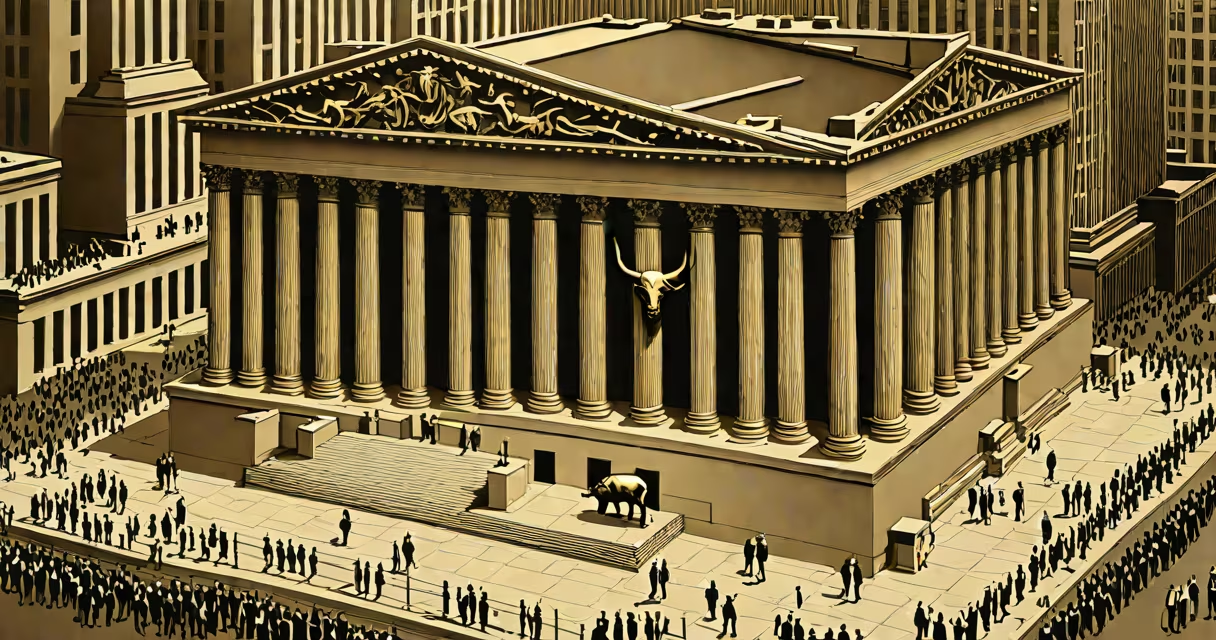
The New York Stock Exchange (NYSE) is headquartered at 11 Wall Street in Lower Manhattan, New York City. It operates as the world's largest stock exchange by market capitalization and serves as a central hub for global equity trading.
Founded in 1792 under the Buttonwood Agreement, the NYSE occupies a historic site where brokers gathered beneath a buttonwood tree to formalize trading rules. Today, the building at 11 Wall Street houses the physical trading floor, electronic systems, and administrative offices that manage one of the most influential financial institutions in the world.
While the NYSE conducts trades electronically through its hybrid system, the iconic trading floor remains operational for certain types of listings and high-profile events. The location is not just a business address-it symbolizes the center of U.S. capital markets and a key node in international finance.
The NYSE functions as a regulated marketplace where publicly traded companies list their shares for buying and selling. It uses a hybrid model combining electronic order matching with human specialists who manage specific stocks during periods of volatility or low liquidity.
Each trading day begins with a pre-market session, followed by regular trading hours from 9:30 a.m. to 4:00 p.m. Eastern Time. During these hours, orders flow through the NYSE's electronic trading platform, which processes millions of transactions daily. The exchange also supports after-hours trading via its extended hours services.
For example, on a typical trading day in 2023, the NYSE processed over 1.2 billion shares traded across its listed securities. This volume reflects the scale of investor activity and the efficiency of the exchange's infrastructure, which includes low-latency data feeds and direct connectivity to institutional traders.
The NYSE is owned by Intercontinental Exchange (ICE), a global operator of financial exchanges and clearinghouses. ICE acquired the NYSE in 2013 for $11 billion, integrating it into a larger network of markets including the NYSE Arca, which handles electronic trading for equities and options.
NYSE Arca is a distinct entity within the NYSE system. It operates as a fully electronic exchange focused on speed and automation. For instance, AEM stock (ticker: AEM) trades on NYSE Arca, where algorithmic strategies execute trades in milliseconds. Traders using this platform benefit from reduced latency and access to real-time market data.
When comparing the NYSE and NYSE Arca, the difference lies in execution method and regulatory oversight. The traditional NYSE maintains a hybrid model with designated market makers, while NYSE Arca relies entirely on electronic matching engines. Both are regulated by the Securities and Exchange Commission (SEC), but they serve different segments of the market.
| Feature | Traditional NYSE | NYSE Arca |
|---|---|---|
| Trading Model | Hybrid (floor + electronic) | Electronic-only |
| Execution Speed | Milliseconds to seconds | Microseconds |
| Market Makers | Designated specialists | Automated algorithms |
| Example Stock | Apple (AAPL) | AEM (AEM stock NYSE) |
Many assume the NYSE is a single physical location where all trades happen. In reality, only a fraction of trading occurs on the floor. Over 90% of NYSE-listed trades are executed electronically through systems like the NYSE Direct+ platform.
Another misconception is that the NYSE controls stock prices. It does not set prices-prices emerge from supply and demand across buyers and sellers. The exchange provides the infrastructure and rules, but market forces determine valuation.
I once observed a flash crash event in 2015 where a single order triggered rapid price swings in several NYSE-listed stocks. The system halted trading briefly for affected securities, demonstrating how automated safeguards prevent cascading failures. This incident highlighted that the NYSE's role is not to influence prices but to maintain orderly execution.
11 Wall Street is more than an address-it's a symbol of financial power. Proximity to major banks, regulators, and media outlets allows firms to respond quickly to market shifts. Firms like Goldman Sachs and JPMorgan Chase maintain offices nearby to support real-time trading decisions.
Geographic concentration also affects market efficiency. High-frequency traders often co-locate servers near the NYSE's data centers to reduce latency. One firm reported achieving 12-microsecond round-trip times between its server and the NYSE's matching engine, giving it a competitive edge in arbitrage and market-making.
Despite digital transformation, the physical presence of the NYSE remains significant. The building hosts investor summits, company listings, and press conferences. When Tesla went public in 2010, the ceremony was held at the NYSE floor, underscoring the symbolic weight of the location.
Understanding "where is NYSE" requires recognizing both its physical and digital dimensions. The exchange operates from a single address, but its reach extends globally through interconnected markets and data networks.
The NYSE's location at 11 Wall Street anchors its identity, but its function transcends geography. As a regulated marketplace, it enables transparency, liquidity, and trust across billions of dollars in daily transactions.