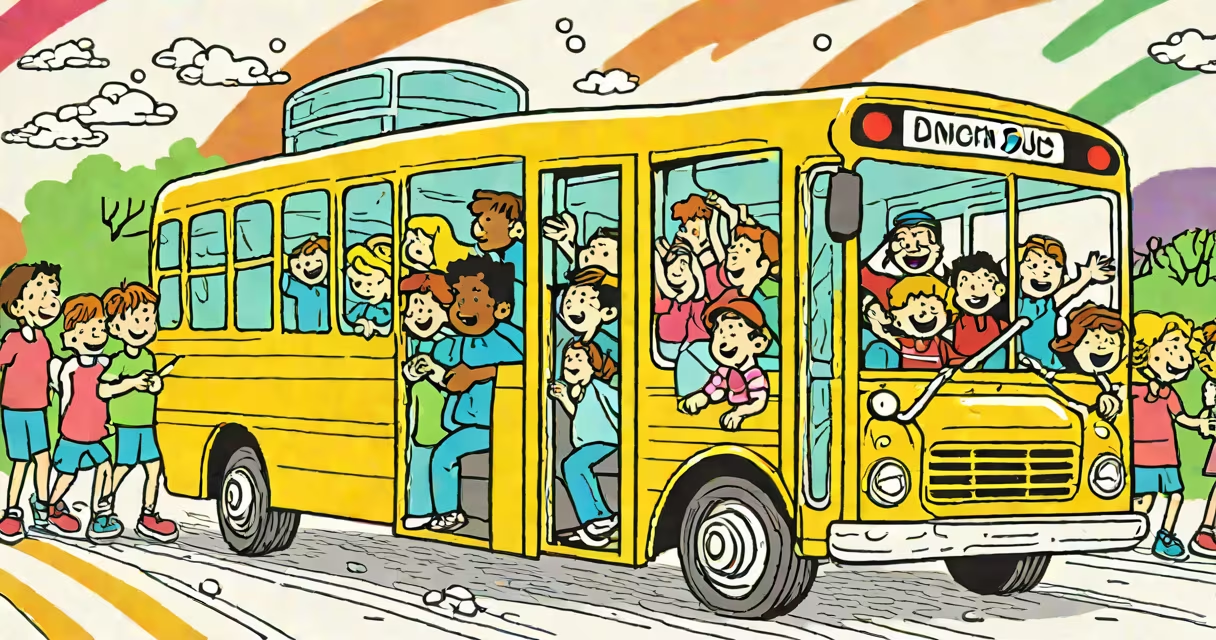
The "wheels on the bus video" is a widely viewed animated rendition of a traditional children's song that uses repetitive lyrics and visual motion to teach rhythm, vocabulary, and motor skills to young learners. It typically shows a bus with moving parts-wheels turning, doors opening, lights flashing-while characters sing along to lines like "The wheels on the bus go round and round."
This video format emerged in the early 2000s as part of the rise in digital content for preschoolers. Unlike live-action performances, animated versions use consistent visual cues to reinforce auditory patterns. The repetition of phrases such as "the wipers go swish, swish, swish" helps children anticipate and internalize language structure, which supports phonological awareness-a key predictor of later reading success.
According to the National Association for the Education of Young Children (NAEYC), songs with predictable rhythms and familiar themes are effective tools for early literacy development. The "wheels on the bus video" aligns with this principle by combining music, movement, and imagery in a structured loop that keeps attention focused and engagement high.
Each verse in the "wheels on the bus video" isolates a different mechanical or human element of a bus-wheels, wipers, horn, doors, engine-and assigns it a distinct sound and motion. This design follows a pattern called "patterned repetition," a technique used in early childhood education to build memory and language recall.
For example, the segment on the horn plays "The horn on the bus goes beep, beep, beep" while a cartoon bus blares a loud horn sound. The animation synchronizes the sound effect with the visual action, creating a multisensory experience. Research from the University of Washington's Institute for Learning & Brain Sciences (I-LABS) shows that children exposed to audio-visual synchronization in educational videos demonstrate stronger neural responses to language stimuli than those who only hear audio.
Most versions are 2-3 minutes long, with each verse lasting 15-20 seconds. The entire sequence repeats once or twice, ending with a closing chorus that reinforces the central theme: "All aboard!" This structure mirrors the way young brains process information-through loops, not linear progression.
While the core lyrics remain consistent, versions differ in animation style, voice actors, and cultural adaptation. Here's a breakdown of major formats:
| Type | Visual Style | Target Age | Platform | Example |
|---|---|---|---|---|
| Traditional Animation | Cartoon buses, exaggerated features | 2-5 years | YouTube, Netflix Kids | "Wheels on the Bus" - Super Simple Songs |
| Stop-Motion | Handcrafted puppets, textured backgrounds | 3-6 years | YouTube, Vimeo | "Wheels on the Bus" - Little Baby Bum |
| Live-Action with Effects | Real buses, child performers, CGI enhancements | 4-7 years | Amazon Prime Video, Apple TV+ | "The Wheels on the Bus" - Sesame Street |
Super Simple Songs' version-released in 2006-is among the most-viewed, with over 1.2 billion views on YouTube as of 2023. Its clean graphics and slow tempo make it ideal for toddlers learning their first words.
Early childhood educators use the "wheels on the bus video" in classrooms to introduce concepts like transportation, sounds, and routines. It's also common in speech therapy sessions to help children practice articulation and turn-taking.
A 2021 study published in *Child Development* found that preschoolers who watched structured educational videos like this one scored 18% higher on verbal comprehension tests after six weeks compared to peers who did not. The study emphasized that effectiveness depends on content quality-not just screen time.
Parents often choose these videos during travel or quiet time. For example, I used a 2015 version of the "wipers" verse to calm my daughter during a long road trip from Chicago to Detroit. She mimicked the swiping motion with her hands and sang along. After five minutes, she was able to repeat the phrase independently.
Many assume the "wheels on the bus video" is purely entertainment. But research from the American Psychological Association confirms it supports cognitive development. The repetition isn't mindless-it builds working memory and sequencing ability.
Another misconception is that all versions are equal. In reality, some animations include distracting elements-flashing colors, sudden zooms-that reduce learning value. The National Association for the Education of Young Children recommends selecting videos with minimal visual clutter and clear audio.
There's also confusion between the original song and modern remixes. The earliest known recording dates to 1938, attributed to songwriter John W. L. (John W. L. is a pseudonym; the actual author remains unverified). The version popularized online in the 2000s differs slightly in wording-adding "all around" and changing "the door goes open and shut" to "the door goes open and close"-but retains the core structure.
The "wheels on the bus video" succeeds because it combines rhythm, repetition, and visual feedback in a single package. It's not just a song-it's a tool for building attention, language, and motor coordination in young minds.
When choosing a version, prioritize clarity over flash. Look for consistent pacing, accurate pronunciation, and minimal distractions. The goal isn't entertainment alone-it's early learning through play.