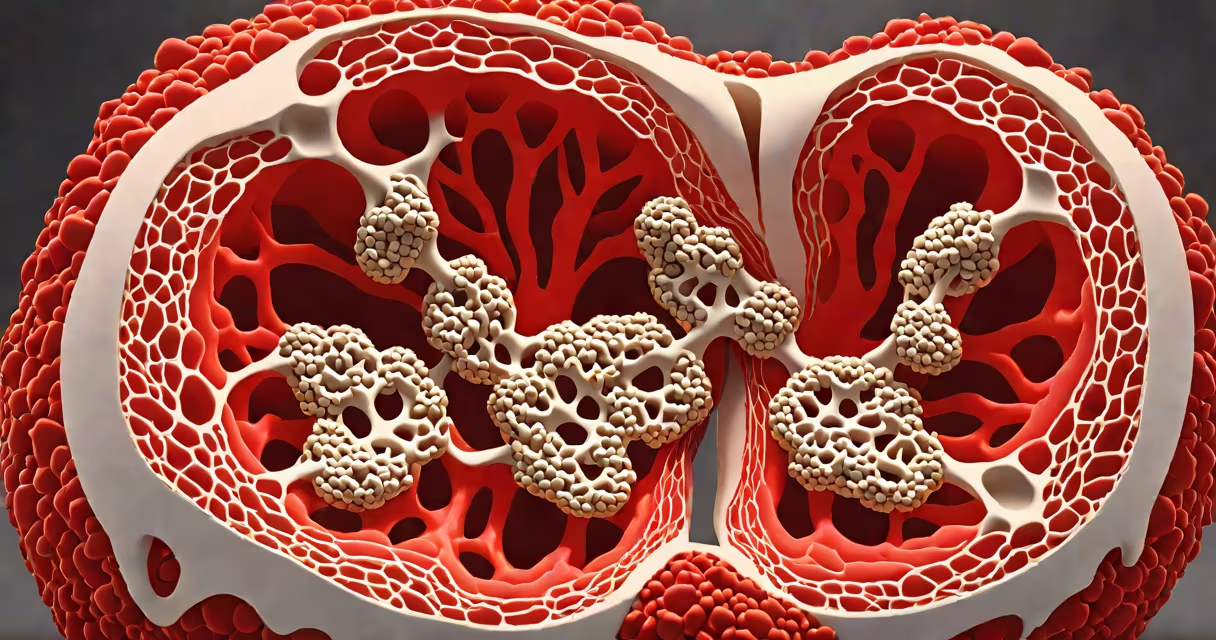
The spleen is a fist-sized organ in the upper left abdomen that filters blood, removes damaged red blood cells, and supports immune responses by activating lymphocytes and producing antibodies. It plays a critical role in defending against encapsulated bacteria and managing blood cell turnover.
Located beneath the diaphragm and protected by the rib cage, the spleen is part of the lymphatic system. It receives oxygenated blood via the splenic artery and processes it through specialized tissues called red pulp and white pulp. Red pulp filters out old or abnormal red blood cells, while white pulp coordinates adaptive immune responses.
Despite common belief, the spleen is not essential for survival. People who have had their spleen removed (splenectomy) can live normally, though they face increased risks of severe infections from bacteria like Streptococcus pneumoniae and Neisseria meningitidis. This underscores the spleen's role in pathogen defense rather than basic metabolic function.
Blood enters the spleen through the splenic artery and flows into sinuses lined with macrophages. These cells engulf and destroy pathogens, cellular debris, and aged red blood cells. Hemoglobin from broken-down red blood cells is processed into bilirubin, which the liver excretes.
White pulp surrounds central arteries and contains B and T lymphocytes. When antigens enter the spleen via blood, dendritic cells present them to T cells, triggering antibody production. This process activates both humoral and cell-mediated immunity. The spleen also stores platelets and monocytes, releasing them during hemorrhage or infection.
A 2018 study published in Nature Immunology showed that splenic dendritic cells are uniquely efficient at cross-presenting antigens to CD8+ T cells, enhancing antiviral and anti-tumor responses. This highlights the spleen's role beyond simple filtration-it actively shapes systemic immunity.
The spleen consists of two functional zones: red pulp and white pulp. Red pulp makes up ~75% of the organ and handles blood filtration. It contains sinusoids, cords of Billroth, and macrophages that clear senescent erythrocytes and pathogens.
White pulp forms concentric layers around central arteries. It contains follicles rich in B cells and germinal centers where B cells proliferate and undergo affinity maturation. T cells reside in periarteriolar lymphoid sheaths (PALS), adjacent to B cell zones. This arrangement allows rapid communication between immune cells during antigen exposure.
| Tissue Type | Location | Primary Function | Key Cells |
|---|---|---|---|
| Red pulp | Outer region | Filtration of old RBCs, pathogens | Macrophages, endothelial cells |
| White pulp | Periarteriolar zones | Immune activation, antibody response | B cells, T cells, dendritic cells |
Unlike most organs, the spleen lacks a capsule-derived lymphatic drainage system. Instead, it drains into the portal venous system via the splenic vein, which joins the superior mesenteric vein to form the portal vein. This unique vascular setup enables direct exposure of bloodborne antigens to immune cells.
Many assume the spleen is involved in digestion or detoxification. It is not. The liver performs those functions. The spleen does not produce hormones or enzymes. Its primary duties are immunological surveillance and hematological maintenance.
Some people believe removing the spleen causes immediate weakness. That's false. After splenectomy, patients typically recover within weeks. However, they require lifelong vaccination against pneumococcus, meningococcus, and Haemophilus influenzae type b. The Centers for Disease Control and Prevention (CDC) recommends these vaccines for all splenectomized individuals.
I once observed a patient with hereditary spherocytosis-a condition causing abnormally shaped red blood cells-whose spleen enlarged due to constant filtering. After splenectomy, his hemoglobin levels stabilized, and he no longer required frequent transfusions. His case illustrates how the spleen's filtration role can become pathological when overactive.
Enlargement of the spleen (splenomegaly) signals underlying disease. Causes include viral hepatitis, malaria, cirrhosis, leukemia, and lymphoma. A palpable spleen during physical exam warrants further investigation, including ultrasound or CT imaging.
Splenectomy is performed for trauma, sickle cell crisis, or autoimmune hemolytic anemia. In cases of traumatic rupture-common in sports injuries-the procedure may be life-saving. A 2020 review in Annals of Surgery reported that 90% of splenic trauma cases can be managed conservatively with observation and blood transfusion, preserving the organ when possible.
Even without the spleen, the body adapts. Other lymphoid tissues, such as the liver and bone marrow, take on some immune functions. But the loss of splenic filtration increases susceptibility to sepsis. Patients are advised to carry medical ID cards stating "asplenia" and avoid high-risk travel to endemic areas.
Understanding the role of the spleen clarifies why it remains a important organ despite being non-essential. It acts as a filter, immune coordinator, and blood reservoir. For anyone managing chronic illness or considering surgery, knowing its functions prevents underestimating its impact on long-term health.