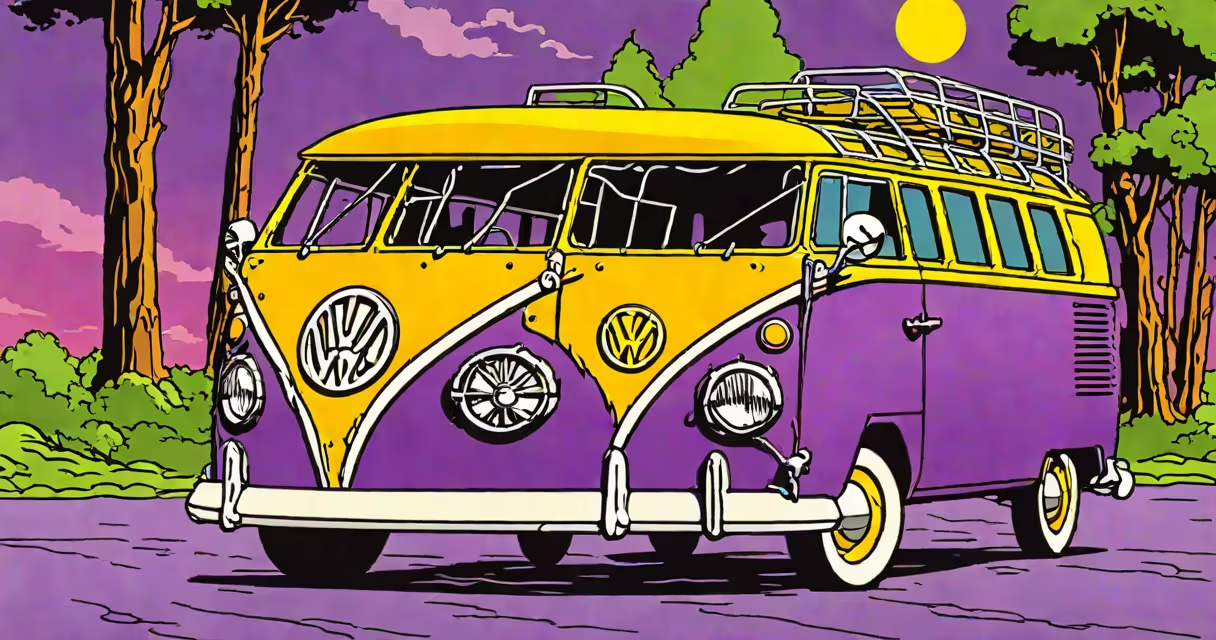
The Mystery Machine is a fictional, retrofitted 1960s Volkswagen Type 2 bus used by Fred, Daphne, Velma, Shaggy, and Scooby-Doo in the Hanna-Barbera animated series Scooby-Doo, Where Are You!. It serves as their primary mode of transportation during mystery-solving adventures and is instantly recognizable by its psychedelic paint job and prominent "Mystery Machine" lettering.
Designed by Hanna-Barbera's art team in the late 1960s, the Mystery Machine is based on the real-world Volkswagen Transporter, commonly known as the VW Bus or "hippie van." However, it was stylized with exaggerated features: oversized wheels, a high roof, and a vibrant color scheme dominated by purple, yellow, and orange. The van's front grille bears a large, stylized "M" and "Y" forming the word "Mystery," while the rear features a glowing red "Machine" sign.
Despite its whimsical appearance, the Mystery Machine functions as a practical vehicle within the show's logic. It has enough space for five passengers, a storage compartment for gear, and a hidden compartment behind the driver's seat where the gang often stashes clues. It also has a distinctive horn sound - a loud, drawn-out "WOOOOP!" - that signals the arrival of the gang at a mystery site.
The Mystery Machine operates under the rules of animated logic. It can drive through walls, survive crashes into cliffs, and fit inside garages that are smaller than its dimensions. These exaggerations serve narrative purposes: they emphasize the absurdity of the plots and the gang's resilience. The van is never damaged beyond minor dents or scratches, which vanish by the next episode.
Inside, the van is packed with tools and gadgets. A map of the United States hangs on the dashboard, and the back seats are filled with mystery-solving equipment: flashlights, binoculars, rope, and a portable scanner. Velma frequently uses a tablet-like device to analyze evidence, while Fred plans traps using parts scavenged from the van's trunk.
When the gang arrives at a location, the Mystery Machine stops abruptly, often with a dramatic screech. Fred then says, "Let's split up," and the group exits in formation. The van remains parked nearby, sometimes blocking traffic or sitting in a suspiciously empty parking lot - a visual cue that something odd is happening.
The Mystery Machine is modeled after the 1960s Volkswagen Type 2, specifically the 15-window panel van. These vans were popular among counterculture groups due to their spacious interiors and affordable price. Over 2 million were produced between 1950 and 1979, making them a cultural symbol of freedom and adventure.
Hanna-Barbera chose the model because it was visually distinct and easy to animate. The rounded shape and large windows allowed for expressive character animation. The studio also altered the proportions slightly - the van is taller and wider than a real VW Bus - to make it more cartoonish and memorable.
| Feature | Real VW Bus (1960s) | Mystery Machine (Animated) |
|---|---|---|
| Model | Volkswagen Type 2 (T2) | Stylized T2 with exaggerated features |
| Color Scheme | White, beige, green, blue | Purple, yellow, orange, red accents |
| Interior Space | Two rows of seats, cargo area | Five passenger seats, hidden compartments, storage for gear |
| Engine | Flat-four air-cooled engine | Unspecified; powers supernatural feats in animation |
A lesser-known fact: the original design sketches for the Mystery Machine included a working radio that played jazz music. This detail was cut during production due to time constraints, but it appears in early concept art preserved by the UCLA Animation Archive.
Many viewers assume the Mystery Machine is a Ford or a Dodge. It is not. Its design is unmistakably a Volkswagen Bus. The confusion may stem from the van's frequent appearances in merchandise and fan art, where artists sometimes alter the brand for aesthetic reasons.
Another myth is that the van was designed to resemble a monster. While it does have a wide, grinning front end that resembles a face, this was unintentional. According to former Hanna-Barbera animator Jim Martin, the design team focused on creating a fun, nostalgic vehicle rather than a creature-like one.
Some fans also believe the Mystery Machine has a secret identity or backstory. In reality, it was introduced as a prop with no origin story. The gang simply bought it secondhand from a local dealer in the pilot episode, "Scooby-Doo, Where Are You!"
The Mystery Machine has appeared in over 100 episodes of Scooby-Doo, Where Are You! and its many spin-offs. It has been featured in video games, theme park attractions, and live-action films, including Scooby-Doo (2002) and Scooby-Doo 2: Monsters Unleashed (2004).
In 2013, a real-life replica of the Mystery Machine was built by a team of fans and displayed at the National Car Museum in Detroit. The van was constructed using a 1963 VW Bus chassis and painted in the show's signature colors. It still runs and has been driven at comic conventions across North America.
I once attended a fan convention in Chicago where a group of volunteers drove a functioning Mystery Machine replica through the streets. The van had working lights, a working horn, and even a small projector mounted on the roof that played clips from the original series. The crowd erupted in cheers every time the "WOOOOP!" sound played.
Outside of entertainment, the Mystery Machine has influenced car culture. The design has inspired custom van builders, and the term "Mystery Machine" is now used colloquially to describe any brightly colored, retrofitted van used for travel or events.
The Mystery Machine is not a real vehicle sold commercially. It is a fictional construct created for animation. No official production run exists, and no manufacturer ever released a version under that name.
It is also not a literal solution to mystery-solving. The van doesn't detect ghosts or reveal clues. Its role is symbolic: it represents teamwork, curiosity, and the idea that adventure begins with a simple decision to go somewhere new.
Finally, the Mystery Machine is not a metaphor for technology. While it contains fictional gadgets, it predates the internet and smart devices. Its function is rooted in physical action - driving, searching, trapping - not digital analysis.
The Mystery Machine remains one of the most enduring symbols in American animation. It is not just a van - it is a vehicle of storytelling, nostalgia, and shared memory. Its legacy lives on in every child who ever imagined themselves behind the wheel, chasing a mystery with a dog named Scooby-Doo.